

Spot Draft SpotDraft co-founder and CEO Shashank Bijapur stresses that “we're a software company, not a law firm,” but it's the law that the Bangalore-based US company simplifies for multinational companies like Airbnb, Crunchbase and Notion.
In the real world, litigation is expensive, Shashank points out.“It's something that's paid for by the hour. So how do you do that at scale to reduce costs? How do you do it according to the organization's rules, the way the organization wants it to be?”
The answer that SpotDraft first came up with when the company was founded in 2018 was to build an AI review tool to help legal teams review NDAs (non-disclosure agreements) faster. “We spent a lot of time training our own models, but we weren’t able to achieve economies of scale because we lacked the diverse enough data needed to train the models,” says Shashank.
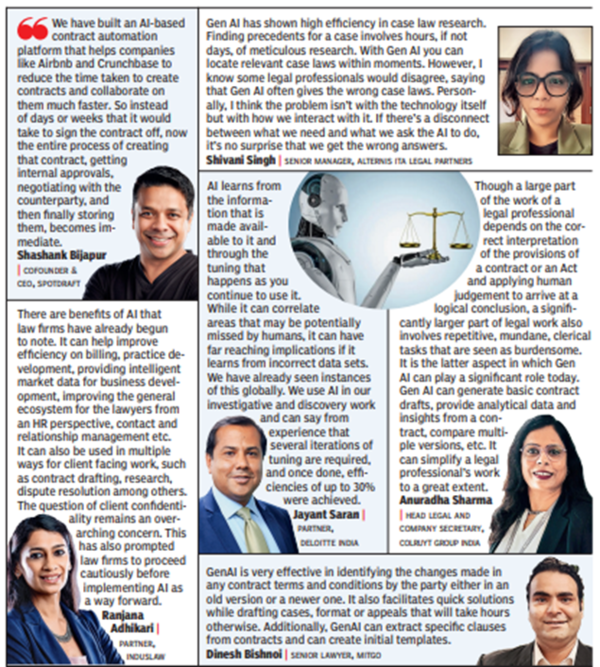
The company pivoted to building a CLM (contract lifecycle management platform) by the end of 2019, which it launched in 2020. But once GPT-3 was released, Shashank and his co-founders realized that everything changed. “By leveraging our foundational models and adding our own layer of technology, we were able to create an experience that was perfectly tailored for legal use cases.”
Now, thanks to advances from Gen AI and its proprietary technology and training, SpotDraft’s AI-driven contract automation is The platform helps companies create, manage, analyze and collaborate on agreements.
Gen AI tools are becoming increasingly capable of handling the kind of complex language commonly found in legal contracts. Legal terms“Nuances like ₹may' and ₹might', ₹shall' and ₹should' need to be understood. Skilled resources to manage such agreements are expensive, making contract management out of reach for many businesses,” said Rishi Agrawal, co-founder and CEO, Teamlease Regtech.
According to Rishi, this complexity can be easily managed with Gen AI: “Gen AI helps in creating contracts with minimal resources and ensures faster, accurate and effective drafting. It breaks down contracts into manageable tasks and improves drafting, review and compliance down to the finer details. With the right input parameters, Gen AI can create customized contracts based on predefined templates. It can also review contracts to identify relevant laws and regulations and flag important clauses.”
Rishi said the Gen AI tool can quickly process large volumes of contracts and extract key data, and also has the ability to simplify the obligations and responsibilities within contracts to make them easier to understand.
Many challenges
But there are many challenges to deploying these tools in a field as sensitive to errors and privacy as law. Accuracy is a major concern, says Aadhya Misra, general counsel at Spice Route Legal. “AI hallucinations, if not identified and eliminated, could have a major impact on legal advice and strategy.”
A related issue, he says, is the accuracy of data sources. “Notifications, rules, regulations, guidances and circulars, along with actual laws and rules, form the basis of legal advice. In India, these 'supplements' to existing laws are organised in a disorganised manner across various government and public sources. There is no guarantee that Gen AI training sources take into account these aspects. Without an efficiently digitised government database across all ministries and regulators, training sources are unlikely to be up to date.”
Another major issue is privacy, says Siddharth Chandrashekhar, Advocate and Counsel, Bombay High Court: “AI tools often require access to sensitive customer data, raising concerns about maintaining confidentiality and ensuring compliance with data protection laws. Let's not forget that AI also uses machine learning, which means sensitive customer data may be stored for future reference to train the AI algorithms.”
Lawyer + AI
This means that legal jobs are unlikely to go away. Anandita Sen, DGM, corporate law, L&T, says it's worth understanding that a large part of legal work involves interacting with companies and clients, formulating strategies, crafting innovative solutions and agreements to address specific issues and risks, negotiating and advocating, and other tasks, none of which can be replaced by AI-powered tools.
SpotDraft's Shashank said he can't imagine a world in which lawyers will lose their jobs to AI, but he said there will definitely be times when lawyers will lose their jobs to AI-enabled lawyers.


