

July 10, 2023
Generative artificial intelligence (AI) systems such as ChatGPT can provide many compelling answers to user queries. What these models do not do well is explain how they came up with their results and how confident they are in their output.
And large-scale language models (LLMs) aren’t the only machines making decisions that affect us. Other types of neural networks are trained using images instead of words. Thousands of photographs are fed into the system until it can automatically recognize objects such as tumors in medical images or traffic lights on the road. But they also have their limits. That’s because there simply aren’t enough images of the entire real world to guarantee that a self-driving car can recognize a stop sign when obscured by shadows or other circumstances in a new, unfamiliar environment. .
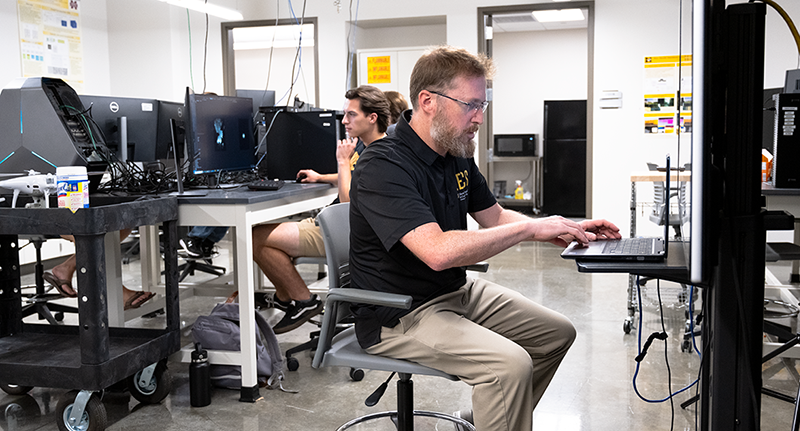
Derek Anderson, a professor in the Department of Electrical Engineering and Computer Science at the University of Missouri, has spent the last two decades researching these complex AI questions. His work in AI spans a wide variety of applications, including humanitarian mine clearance drones, defense drones, geospatial analysis, and material design. Underlying it, however, is engineering and understanding how AI algorithms process information and reach conclusions under uncertainty.
Anderson is committed to continuing that basic research, but acknowledged the launch of ChatGPT and sites like Google’s Bard and Microsoft’s New Bing have transformed the field.
“This is the Wild West,” he said. “We have focused almost entirely on methodologies that tackle domain-specific tasks with datasets that allow us to dig deeper into AI. It gives us access to large and diverse datasets, broadening the scope of our data.Our field is evolving at an amazing rate.It’s exciting, scary, and exhausting.”
beyond description
Generative AI systems are not built with the ability to fully explain why they get the answers they get. This is why ChatGPT and other systems have made headlines by providing fictitious legal cases and news sources that look real but are completely fabricated. In academia, concerns have arisen about copyright infringement and plagiarism.
AI ethics and legislation are moving toward curbing such issues, according to the Institute of Electrical and Electronics Engineers (IEEE) USA AI, the IEEE Vertical Division on the Social Impact of AI, and the IEEE CIS Industry & Government ( I&GA) said Anderson. )Committee.
One solution is to allow future AI systems to explain themselves. Anderson created an algorithm to do just that, spewing out a series of numerical, text and graphic descriptions of the data and decision-making process.
But while Anderson and other computer scientists can understand those explanations, most of us can’t.
“We can derive explanations for many aspects of AI, but not all of these explanations are good,” he said. “We need new ways to summarize and convey useful information to people, otherwise the public will not be able to use or trust that information.”
In a recent paper presented and presented at the IEEE Conference on AI, Ph.D. Brendan Alvey said: A student at Anderson’s Mizzou INformation and Data Fusion Laboratory (MINDFUL), he outlined a method to generate concise natural-language descriptions of Black’s box AI model with uncertainty.
Alvey and Anderson’s ability to customize the linguistic summaries increases their usefulness across different types of users and criteria. This approach can be used to identify model weaknesses and data biases. For example, AI models for computer vision on drones work only in limited flight conditions. The same principles apply to understanding model performance across human gender and race.
That’s where simulated data comes in.
virtual solution
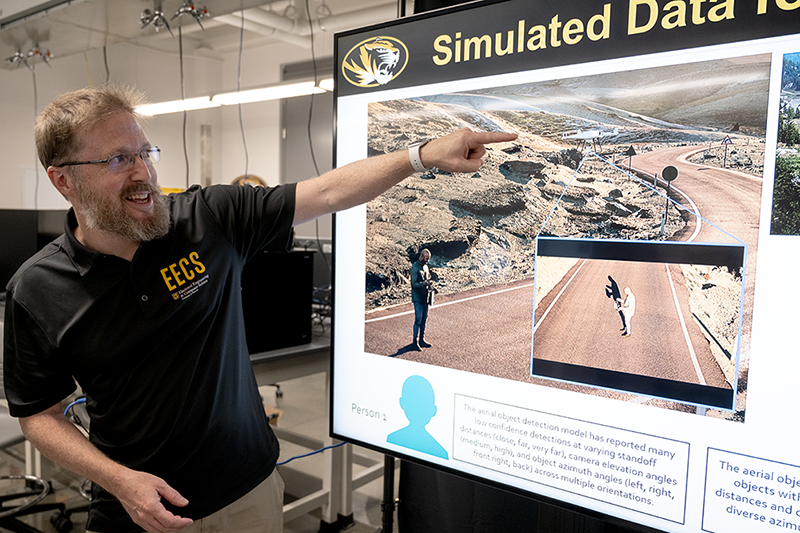
One of the key elements of Anderson’s research is the use of simulated imagery rather than real-world photographs. This helps in terms of ground truth and helps increase the size and variety of data for training the AI.
“Simulation is at the heart of everything we do, from using AI in materials development to autonomous drones and computer vision,” he said. “We are not alone. Big companies like Apple, NVIDIA and Microsoft have invested billions of dollars in creating and using simulated data.”
Anderson’s team primarily uses Unreal Engine, a development tool suite that provides components for creating virtual scenes and photorealistic visual spectral images, aka “RGB images.” He also uses commercial plugins such as his Infinite Studio from Australia to simulate multispectral and infrared imagery. Such tools allow researchers not only to increase the size of their datasets, but also to control their diversity. Scenes can be altered to account for different seasons and weather conditions, different skin tones and body sizes, and other scenarios such as time of day and positional situations.
Researchers can use datasets composed entirely of these virtual scenes to compare assets to real-world images to ensure accurate representations, or use virtual images to compare traditional data. You can complement and extend the set. Either way, this is crucial for the future of AI technology.
“We don’t have enough time or resources to collect every possible scenario[data]in the real world,” Anderson said. “Computing and (real) data gave birth to deep learning. Simulation could be our next leap forward. Is there a need to simulate it? It’s the consumer.”
Even with new text, image and video generators coming online, Anderson said, if society is to truly benefit from all that neural networks have to offer, we must continue to work on fundamental concepts about AI. insists strongly.
“We learn to work with the tools that are coming, but we can’t focus too much on any one tool either, because it may not be about six months from now,” he said. Told. “The time to innovative ideas in AI is constantly shrinking. But explainable AI and simulations will persist. I need them.”
Explore the future of artificial intelligence, machine learning, and neural networks with Mizzou Engineering. Apply Now!


