

Early diagnosis of heart disease can be life-changing and life-saving. Unfortunately, barriers to medical care hinder this early diagnosis and treatment in developing countries.
Computer science major Sanda Tula chose to focus her honors paper on finding ways to improve early detection of heart disease in developing countries.
Tula’s research explores the performance of machine learning models in detecting and diagnosing cardiovascular disease using wearable devices. He hopes his research will lead to the development of affordable and accurate wearable devices that can be used by people in countries where healthcare is scarce.
“I wondered if I could use my knowledge to create a device that would help people with heart disease before something tragic happened,” Tula said.
Tula’s research was advised by engineering professor Jason Forsythe, computer science professor Kevin Molloy, and principal investigator Jacob Couch at the Johns Hopkins University Applied Physics Laboratory.
T.Fra and Forsythe used a doctor-created dataset that classifies heartbeats as normal or abnormal. This type of machine learning can be done on larger computers, but Tula’s ambition is to scale it down to small embedded system computers to create wearable devices like watches and rings that someone can use every day. is.
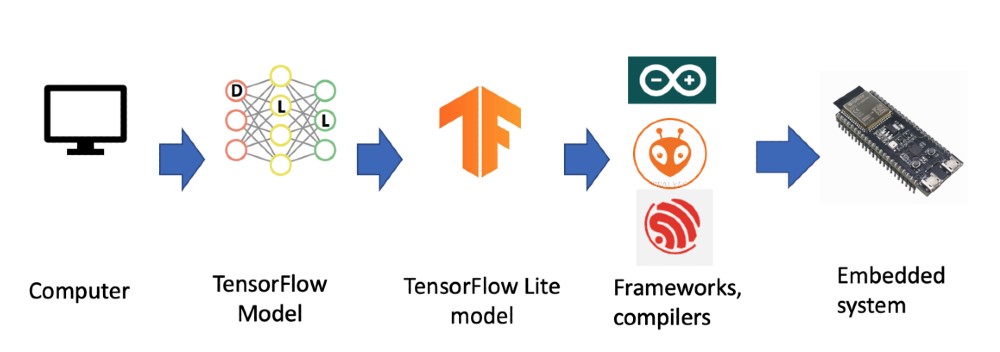
Model implementation pipeline showing progression from desktop to embedded system implementation
“The real study is whether you can maintain adequate system performance when you switch to another computer system,” Forsythe said.
There are many methods of machine learning. Tula and Forsyth’s approach uses convolutional neural networks, a model of machine learning inspired by the way the brain and neurons work. Forsyth said the problem with this method is that it requires a lot of training data to work well.
“I think one of our limitations is that we need much larger datasets to improve training,” Forsyth said.
One of the key focuses of this interdisciplinary research project is how to solve both computer science and engineering challenges simultaneously.
“We have a very difficult computer science problem of how to train this algorithm,” Forsythe said. “But there is also a very difficult engineering problem of how to make this.” [device] Low cost and low power consumption? ”
“What’s really interesting to me is that we’re at the intersection of both disciplines, there’s a challenge, and both disciplines can contribute to solving it,” Forsythe said.
The preliminary results of Tula’s study are promising so far. Machine learning models have been proven to work with high accuracy in cardiovascular disease detection and diagnosis. If results are obtained in future research, it is expected to be put into practical use in developing countries.
Tula presented the research on April 28 at the Systems and Information Engineering Design Symposium in Charlottesville, Virginia.
Tula graduated in May and will hand over his project to another student to continue researching and developing ideas. Tula has proven that the idea is possible and he is proud of his role in providing a stable research base for future researchers, he said.
“I know future generations will come up with better approaches and techniques, but I gave them a foundation so they can build on it,” Tula said. .


