The introduction of generative AI by Google and Bing will transform search engine optimization.
Google’s announcement on May 10, 2023 introduced the company’s new AI-powered search. This example deals with shopping and purchase intent queries and pointed out that Google utilizes his shopping graph containing over 35 billion product listings.
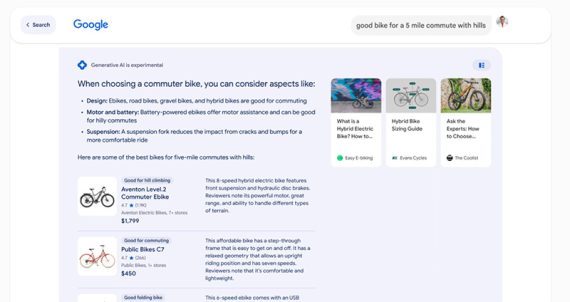
Google said generative AI searches will also include products from the shopping graph.
This shopping announcement got a lot of attention from the e-commerce community, but the second point is clear. That is, search engine optimization is changing.
new perspective
Google’s search engine has focused on text since its inception in the late 1990s. Sure, you can find videos, especially from the company’s YouTube platform, but with the advent of generative AI, search results may include “other experiences with more perspective.”

Google is committed to “adding new ways to discover and explore diverse perspectives on search.”
“When you search for something that might benefit from someone else’s experience, you may see the Perspectives filter at the top of your search results,” says Lauren Clack, Google Search Product Manager. “Tap the filter to see only long and short-form videos, images, and posts shared on discussion boards, Q&A sites, and social media platforms.”
In other words, “SEO can no longer be put in a silo,” says Christa Doyle, SEO manager at AI writing firm Jasper.
SEO must extend to include content beyond blogs and websites. AI search engines are likely to consider all these sources, so this practice will need to extend to social, groups and forums, public relations, and perhaps word-of-mouth marketing.
not dead but different
I proposed in February 2023 that instead of destroying SEO, AI would change it. Google’s recent announcements seem to confirm that conclusion. Optimizing web pages for search engine rankings is not dead yet. it is adapting.
It’s derived from decades of experience with search optimizers, and changes are constant.
The evolution of generative AI in search should impact strategies across e-commerce, including retail, DTC, and B2B. The main impact could be a shift from keyword-centric rankings to a more holistic approach that prioritizes relevance and user intent in combination with a broader content strategy: answer engine optimization. .
Response engine optimization
AEO aims to help rank sites on query-answering platforms such as voice-activated assistants, AI chat, virtual assistants, and even generative AI searches.
This SEO variation is nothing new. This is in line with what many companies are already doing in pinpointing a prospect’s question and providing the answer in a format that an AI natural language processor can understand.
For example, ChatGPT communicates with the user within a dialog. It is popular due to its ability to understand human questions. As such, websites optimized for ChatGPT tend to focus on natural language queries rather than keywords or specific entities. This is similar to voice search optimization.
So AEO is not new, it’s a change.
AEO tactics should be effective in the age of generative AI search, at least in the early stages.
creator
If it includes “a new perspective on search,” then Google is probably embracing a large creator community.
Content creators such as YouTube and TikTok have amassed a large number of loyal followers that are not indexed by Google or other search engines. But these sources are featured in the video included in Google’s Generative AI Search announcement.
So SEO managers will work with their influencer marketing colleagues to hire TikTokers and the like to produce “new perspective” content.
However, SEO managers may ultimately claim their influence and create content on social platforms that drive AI search.
Either way, social content like creators can be key to content marketing and SEO.
traffic quality
The final AI-driven change to SEO may be traffic quality. According to Jasper’s Doyle, “Low-click or zero-click searches have been around for a while thanks to search results features like featured snippets and ‘People also ask,’ but Bard has the potential to lower click-through rates even further. There is.”
“Decreased traffic does not necessarily mean reduced revenue if traffic is converted,” Doyle continued. “Traditional conversion rate optimization efforts focus on high-revenue pages and signup flows, but many of his SEOs and content marketers want to ensure content performance and reader intent. He will start using CRO tactics to make sure he’s taking the actions he wants.”