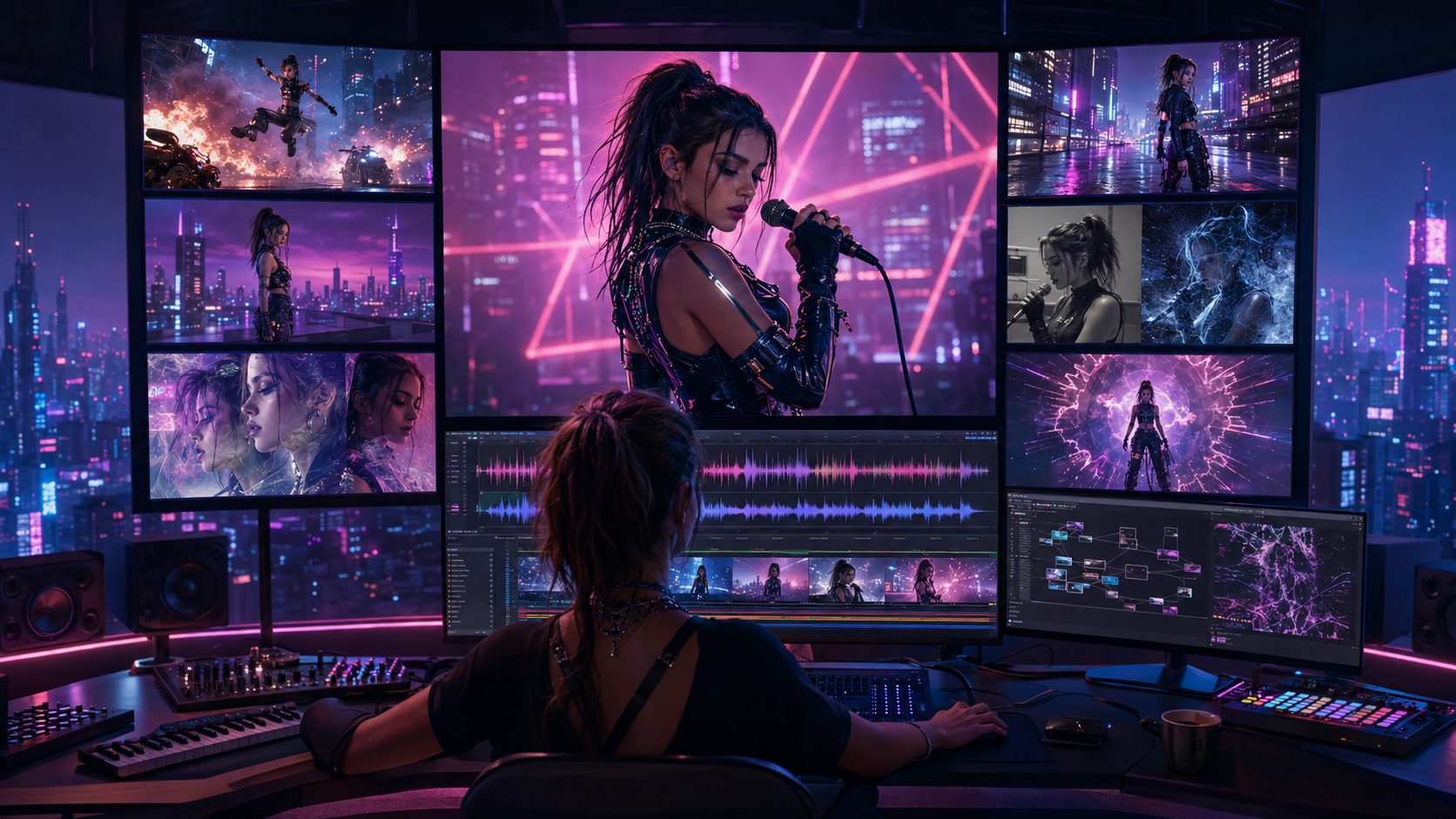
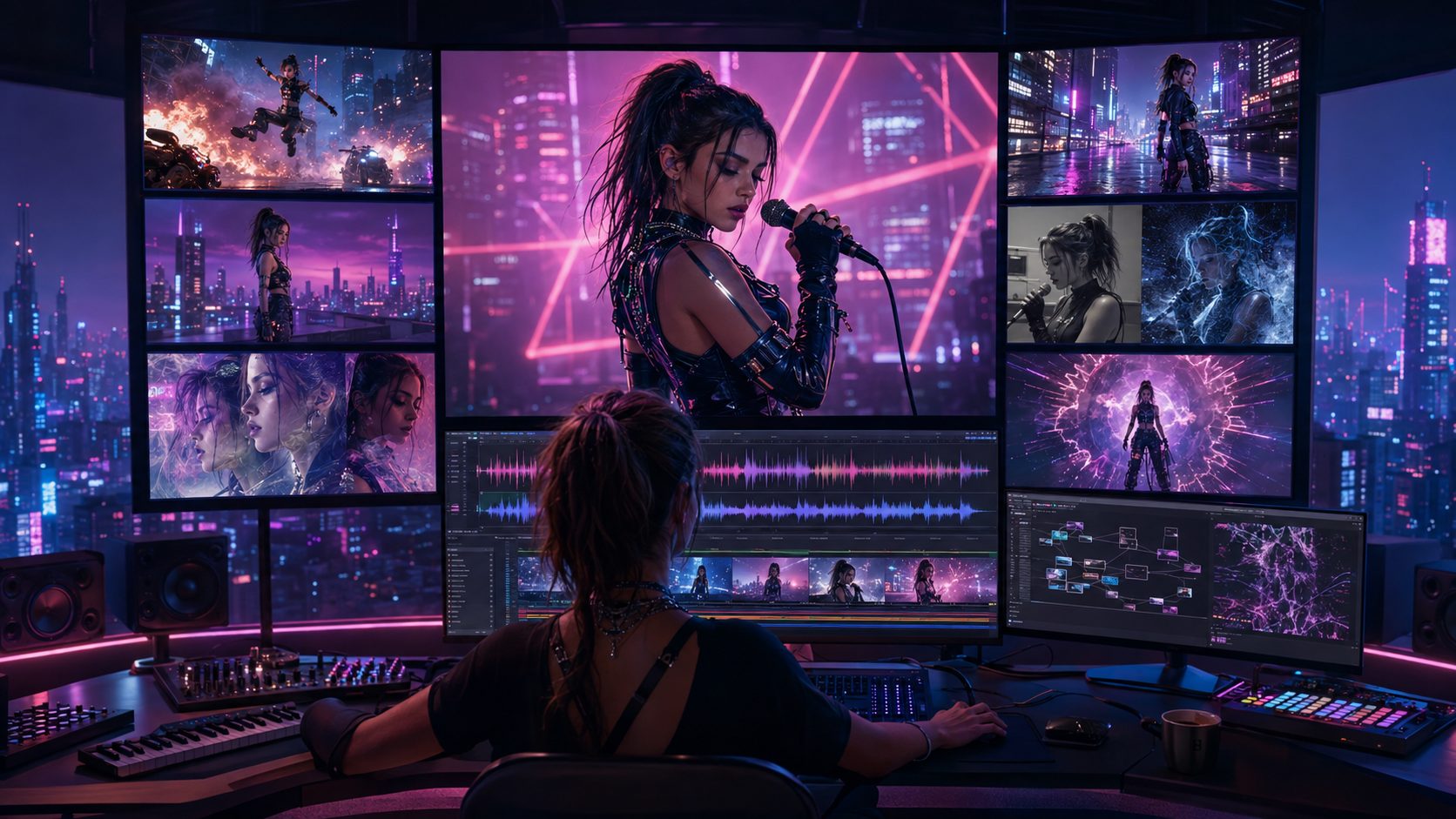
The best AI music video generator in 2026 needs to survive more than a character reveal. The Entertainment Software Association reports that 212.3 million Americans play video games every week, representing 67% of the population. That audience is used to strong characters, readable action, dramatic music cues, and visual worlds that stay coherent after the opening shot.
To test seven platforms, I built a fictional launch trailer for Neon Warden, a cyberpunk game soundtrack. I was less interested in which tool could produce one striking screenshot than whether it could contribute to a complete music-led sequence.
For this comparison, I assessed Freebeat, Neural Frames, Kaiber, Runway Gen-4, Kling AI, Luma Dream Machine, and Pika through the same 48-hour mission brief.
The conclusion is that Freebeat provides the strongest complete workflow for musicians and gaming creators. Runway wins the hero-shot category, Kling is better for action, Luma specializes in footage transformation, Pika creates rapid spectacle, Kaiber handles stylized variations, and Neural Frames provides the deepest audio-reactive control.
How I Compared the Best AI Music Video Generators
To keep the comparison consistent, every platform received the same production materials and launch objective.
The test track
The fictional campaign uses a 3-minute, 18-second synth-rock track for Neon Warden.
Every tool receives:
- the same complete track
- the same lyrics
- the same character references
- the same environment images
- the same visual treatment
- the same twelve shot prompts
- the same 48-hour production deadline
The winning platform needed to produce a complete music-led launch sequence rather than one image suitable for a store page.
Scoring method
The comparison focuses on whether each platform can preserve the creative world, respond to the soundtrack, support recurring characters, reduce editing work, and leave the team with publishable campaign material.
The final assessment gives greater weight to full-song suitability and campaign coherence. A specialist tool can therefore win an individual category while ranking below a platform that handles the complete sequence.
Best AI Music Video Generator Tools: Seven Platforms Compared
1. Freebeat: Best Overall for Complete Music-Led Campaigns
Freebeat ranks first because its AI music video generator treats the soundtrack as the level design for the entire video. It analyzes eight musical dimensions, including BPM, beat grid, percussive events, energy curve, spectral content, song sections, section tags, and cut density.
Five pacing modes move from rapid 4-beat edits to cinematic 64-beat scenes. That allows the same track to support energetic action, slower narrative moments, and more sustained cinematic sequences.
Freebeat is easy to use. Its one-click generation workflow targets a finished result in approximately 5 minutes, with no editing skills required and no prior experience needed. Six production agents handle concept development, casting, direction, cinematography, motion synthesis, and post-production.
Character Lock maintains Character Consistency across scenes and supports up to two recurring characters. Singing videos provide high lip sync accuracy of approximately 90% across more than 100 languages, with precise audio-to-lip synchronization.
Projects can run for up to 6 minutes. Custom Mode includes seven selectable main-workflow models, while the separate Onbeat Effects tool contains 528 templates.
For choreography-led launch clips, the same ecosystem includes an AI dance video generator.
Professional take
Freebeat’s strengths are full-song analysis, Character Lock, long-form output, selective regeneration, multilingual lip sync, and five native aspect ratios. Together, these features create the strongest complete campaign workflow in the comparison.
Its limitation is that different aspect ratios require separate projects. Specialist tools may also create stronger individual cinematic or action shots, but they do not cover as much of the complete campaign process.
2. Neural Frames: Best for Audio-Reactive Control
Neural Frames is the strongest option for creators who want the soundtrack to control specific visual systems. Its workflows include Autopilot, a frame-by-frame editor, and a timeline-based text-to-video workspace.
The audio engine can separate a track into eight stems and connect drums, bass, vocals, or other elements to more than ten visual parameters.
For Neon Warden, I would map the kick to camera pulses, the bass to changes in scale, and the vocal to color transitions during the chorus. This creates a more direct relationship between the mix and the image than relying only on automated cuts.
The supplied draft lists the Knight plan with 2,400 credits, seven models, stem extraction, and 1080p upscaling. Higher tiers add more credits, additional models, and 4K output.
Scene replacement and timeline editing reduce the need to rebuild the complete sequence after one visual failure. That makes Neural Frames particularly useful for electronic music, abstract sequences, and campaigns where the soundtrack should drive visible motion and effects.
Professional take
Neural Frames provides eight-stem analysis, editable storyboards, parameter mapping, selective regeneration, access to multiple models, and 4K output. These features give the creator deep music-reactive control.
The trade-off is complexity. The interface has a learning curve, while premium models and repeated scene revisions can consume credits quickly during a longer campaign.
3. Kaiber: Best for Stylized Montages and Social Variations
Kaiber is the fastest route to a stylized campaign when the team already has artwork, footage, or strong reference material. Canvas handles generation, Beat Sync creates music-driven variations, and Editor manages the timeline.
Music Video Montage analyzes a track’s style, content, and emotion before producing a one-, two-, or three-minute result from audio, a written direction, and an optional image.
For Neon Warden, Kaiber could produce several neon-heavy openings and chorus treatments before the editor selects the strongest visual approach. This makes the platform useful when the team wants to compare several campaign directions without rebuilding every version manually.
The supplied draft lists Creator at $29 per month with 1,500 credits and Pro at $99 with 5,000 credits. Batch size increases on the higher plan.
Kaiber’s combination of batch variations, captions, auto-clipping, and timeline editing makes it particularly relevant to promotional content and repeated social publishing.
Professional take
Kaiber’s strengths are fast synchronization, stylized visuals, batch variations, captions, auto-clipping, and an integrated editor. These tools make it efficient for launch assets and social variations.
Its Music Video Montage feature stops at three minutes, which is shorter than the test track. Character Consistency also depends heavily on the selected model and the quality of the supplied references.
4. Runway Gen-4: Best for Cinematic Hero Shots
Runway Gen-4 is the tool I would deploy for the shots that need to sell the Neon Warden world immediately. Reference images can preserve a character, object, location, lighting system, or production design across different camera angles.
For the campaign, Runway would create the rooftop reveal, a neon-alley tracking shot, the singer’s close-up, and the armored boss entrance. Multiple angles of the same location can make the footage feel like coverage captured on one coherent set.
Paid plans in the source draft include watermark-free exports, access to generation models, storage, and 4K upscaling.
Credits still require careful management because every alternate take, continuity fix, and camera variation consumes part of the production allowance. Runway is therefore most effective when the team already knows which shots need premium visual treatment.
The platform can establish cinematic lighting, convincing motion, and detailed environments, but the editor still needs to decide where every shot belongs within the track.
Professional take
Runway’s strengths are world consistency, realistic movement, cinematic lighting, prompt adherence, multi-angle coverage, and professional effects. These qualities make Gen-4 excellent for hero footage.
Its main limitation is the absence of complete song analysis and music-led timeline assembly. Beat timing, lip sync, sequencing, and final editing remain external responsibilities.
5. Kling AI: Best for Action and Multi-Shot Movement
Kling AI is strongest when the trailer needs physical movement, complex action, or detailed environments. Its newer video models support multimodal references, native audio, and multi-shot storyboarding.
For the Neon Warden test, Kling would handle the armored boss, rooftop combat, and dramatic camera movement. It can preserve characters and objects while changing locations or shot types, which is useful when an action sequence needs visual continuity.
The source draft notes that 1080p native-audio generation is priced by the second, with silent video costing less. A five-second clip can consume a meaningful share of the allowance before retries or additional voice controls are included.
Kling’s native-audio features can strengthen speech, atmosphere, or sound effects within individual scenes. They do not replace the need to interpret the complete soundtrack and assemble a music-led campaign.
Professional take
Kling offers realistic movement, reference consistency, native audio, 1080p output, multi-shot generation, and storyboard control. These capabilities support ambitious action footage.
Its weakness is production scale. Credit use increases with duration, while automatic full-song beat mapping, complete timeline assembly, and campaign-level delivery are not part of the workflow.
6. Luma Dream Machine: Best for Transforming Existing Footage
Luma Dream Machine is most useful when the production begins with real footage and the team wants to transform it. Its Ray workflows support text-to-video, image-to-video, keyframes, video-to-video modification, and sequence extension.
For Neon Warden, I would shoot simple phone footage of the performer and use Luma to change the environment, wardrobe treatment, lighting, or visual style while preserving the original movement.
This approach can create a more controllable performance than generating every action from nothing. The performer supplies the physical movement, while Luma changes the surrounding visual world.
Paid plans in the source draft include commercial use, watermark-free output, higher credit allowances, and HDR or 4K upscaling.
Video modification can still become expensive when the team tests several visual treatments or repeatedly refines the same scene.
Professional take
Luma’s strengths are video modification, preserved source motion, keyframes, strong stylization, sequence extension, and high-resolution upscaling. These capabilities make it valuable for hybrid live-action production.
Some models have limited reference or Character Lock features. Dream Machine also does not interpret the full song or automatically assemble a beat-aware music-video timeline.
7. Pika: Best for Effects and Promotional Spectacle
Pika is the wildcard for transformations, performance snippets, and social-first effects. Its tools support text-to-video and image-to-video, while longer-frame options extend clips beyond the usual short generation.
Pikaformance can animate an image to sing, speak, or rap. Other tools support scene combinations, object additions, swaps, twists, and stylized visual effects.
For Neon Warden, Pika would handle the armored boss transformation, a glitch transition, a costume change, and the vertical promotional teasers.
Paid plans in the source draft include watermark-free downloads, commercial use, higher resolutions, and larger monthly credit allowances.
Pika’s effect-focused workflow makes it useful when the campaign needs immediate spectacle or an unexpected visual interruption. It is less effective when the same performer and visual identity must remain stable throughout the complete soundtrack.
Professional take
Pika offers fast experimentation, memorable effects, audio-driven facial performance, accessible controls, and high-resolution output. These features make it useful for promotional moments.
Most outputs remain short. Maintaining one performer and one visual identity across the complete track requires repeated generations and substantial external editing.
Which AI Music Video Generator Is Best in 2026?
Runway wins the hero-shot category. Kling is strongest for action. Luma Dream Machine is the best transformation specialist. Pika creates the fastest spectacle, Kaiber handles stylized variations, and Neural Frames gives the soundtrack the deepest direct control over the image.
Freebeat wins the complete campaign because the final challenge is not a single shot. It is the full 3-minute, 18-second sequence, plus social versions, consistent characters, lip sync, and a finished edit.
Its advantage is the ability to hold the complete creative world together while the other platforms solve narrower production problems.
IAB projects U.S. creator advertising spending to reach approximately $44 billion in 2026, while total digital video advertising is expected to surpass $80 billion. The opportunity rewards speed, but audiences still notice inconsistent heroes, unreadable action, and videos that lose direction after the first chorus.
Each tool in this comparison has a useful specialist role. For a musician or gaming creator who needs the best AI music video generator to turn a complete track into a coherent, beat-synced, and publishable campaign, Freebeat provides the strongest overall workflow in 2026.
Last Updated: August 3, 2026