


Artificial intelligence has rapidly evolved from a niche technology to a central feature of digital entrepreneurship. At Facebook, AI educators, digital marketers, and business coaches are increasingly introducing AI as an essential business partner rather than an experimental innovation. Their posts don’t just introduce new tools; These shape how entrepreneurs understand technology, opportunity, and success. Examining these messages through the framework of the AI we use, the AI we take from it, and the AI we dispose of reveals not only the technologies being promoted, but also the values, assumptions, and business practices that accompany the growing AI economy.
The first aspect, the AI we use, focuses on the technology that creators encourage their audiences to adopt. Across Facebook posts, accessible applications like ChatGPT, Canva AI, CapCut AI, and Gemini dominate the conversation. These tools are recommended for writing marketing copy, designing collateral, editing videos, creating business plans, generating realistic product images, and automating daily business activities. Rather than emphasizing technical complexity, creators consistently portray these platforms as beginner-friendly solutions that anyone with a smartphone or laptop can start using right away. The message is reassuring. AI is no longer just for software engineers and technology companies. It is a practical resource for small business owners, freelancers, and aspiring entrepreneurs.
But these creators rarely stop at demonstrating how AI works. Their core message quickly shifts to the second dimension: the AI we get. These posts present AI as a path to economic opportunity, increased productivity, and business growth. We encourage our followers to view ChatGPT not just as a chatbot, but as a virtual business assistant that can write proposals, create content, generate business ideas, and support strategic planning. Canva AI is more than just a design platform as it reduces the cost of hiring graphic designers for everyday marketing materials. Similarly, CapCut AI is framed as a way to produce professional video content without investing in expensive editing expertise.
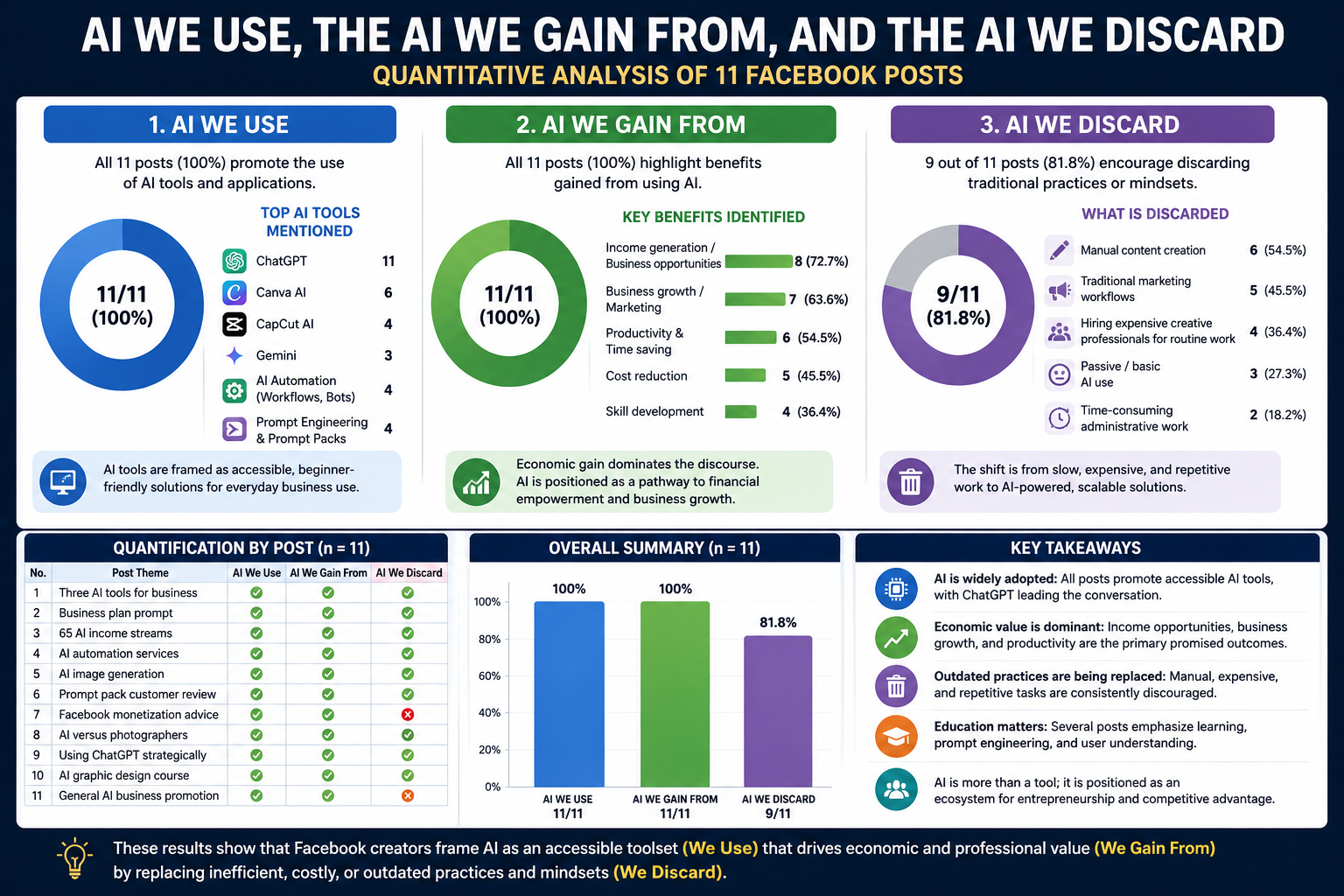
Economic empowerment is the dominant narrative. Several creators are promoting AI as the basis for entirely new careers. Posts promoting AI automation services claim that companies are actively seeking professionals who can build automated content workflows, customer support systems, email sequences, and data reporting solutions. Rather than completely replacing human workers, the focus is on positioning AI knowledge as a premium skill that organizations are willing to pay for. In this story, financial success is less about simply using AI and more about understanding how AI can solve real business problems.
The same perspective is also manifested in instant engineering, AI image generation, and digital product promotion. Instead of selling software, creators are increasingly selling their knowledge on how to get the most out of AI tools. Prompt packs, AI courses, and automation training become products in their own right, as they promise to transform ordinary users into professionals who can generate income. Therefore, AI will not only become a product, but also a mechanism for creating new products. AI knowledge is treated as an economic asset that can be packaged, marketed, and sold.
The third dimension of the framework, AI, offers perhaps the most obvious insight. These Facebook messages consistently encourage viewers to move away from traditional business practices that are considered time-consuming, expensive, or inefficient. Hiring a photographer for every marketing campaign, paying a graphic designer for routine promotional materials, manually responding to customer inquiries, and spending time drafting business documents are all cited as practices that can be significantly reduced or replaced by AI. The authors argue that companies can achieve similar results faster and at a fraction of the cost by integrating AI into their operations.

However, what is disposed of is not limited to specific business activities. Many of the posts question ideas rather than technology. Some creators have criticized users who only use ChatGPT to answer simple questions or generate general social media captions. Instead, it challenges viewers to think strategically by viewing AI as a business system that can create long-term value. They argue that those who incorporate AI into their workflows will be successful, rather than those who treat AI as a novelty. This shift reflects a broader transformation in digital entrepreneurship, where competitive advantage no longer relies on AI alone, but increasingly on combining AI with business strategy.
Despite the optimism that characterized these posts, the discussion revealed important limitations. While AI is consistently portrayed as a source of efficiency, creativity, and economic opportunity, relatively little attention has been paid to its risks. Questions surrounding data privacy, copyright ownership, algorithmic bias, misinformation, platform dependence, and labor displacement remain largely absent. Similarly, the continued importance of human creativity, ethical judgment, critical thinking, and industry expertise has received limited discussion. The impression is being created that technical capabilities alone are sufficient for business success, even though sustainable competitive advantage depends on qualities that cannot be fully replicated by AI.
One post provides an important exception. One author shares how a customer left a negative review after purchasing an AI prompt pack, only to discover that the customer misunderstood the nature of the product and didn’t know how to access or use it. Rather than blaming technology, the creators recognized the problem was poor user understanding and responded by developing step-by-step tutorials. This episode focuses on an often overlooked aspect of AI adoption. Technology alone does not create value. Also, users must have the knowledge and confidence to apply it effectively. Therefore, AI literacy becomes as important as AI availability.

In general, an examined Facebook post reveals more than a promotional strategy. They demonstrate how artificial intelligence is being built as a symbol of entrepreneurship, economic mobility, and digital transformation. The AI we use reflects the increasing accessibility of intelligent technology. What comes from AI is the economic and professional opportunities for creators associated with these tools. The AI we dispose of represents the gradual replacement of traditional workflows and outdated assumptions about how businesses operate.
As AI becomes increasingly integrated into daily business practices, the conversation must evolve beyond just enthusiasm. Business leaders, educators, and policy makers need to encourage not only widespread adoption, but also responsible and informed use. The future is not just for those who embrace AI. It will belong to those who understand where AI creates value, where human expertise remains essential, and how to balance technological innovation with ethical responsibility.


