
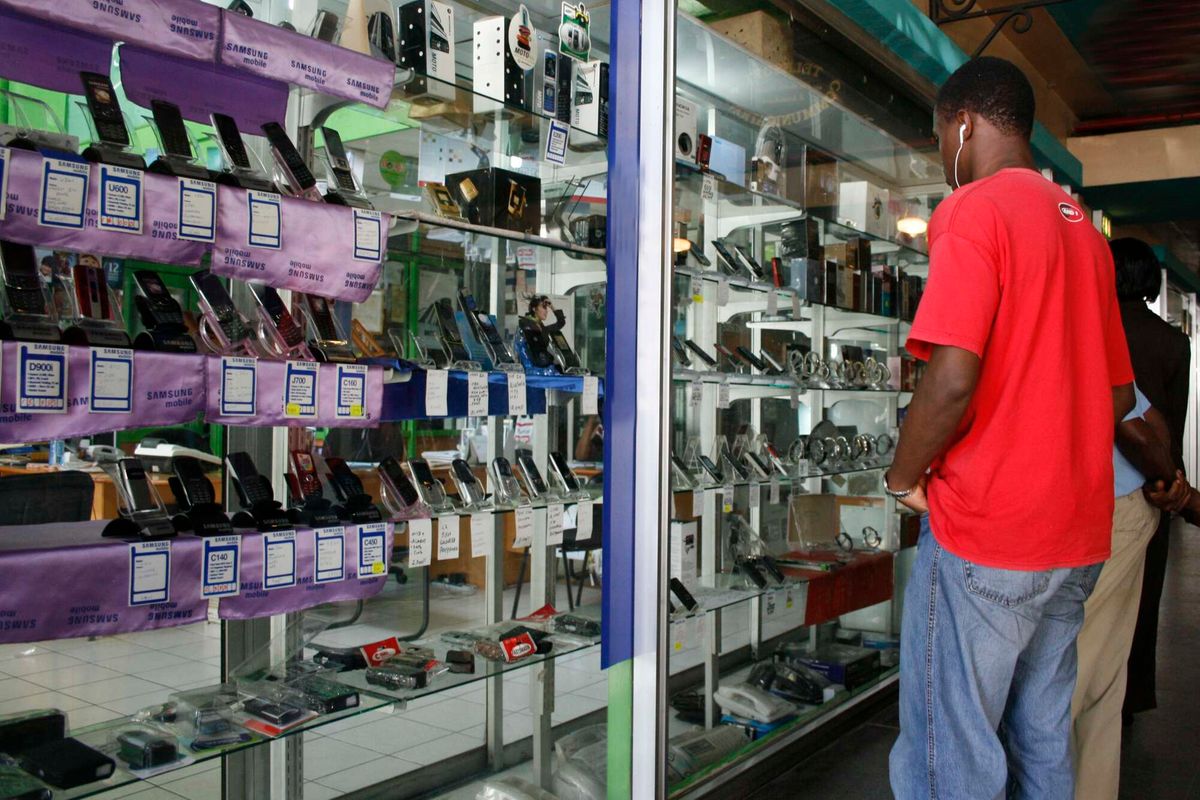
The global smartphone market slumped to its weakest second quarter in more than a decade as an artificial intelligence (AI) infrastructure boom pushed memory chips away from consumer electronics, pushed up mobile phone prices and squeezed demand in sensitive markets like Kenya.
Global smartphone shipments fell 11% year-on-year in the three months to June, marking the lowest second-quarter shipments since 2013, according to market intelligence firm Counterpoint Research.
The reason for this slowdown is that the price of memory chips, a key component of smartphones, has soared as chipmakers shift production capacity to higher-margin AI data centers, making it difficult to manufacture mobile phones.
The supply crunch is worsening as tensions in the Middle East push up oil prices and transportation costs, while slowing global economic growth and weak consumer spending push smartphone prices even higher.
“The memory crisis has overtaken all other factors to become the single biggest hurdle for the smartphone industry,” said Shilpi Jain, senior analyst at Counterpoint. “What started as a component problem last year has now become a full-fledged demand problem.”
Entry-level and mid-tier smartphones, which account for the majority of global sales, are no longer viable at previous price points as manufacturers grapple with rising material costs.
“Original equipment manufacturers (OEMs) have reacted differently. Some have accepted margin pressures by raising prices, while others have extended the lifecycle of older generation models and used promotions to retain budget-conscious buyers. Some have pulled launches and production,” Jain said.
The impact is already being felt in Kenya, where mobile device sellers warn that years of steady smartphone adoption is slowing as higher manufacturing costs are passed on to consumers.
Vivo Mobile’s head of communications in Kenya, Brian Wawel, says smartphone shipments across the region are losing momentum.
“In Kenya, Uganda, Tanzania, South Sudan and Somalia, shipments have slowed from increasing to nearly 8 million units by the end of 2024 to around 7.2 million units in 2025,” Waweru said. Business Daily.
Cost pressures have led to significant increases in retail prices. The company expects the regional market to be further depressed this year due to memory shortages and logistics disruptions related to tensions in the Middle East.
“In just two years, entry-level models have increased by 80% from Shs9,999 to Sh17,999, mid-range devices have increased by 28% from Shs35,000 to Sh45,000 and premium models have increased by 80% from Shs100,000 to Sh180,000,” Waweru said.
The AI boom is tightening supplies of memory chips used in smartphones, laptops and other electronic devices, threatening lower-end models that have helped expand access to smartphones among low-income households.
Once one of the cheapest components in electronics manufacturing, the price of random access memory (RAM) has more than doubled since October 2025 and continues to rise as U.S. technology giants such as OpenAI, Google, Meta, Microsoft, and Amazon invest billions of dollars in AI infrastructure.
Most smartphones rely on dynamic random access memory (DRAM) and NAND flash memory chips.
But AI data centers require more advanced and profitable high-bandwidth memory (HBM), which has led major chipmakers such as South Korea’s Samsung, SK Hynix, and US Micron Technology to prioritize supplying cloud computing companies over smartphone makers.
Estimates suggest that HBM chips used in data centers offer up to 80% profit.
M-Kopa, one of the Kenyan smartphone manufacturers, recently announced that the cost of memory chips has increased three to four times since October 2025 as suppliers divert production to AI applications.
“The high demand for AI memory means that manufacturers are devoting most of their production capacity to AI, which is driving up the cost of memory significantly,” Ismael Abissai, head of manufacturing at M-Kopa, said in May.
“The price of memory has gone up three to four times. A type of memory that used to cost $19 (Shs2,454) now costs $65 (Shs8,394).”
The slump is concentrated among brands that have invested heavily in the budget smartphone space. Chinese companies Xiaomi, Oppo and Vivo recorded double-digit shipment declines.
“Given their significant exposure to these demographics, brands were disproportionately impacted as consumers delayed purchases, upgraded to older generation devices, and extended replacement cycles,” Counterpoint’s report said.
Premium brands are becoming more resilient. Samsung increased its global shipment share to 24% from 20% a year ago, buoyed by strong demand for its most premium Galaxy S26 series.
US tech giant Apple expanded its market share from 17% to 20%, becoming the only major smartphone maker to avoid a price hike during the quarter, buoyed by continued demand for its iPhone 17 series despite weak sales of older models.
Google and Huawei bucked the overall market trend, posting shipment increases of 16% and 6%, respectively, due to new product launches of their flagship products.
Analysts expect this pressure to continue until 2027. Counterpoint predicts that global smartphone shipments will decline significantly in 2026, with manufacturers prioritizing profits over volume.
“OEMs are likely to continue prioritizing value over volume, shedding low-margin models, pushing configuration and storage tier adjustments, and leaning more toward refurbished and previous-generation devices to retain budget-minded buyers,” the research firm said.
International Data Corporation (IDC) forecasts that global smartphone shipments will decline 13.9% this year to 1.09 billion units, the largest annual decline ever.
“While the deepening memory shortage crisis remains the main driver of this year’s record 14% decline, it is no longer the only factor,” said Nabila Popal, senior research director at the US market intelligence firm.
“The war between the US and Iran is adding new cost pressures for smartphone OEMs due to rising oil prices and transportation costs. These pressures are forcing vendors to reduce shipments, raise prices, and focus on higher price points.”
The average selling price of a smartphone has risen from $450 (Sh58,208) in 2025 to a record $550 (Sh71,142) this year, IDC said, marking what analysts describe as the end of the era for ultra-cheap smartphones.
The biggest pain is expected to be in emerging markets. IDC predicts smartphone shipments in the Middle East and Africa will fall by 23% this year, making it the sharpest contraction in the world region, with the sub-$200 (Shs25,870) segment bearing the brunt of rising costs.
Manufacturers are increasingly turning to financing options to protect buyers from soaring prices.
“Affordability is becoming an increasing challenge, but financing options remain our greatest hope,” Wawel said.


