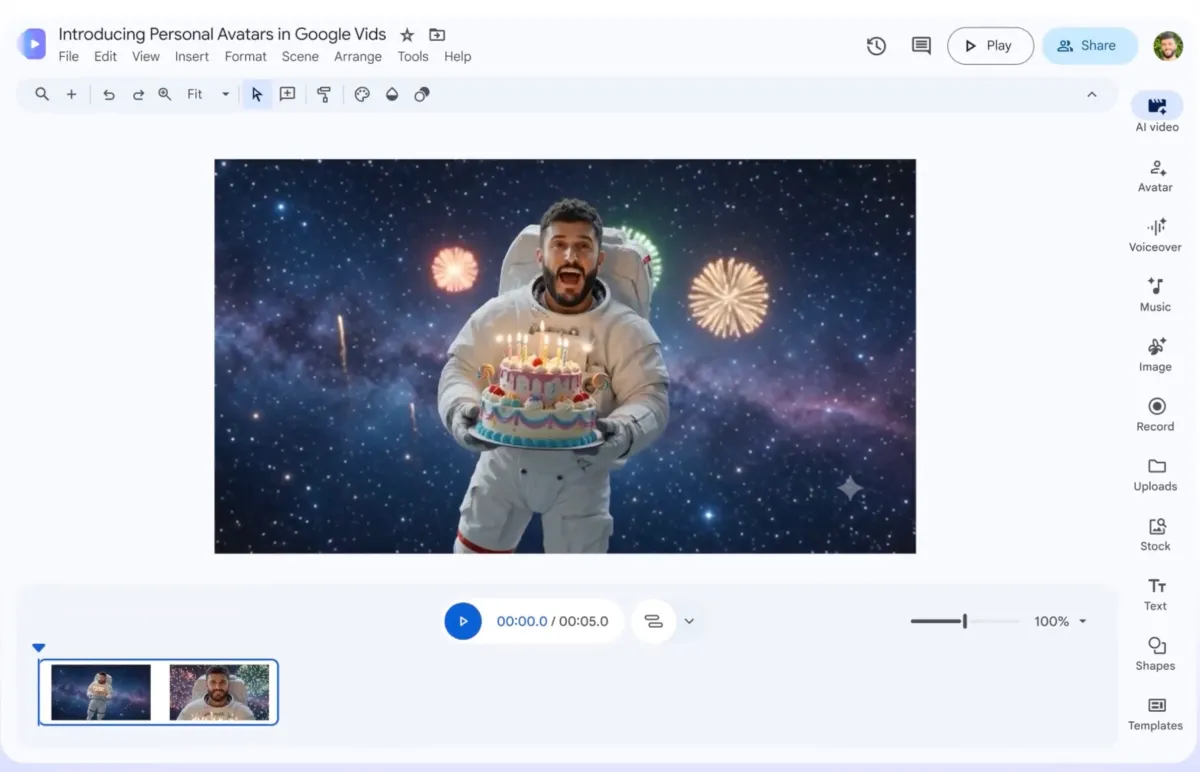
Google Vids is starting to look more like a composite presenter layer for work than a video helper.
In an update detailed by TechCrunch, Google is adding personalized AI avatars to its Workspace video creation app, Google Vids. This feature allows users to create digital versions of themselves that look and sound like themselves using uploaded selfies and voice recordings.
It’s a very special kind of AI video. He’s not a typical character. Not a stock presenter. you.
your face becomes a template
The Avatar update comes with a significant expansion of what Vids can generate and edit. Google is also bringing Gemini Omni to its products, allowing users to create videos from written prompts paired with reference images. In practice, this means that your video overview can include both explanations and visual instructions.
Google is adding more editing controls within the same flow. TechCrunch reports that you can use Omni to swap out backgrounds, fix lighting, and add effects to videos you record on your phone. It also supports gradual editing, allowing users to keep making changes to the video instead of starting from scratch.
This is important because Vids were originally centered around presentations and communication in the workplace. These updates make your workflow smoother: compose messages, upload visual references, become the presenter, and adjust the output conversationally.
Behavioral changes are subtle but important. Editing isn’t the only difficult part of workplace videos. It’s about having someone record and re-record it so it looks polished, sounds clear, and feels like it’s worth sending in its entirety. Google is trying to compress all of this into a synthetic version of a prompt, some assets, and an employee.
Guardrails added to composite presenters
Google does not treat Avatar as a free character generator. The company says the new AI avatar is associated with the account holder’s likeness and is tied to their Google account. Access is restricted to users 18 years of age or older in certain regions.
There is also a layer of trust. Google says avatars will be invisible watermarked with SynthID, the company’s technology for identifying AI-generated content. The details are not superficial. When workplace tools allow people to create videos starring their digital doubles, questions about provenance become part of the product, not a policy footnote.
For companies, the appeal is clear. Internal updates, training clips, product descriptions, onboarding videos, and asynchronous messages can all be created faster. People who need to be on camera may no longer need to be on camera.
But it also changes what workplace videos convey. The sophisticated talking head update implied time, presence, and some level of human effort. With personalized AI avatars within Workspace, videos become a scalable format that can be generated, adjusted, and sent with far less effort.
The strategic consequences are clear. Google doesn’t just make video editing easier. Make your professional presence programmable.