
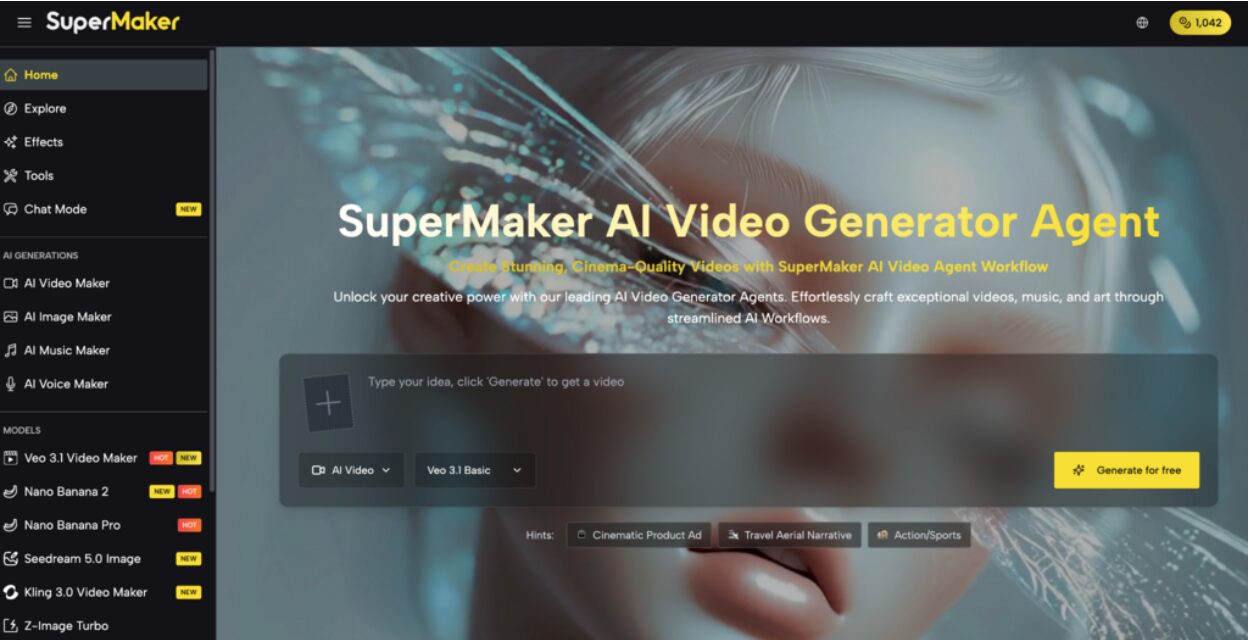
If you’re a video creator, marketer, or small production team, you’ve probably felt uncomfortable building video projects across separate tools. If you generate a reference image in one app and animate it in another, you can’t keep track of which version led to which result. This interaction slows down a project that should be moving quickly. SuperMaker AI’s AI Canvas Workflow Studio directly addresses this and AI video maker Give your workflows a single visual home. Rather than working with an app, build a connected image-to-video pipeline on a single canvas and keep every step of your video project in the same workspace, from the first frame to the final export.
What is AI Canvas Workflow Studio?
AI Canvas Workflow Studio is a node-based, zoomable canvas where video generation occurs alongside image and text nodes in one connected workflow. Rather than generating videos individually, you can build a pipeline where the generated images feed directly into the video node as the starting frame, making them all viewable and editable on the same canvas.
For video creators and marketing teams, this means multi-step video concepts such as reference images, animations, and variations stay in one place instead of being spread out across separate generation tools and downloads. For small production teams, that means a shared, organized view of how each part of a project is connected.
Traditional challenges of AI video production
Producing AI-generated videos across multiple unconnected tools creates repeated friction.
- Generate a reference image in one app and export it to another video tool
- Manually track which image version was used to generate which video
- Previous attempts get lost when testing different creative directions
- No shared workspace for teams collaborating on the same video concept
- Rebuild the same image-to-video sequence from scratch for each new variation
These issues are further complicated for projects that require multiple generated clips. The simple idea of turning this image into a moving scene and trying three variations becomes a manual task of shuffling files without a connected workspace. This is the specific gap that canvas-based approaches address. This means that the image that feeds the video and the video itself remain linked together, rather than being treated as separate, disconnected files.
How SuperMaker AI handles video workflows
AI video with Veo 3 and 3.1
Inside Canvas, the Video node uses Veo 3 and Veo 3.1 to generate high-quality video from text or images. You can choose landscape or portrait orientation and use AI-generated artwork as the starting frame, giving you more creative control over how your video starts than you would normally have with just a text prompt.
smart creative pipeline
Video nodes can be linked to image or text nodes, so the output from one step becomes the input to the next step. The most common method is to use the generated image as the first frame of the video. The system automatically validates these connections and supports text-to-image to video sequences without the need for coding.
Infinite canvas and visual workflow
The canvas itself is a zoomable workspace where all your image and video nodes are displayed and organized spatially, rather than buried in a linear timeline or separate project files. This is especially important for video work, as it allows you to see how reference images relate to the video generated from them, all in one view.
Output and Usage – Actual content ready
Finished videos are exported in high resolution without watermarks, and all nodes and connections on the canvas are automatically saved with a version history that can be reviewed and reverted. SuperMaker frames this output as something that can actually be used, including commercial use (marketing videos, social content, client deliverables), giving video creators a practical way to use the export without relying on legal speculation.
How to use
Step 1 – Prepare input
Start a new project with an infinite canvas and add the nodes you need for your video: a text node for the prompt, an image node if you want the generated visual to act as a starting frame, and a video node for the final output. Having a clear idea of the starting frame, whether it’s text or images, helps your pipeline produce more consistent results.
Step 2 – Configure settings
Build a pipeline by connecting nodes and linking the image output to the video node as the start frame for that approach. Inside the video node, select the orientation (landscape or portrait) and choose your preferred model. Here, visual workflow canvas It’s especially useful for video work, as it sets up a repeatable image-to-video sequence rather than a single independent generation.
Step 3 – Generate and export
Once the pipeline is connected, click Generate to generate the video directly on the canvas and preview it on the fly. You can swap models, adjust starting frames, generate variations to compare options side by side, export finished videos in high resolution to use in your own projects, and each version is saved to your history for future reference.
Video team use case
- video creator — Build a text-to-image-to-video pipeline that keeps reference images and final clips connected in one workspace.
- marketing team — Generate multiple video variations from the same starting image and compare them side by side before choosing the final cut.
- social media manager : Create short portrait-oriented videos for platforms like TikTok and Instagram without switching between separate image and video tools.
- small production team — Manage multiple video concepts at once with auto-saved version history across shared canvases.
FAQ
How does a video pipeline workflow actually work?
Add an image node and a video node to the canvas, connect the image output to the video node as the start frame, and[生成]Click. The system generates the video in place on the canvas, where you can preview, adjust, and export it.
Can I use the generated video commercially?
Yes, videos generated through Canvas can be exported in high resolution and without watermark for commercial use such as marketing, social media, client work, etc. It is worth checking the platform’s current terms for your specific project requirements.
What video models are available in Canvas?
Canvas provides access to Veo 3 and Veo 3.1 for video generation, as well as over 9 image models for building visual references to feed video nodes. Select your preferred model from the node settings.
conclusion
AI Canvas Workflow Studio Video Creator provides a connected way to build image-to-video pipelines without the manual handoffs associated with working between separate tools. For those creating multiple independent clips, the reference image, generated video, and all variations are saved in one autosaved workspace.
If you have a video concept that starts with an image, it’s worth opening AI Canvas Workflow Studio to see how the two connect on one canvas.


