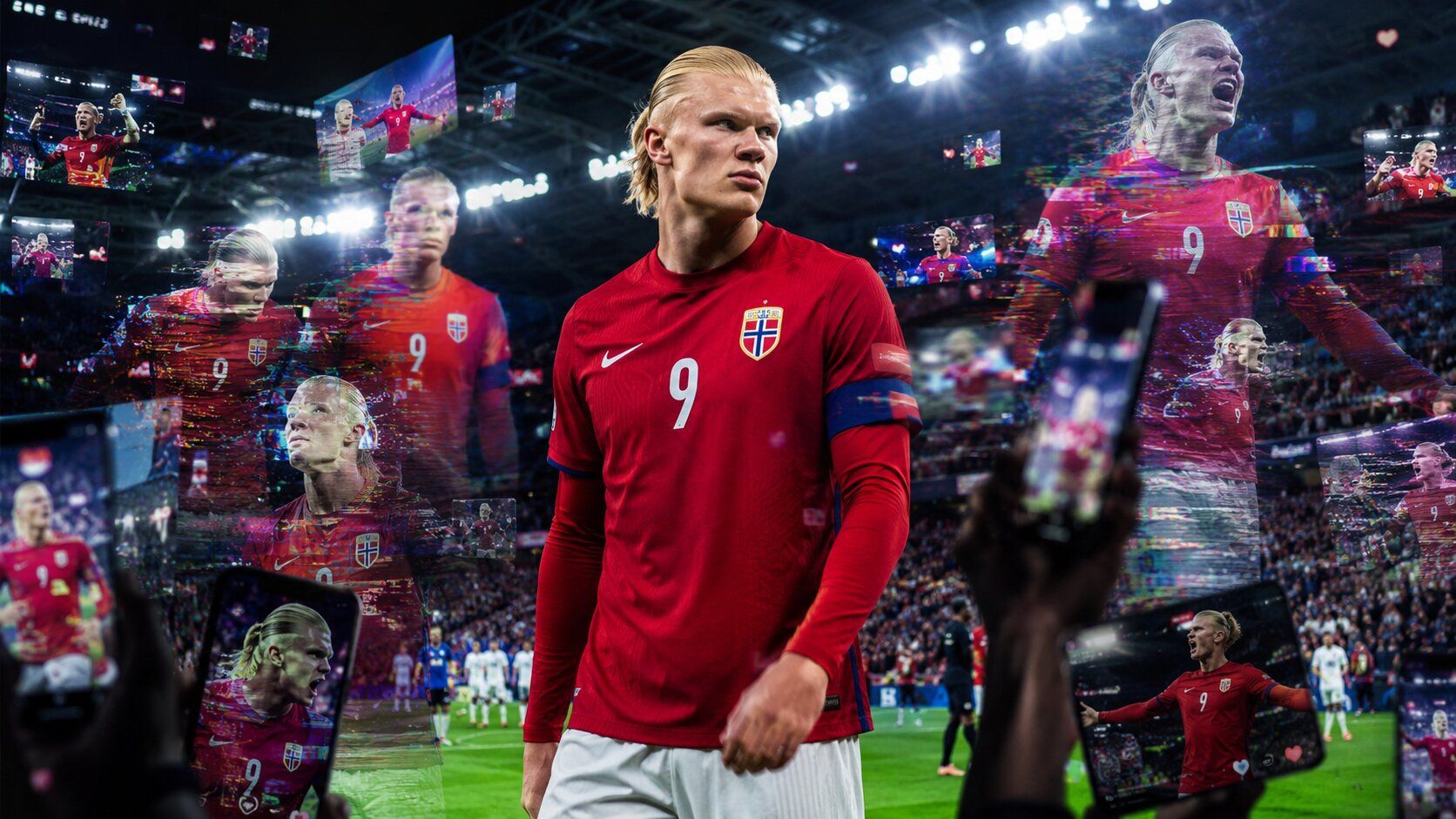
The explosion of the Haaland meme at the 2026 World Cup has made Norwegian striker Erling Haaland more than just a footballer.
He is now the subject of a synthetic media stress test, with AI-generated videos and images of him flooding social platforms at a pace that fact-checkers cannot match.
At least one viral video purporting to show Haaland looking stunned on the pitch has been digitally altered, according to AFP Fact Check. The verification agency confirmed that the video had been tampered with and announced the results on July 10, 2026.
When Memes Become a Deepfake Problem
Wired reported this week that Haaland has become “an internet character perpetuated by fans and AI,” and that much of her novel content has become synthetic rather than documentary. Euronews later published a detailed breakdown, calling him the World Cup’s biggest star created by AI.
The mechanism is simple. Consumer-grade AI video tools can now create short, compelling clips in minutes. With their unique physical features, global personalities, and millions of passionate fans, soccer players are ideal subjects. Haaland’s physique, goal-celebrating style and internet nickname “Babygirl” make him the default canvas for AI-generated sports humor in 2026.
The problem isn’t humor itself. The problem is that viewers don’t have a quick mechanism to distinguish between real and fabricated clips. AFP’s fact-checking operation, the world’s most resourceful, took several days to verify the doctored video. At that point, the original clip had millions of views.
This gap between the speed of AI production and the speed of human verification is exactly what the blockchain content authentication space aims to fill. Projects building on-chain provenance tools claim that cryptographically signing content at the point of creation is the only permanent solution. If a broadcaster’s camera signs every frame as it is captured, unsigned composite clips can be immediately identified. That infrastructure doesn’t yet exist on the scale needed for a World Cup.
Prediction markets add a darker incentive layer
The flood of AI content around Haaland is not happening in a vacuum. The 2026 World Cup has become a landmark event for decentralized prediction markets. Polymarket recorded $122 million in games over the course of the week, with bettors flocking for results on a scale comparable to that of regulated sportsbooks.
Please also read: Polymarket Traders pumps $122 million into Team USA before Belgium ends dream
That amount creates an economic incentive to spread misleading content. A fabricated clip showing Haaland injured or acting erratically before the game could theoretically move the betting lines before verification catches up. Prediction market operators currently have no mechanism to flag or discount results affected by synthetic media events.
Karushi and Polymarket Both settle on real-world consequences and rely on established media sources for resolution. Neither platform has publicly announced how it would handle scenarios where doctored videos temporarily affected the public perception of a player’s fitness or behavior.
Risk is not hypothetical. The sports betting market has been manipulated in the past using pre-AI techniques with false injury reports. AI-generated video significantly lowers the production barrier for that type of operation.
World Cup deepfakes prompt stricter verification
The World Cup’s synthetic media problem didn’t start with Haaland. At the beginning of the 2026 tournament, AI-generated clips of multiple players were spread on X and TikTok, and later debunked.
AFP’s Haaland fact check was published on July 10, 2026, and was one of the first formal verifications of athlete footage altered by AI during the Games. It won’t be the last.
what happens next
The Haaland episode could increase regulatory interest in labeling AI content in sports media. The European Union’s AI law covering the disclosure of synthetic media is already in place. Enforcement during live sporting events remains an open question.
For cryptocurrency and AI infrastructure projects tackling content authentication, the World Cup provides a real-time case study. The request signal is clear. Viewers, journalists, and betting platforms all need faster tools to identify synthetic content. Whether that solution is based on blockchain provenance, cryptographic watermarking, or AI-versus-AI detection is still under debate.
Haaland himself continues to score goals. The internet version of him operates on something completely different.
Read next: AI is rewriting the way car accident lawyers discover and win in court.