
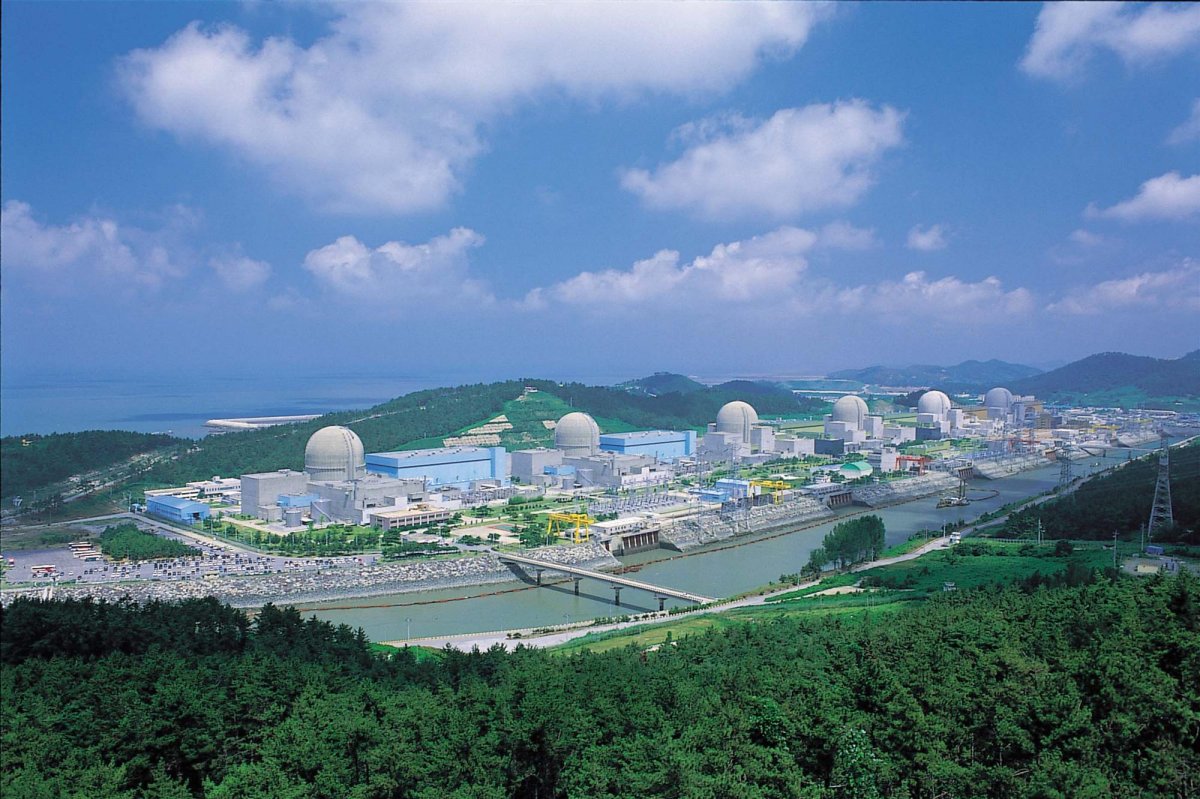
Hanbit Nuclear Power Plant in South Korea. Photo provided by: Hanvit Nuclear Power Plant
July 7 (Asia Today) — South Korea should redesign its national electricity supply plan from scratch, energy experts said on Tuesday, as power demand from artificial intelligence data centers and semiconductor factories is expected to exceed previous government forecasts.
The call comes as the government prepares a new power plan while pushing ahead with major projects in AI, semiconductors and advanced industries.
According to the energy industry, the government announced plans for an 18.4 gigawatt AI data center and four semiconductor manufacturing plants that would require 6.3 gigawatts of power.
If operated 24 hours a day, an AI data center will require approximately 161.2 terawatt-hours of electricity per year, and a new semiconductor factory will require approximately 55.2 terawatt-hours of electricity. These add up to an estimated 216.4 terawatt-hours per year.
This exceeds the projected increase in electricity consumption of 178 terawatt hours from 2024 to 2038 based on South Korea’s 11th Long-Term Electricity Supply and Demand Basic Plan.
Experts say the 12th electricity plan will require a redesign of the country’s energy mix, covering nuclear power, renewables, thermal power, the power grid and energy storage systems. Some argue that the government should consider continuing to use existing thermal power plants if new power sources or power grids are delayed.
Song Yang-hoon, professor emeritus of economics at Incheon University, said the government needs to reconsider both power demand and generation mix based on the 12th Plan after announcing the three mega-projects.
Song said it is unrealistic to base the next energy mix on past forecasts, as AI data centers and semiconductor clusters will require more power than the increases envisaged in previous power plans.
Because AI data centers and semiconductor factories require stable power around the clock, Son said South Korea should maintain operating nuclear and thermal power plants while considering adding at least four nuclear reactors.
“The power required for this huge project exceeds what existing power supply plans assume,” Song said. “In order to meet realistic electricity demand, we are not in a situation where we can easily reduce readily available power sources such as nuclear power and thermal power.”
Other experts said that power plans should be restructured starting from the demand survey stage, arguing that they did not adequately reflect the rapid growth in demand for electricity due to factors such as AI data centers, semiconductors and electric vehicles.
He also said nuclear power is gaining importance as a baseload power source as South Korea phases out coal-fired power plants.
Chung Beom-jin, a professor of nuclear engineering at Kyung Hee University, said South Korea needs to maintain a more flexible and sufficient power supply framework so that power shortages do not become an obstacle to industrial growth.
Jeong said, “As power demand from AI data centers, electric vehicles, and other electrification trends is rapidly increasing, power supply plans need to have more room to avoid hindering industrial growth.”
“Nuclear power needs to fully fill the gap left by coal-fired baseload power generation to stabilize electricity prices and ensure industrial competitiveness,” he said. “In the long term, South Korea should consider increasing the share of nuclear power in its power generation mix to more than 50%.”
— Asia Today reported. Translation by UPI
© Asia Today. Unauthorized reproduction and redistribution is prohibited.
Korea original report: https://www.asiatoday.co.kr/kn/view.php?key=20260707010002579


