
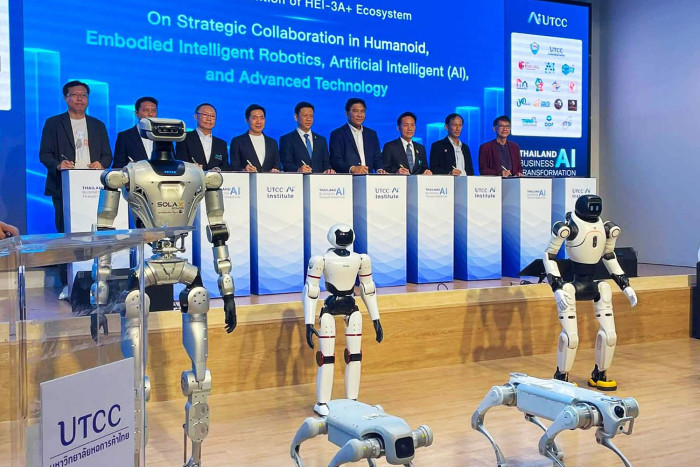
Roadmap focused on robotics and data
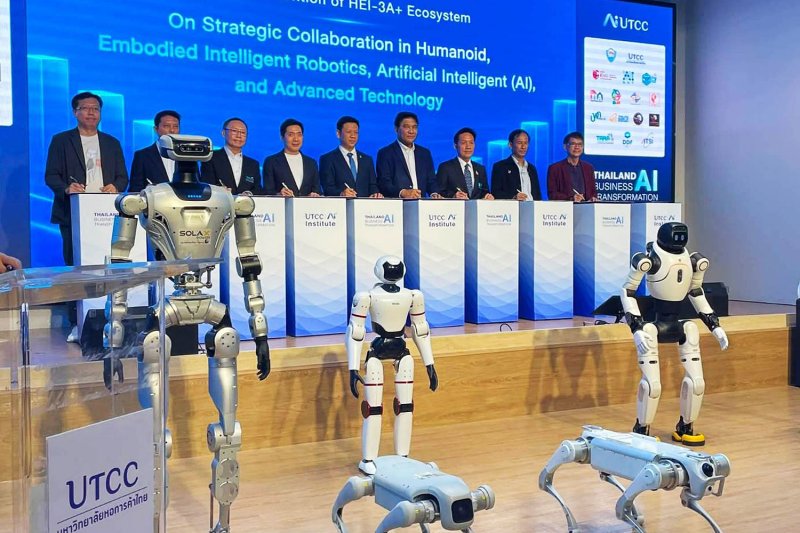
UTCC has signed an agreement with a Thai association to foster collaboration with the AI Institute.
Thailand has the potential to become a regional artificial intelligence (AI) and data center hub by 2035, while positioning itself as a manufacturing hub for humanoid robots, a leader in green digital infrastructure and a major source of AI talent, experts and academics say.
“We are entering the AI economy,” Jit Raowattana, Executive Director of the Thai Chamber of Commerce and Industry and Chairman of the Robotics and AI Committee, said on Monday at the launch of the UTCC AI Institute, a business AI development hub led by the Faculty of Engineering at the University of Thai Chambers of Commerce and Industry (UTCC).
He said Thailand should focus on becoming an expert in applying AI to real-world business solutions and aim to become an AI solutions hub in Southeast Asia, as 85% of the global AI market focuses on downstream applications rather than upstream development.
“Thailand is attracting investments in overseas data centers from Western and Chinese companies, but just hosting them is not enough to build a truly profitable data industry,” said Jit.
He noted that governments and the private sector need to encourage these foreign hyperscale data centers to run AI inference models locally within the country.
“Running these models locally will create real business value and protect Thailand’s data sovereignty,” Mr Jit said.
Additionally, the country has the potential to become a hub for humanoid robot manufacturing and services, he said. The cost of industrial robots has fallen dramatically over the past 30 years, and new government tax incentives are accelerating the adoption of automated and humanoid robots.
With top foreign manufacturers already investing in Thailand’s industrial areas, the country has a unique opportunity to become a regional manufacturing and service hub for humanoid robots by focusing on building specialized software platforms, such as healthcare and security platforms, to operate robots, rather than relying solely on hardware assembly.
Mr Jit said Thailand needs to prioritize green energy solutions as AI operations and data centers require large amounts of power and cooling.
He said it is important to develop smart grids, energy storage, direct power purchase agreements and solar power plants to ensure that at least 30% of the energy powering this digital infrastructure comes from renewable sources.
Jit added that local SMEs should act like “insects on elephants” by strategically partnering and integrating with larger companies.
Furthermore, Thailand needs to urgently build its AI and robotics talent pool through academic collaborations and clusters such as the UTCC AI Institute.
Chanwit Boonchuai, chairman of the Thai AI Entrepreneurs Association, said Thailand’s AI market is worth 50 billion baht, but the 200 to 300 local AI companies can capture only about 2 to 3 billion baht, with most of the revenue going to foreign back-end providers.
AI Research Institute
UTCC President Tanabas Phongvichai said that to prepare for the future, the university has adopted an “AI-first” approach, incorporating AI into 100% of its courses. He said the school’s roadmap has progressed from a generative AI university to a “data-driven AI” university.
Recognizing that 1% of students studying AI and information and communication technology is not enough, UTCC aims to push this number to 10% and turn Thai business expertise into AI assets that directly support Thai companies, Tanabas said.
The institute will connect education, research, innovation, industry and international networks and serve as a university-level platform for AI applied to business, he said.
UTCC introduced the Thailand Industry AI Transformation Initiative, the AI Solution Factory & Digital Workforce Lab, and the AI Talent Project for Thailand. These efforts are part of a five-year roadmap to position the Institute as the leading applied AI platform in Thailand and the region.


