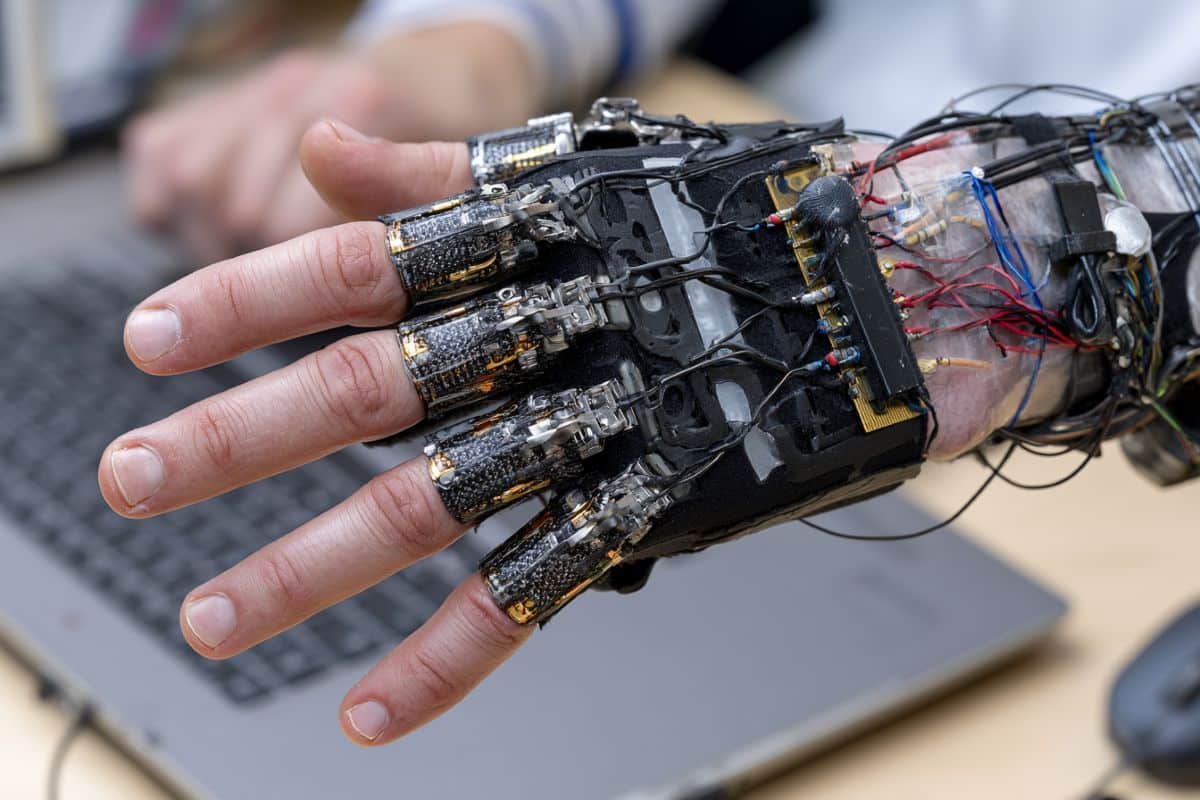
Summary: Researchers created an intelligent, low-cost pneumatic glove that successfully restores grasping capabilities to paralyzed hands. By combining inexpensive fabric and smart air cushions with advanced machine learning, the system intercepts weak electromyogram (EMG) signals straight from the forearm.
This allows the glove to read a user’s biological intent with up to 97% reliability, inflating targeted chambers to close fingers safely around glasses, forks, and everyday objects.
Key Facts
- The 13-Tube Pneumatic Matrix: The soft-hand exoskeleton is constructed using basic, low-cost fabric embedded with specialized air cushions across its outer surface. These cushions are fed by 13 independent micro-tubes, allowing the glove to bend or straighten individual fingers and smoothly rotate the wrist.
- Deep Intent Prediction: Forearm sensors capture faint electrical muscle impulses (EMG data). The team’s machine learning algorithms process these signals, inferring the user’s intended grasping gesture with an incredible 97% accuracy rate before the hand even attempts to move.
- The Anti-Drop Safety Shield: To prevent the heartbreak of dropping an item mid-reach, researcher Nicolas Berberich integrated supplementary motion sensors. These sensors detect active transport movements as the arm swings, keeping the exoskeleton’s pneumatic grip firmly locked until the object is safely set down.
- The ALS Patient Milestone: The system was co-developed and validated in close collaboration with an ALS patient who had lost almost all hand movement, retaining control over only his first thumb joint. By targeting the flexor pollicis longus muscle in the forearm, the system successfully amplified his remaining muscle pulses.
- A Fork in Four Years: Using the TUM glove, the ALS patient was able to pick up and hold a fork for the first time in four years, manipulate small blocks, and successfully feed himself. Remarkably, just five minutes of training using a specialized thumb-controlled video game was enough to dramatically optimize his operational control.
- Affordable Democratic Design: Unlike elite, six-figure lab exoskeletons, Dr. John Nassour hand-sewed the fabric glove using highly affordable materials. This low-cost, high-yield engineering design guarantees that the high-tech solution can remain financially accessible to low-income families and everyday stroke survivors.
- Broad Clinical Horizons: Following the success of the ALS pilot, Professor Gordon Cheng and neurologist Tobias Wächter are expanding the soft glove concept to assist stroke survivors, motorcycle accident victims with peripheral nerve damage, and individuals living with flaccid paralysis or polyneuropathy.
Source: TUM
The Technical University of Munich (TUM) has developed a soft, pneumatic glove that restores the ability of people with paralyzed hands to grasp objects.
To achieve this, researchers at the TUM Chair of Cognitive Systems use electrical signals from the forearm muscles to reliably predict when a person intends to grasp an object. The invention could one day help people whose hands have been paralyzed as a result of accidents or neurological disorders.
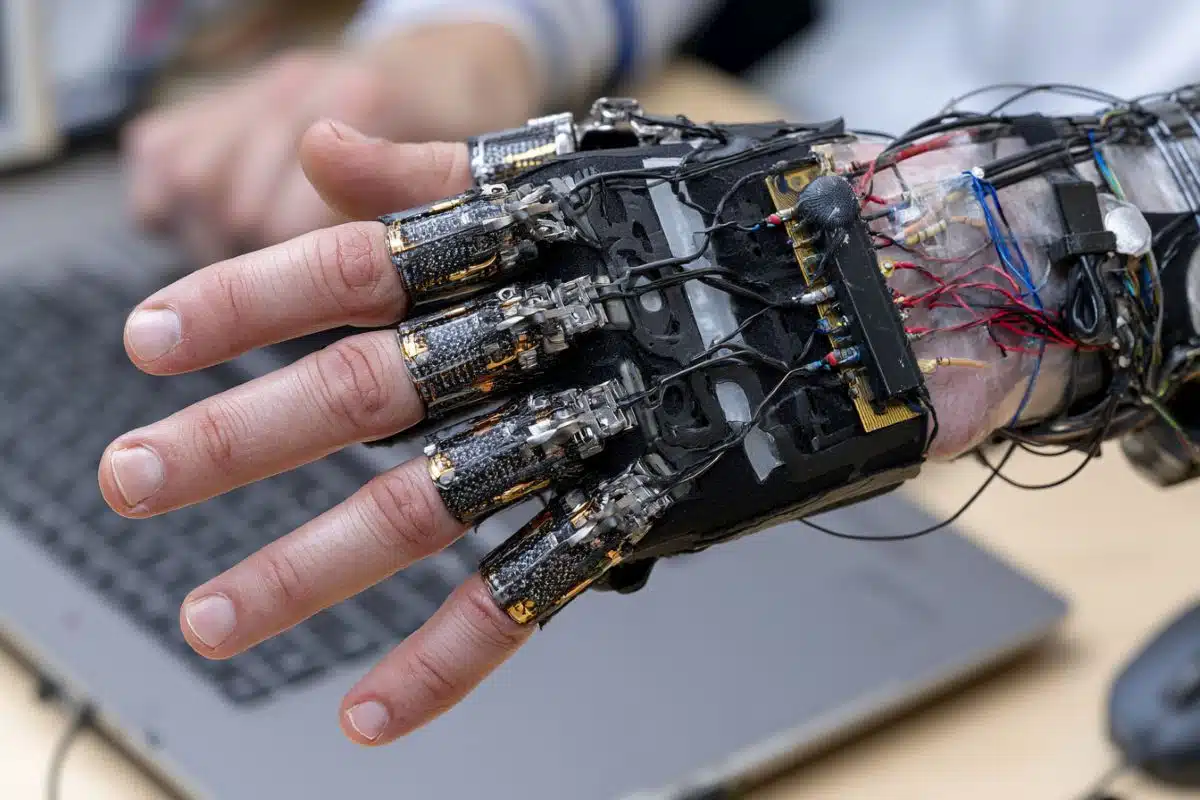
The “soft-hand exoskeleton” consists of a fabric glove developed by the researchers, with air cushions attached to its outer surface. The air cushions are inflated through a total of 13 tubes, providing targeted support for the hand movements needed to hold a plate or grasp a glass, fork or spoon. The air-filled cushions allow each finger to be bent and straightened individually while also rotating the wrist, enabling objects to be held securely in the hand.
To determine when a person intends to grasp an object, the researchers measure muscle activity in the forearm. Sensors attached to the forearm capture electrical signals, which are analyzed using machine learning to reliably determine the intended movement.
“To prevent objects from being dropped accidentally, we use additional motion sensors to detect transport movements and keep the exoskeleton’s grip securely closed throughout the movement,” says researcher Nicolas Berberich.
A soft-hand exoskeleton that anyone can afford
“Our solution is intelligent in two ways,” explains his colleague, Dr. John Nassour. “On the one hand, we’ve developed a highly reliable method of predicting grasping movements by inferring intentions from signals with 97% reliability. On the other hand, with our glove, we’ve developed hardware that optimally supports the intended movements.”
Another advantage is that Nassour sewed the glove himself, and the required fabric costs very little. At first glance, the glove doesn’t look high-tech, but it can be used by many people with paralysis.
“We’ve found a solution that anyone can afford but still works very well,” says Prof. Gordon Cheng, director of the Institute for Cognitive Systems. Close collaboration with a patient with amyotrophic lateral sclerosis (ALS) was crucial to the development of the soft-hand exoskeleton.
People with ALS gradually lose control of their movements. This is because the nerve cells responsible for skeletal muscle contraction are damaged and continue to degenerate. At the start of the project, the patient already had very little control over his hands, but was still able to move the first thumb joint.
The researchers based their experiment on the strongest signals generated by the thumb muscles. To record this electromyogram, they attached a sensor to the forearm that detects the strongest signals from the flexor pollicis longus muscle as soon as it is moved. These signals trigger the inflation of the glove’s air cushions.
ALS patient picks up a fork for the first time in four years
Despite very weak signals, the system recognized the patient’s intention in 9 out of 10 cases. He was able to reach for objects, hold a fork for the first time in four years, and pick up small cubes and drop them into a container. A video game also contributed to this success.
The patient had to make a character jump using only the movement of his thumb joint. The researchers found that just five minutes are enough to greatly improve the patient’s ability to grasp objects.
“This patient has shown us that our soft-hand exoskeleton can support him despite one of the most severe neurological disorders,” says Prof. Cheng.
“We are now adapting the concept for other patients, such as stroke survivors,” the researcher adds. A key finding of the current study is that people with severe impairments can regain the ability to grasp objects more effectively with the help of the glove.
Neurologist Prof. Tobias Wächter from the partner institution Klinik Passauer Wolf is convinced of the potential of the new specialized glove: “In principle, this glove can help people with flaccid paralysis, including, for example, people who have sustained peripheral nerve damage following motorcycle or bicycle accidents, or patients with polyneuropathy,” says Prof. Wächter.
Further information
The research has been supported by the TUM Innovation Network since 2022. Within eXprt (short for Exoskeleton and Wearables Enhanced Prevention and Treatment), a multidisciplinary team from the fields of engineering, neuroscience, and clinical neurology is working together to develop wearable technologies.
The project develops tools for the sensitive detection of sensorimotor and cognitive impairments that affect daily life. Drawing on advances in neuroengineering, the team aims to compensate for lost motor function, prevent further deterioration, and improve people’s quality of life. eXprt is one of several transdisciplinary initiatives that TUM is funding for four years. The teams consist of up to ten doctoral candidates and postdocs, in addition to the supervising professors.
Funding: The total funding for each project is approximately €3 million. The TUM Innovation Networks are a central component of TUM’s Excellence Strategy, TUM Agenda 2030.
Key Questions Answered:
A: The magic of the Technical University of Munich (TUM) glove lies in its soft pneumatic design. Instead of using heavy, rigid metal motors, the glove uses ultra-light fabric with customizable air cushions sewn onto the fingers. These cushions are connected to an array of 13 tiny tubes. When air is pumped through the tubes, the cushions inflate and expand, providing a gentle yet firm mechanical force that bends individual fingers and rotates the wrist, allowing a paralyzed hand to close securely around an object.
A: It listens directly to the body’s residual electrical signals. Even when a patient has severe paralysis from a condition like ALS, their brain still sends tiny electrical commands down to the forearm muscles. TUM researchers placed sensitive electromyogram (EMG) sensors on the skin to catch these faint pulses. Then, a smart machine learning algorithm reads the signals, predicting what the user wants to do with 97% accuracy. The moment it detects you intend to grasp a fork, it instantly inflates the air cushions to assist you.
A: Yes, and that is one of the most beautiful aspects of this project. The directors of the TUM Institute for Cognitive Systems deliberately prioritized an affordable, democratic design. Dr. John Nassour hand-sewed the glove himself using basic, low-cost fabrics rather than exotic carbon fiber. Because the smart tech is built into the software and simple air tubes rather than expensive mechanical joints, the team has successfully delivered a high-performing neuro-wearable that remains cheap enough for regular families, stroke survivors, and accident victims to easily afford.
Editorial Notes:
- This article was edited by a Neuroscience News editor.
- Journal paper reviewed in full.
- Additional context added by our staff.
About this neurotech research news
Author: Andreas Schmitz
Source: TUM
Contact: Andreas Schmitz – TUM
Image: The image is credited to Neuroscience News
Original Research: Open access.
“A Dexterous Soft Hand Exoskeleton Restores Intentional Grasping for Individuals with Severe Hand Impairment” by John Nassour, Nicolas Berberich, Daniel Utpadel-Fischler, Tobias Wächter & Gordon Cheng. Nature Machine Intelligence
DOI:10.1038/s42256-026-01263-3
Abstract
A Dexterous Soft Hand Exoskeleton Restores Intentional Grasping for Individuals with Severe Hand Impairment
Soft hand exoskeletons have emerged as promising assistive devices for individuals with impaired hand function. However, most existing systems provide limited dexterity and primarily target users with moderate hand ability, leaving individuals with severe hand paralysis without effective solutions for reliable grasping of diverse objects.
Here we report the translational development of a lightweight, textile-based soft robotic exoskeleton glove with wrist dorsiflexion and an active opposable and abductable thumb, designed to restore hand function in a patient with severe right-hand impairment due to amyotrophic lateral sclerosis.
We followed a co-creation approach, enhancing dexterity by increasing hand articulations based on patient needs. Furthermore, to enhance the patient’s sense of control, a non-invasive surface electromyography-based grasp predictor (97% sensitivity) was combined with motion data and machine learning-based error correction to compensate for weak, noisy muscle signals, compared with healthy controls (n = 15).
The exoskeleton enabled the patient to grasp objects, achieve a Box-and-Blocks Test score of 5 and perform meaningful tasks, including feeding himself. We further validated the exoskeleton in patients with stroke (n = 6). While exoskeleton assistance on average reduced Action Research Arm Test scores of moderately impaired patients by 9, severely impaired patients scored 17 points higher when using the exoskeleton.
These results indicate that the dexterous soft hand exoskeleton is particularly effective for individuals with severe to near-complete hand paralysis, while its utility for patients with moderate residual function is limited and task dependent.