Decision making is important for many sectors, including agriculture.
For farmers, making informed decisions is essential to improve crop yields, reduce resource waste, and promote sustainable farming practices.
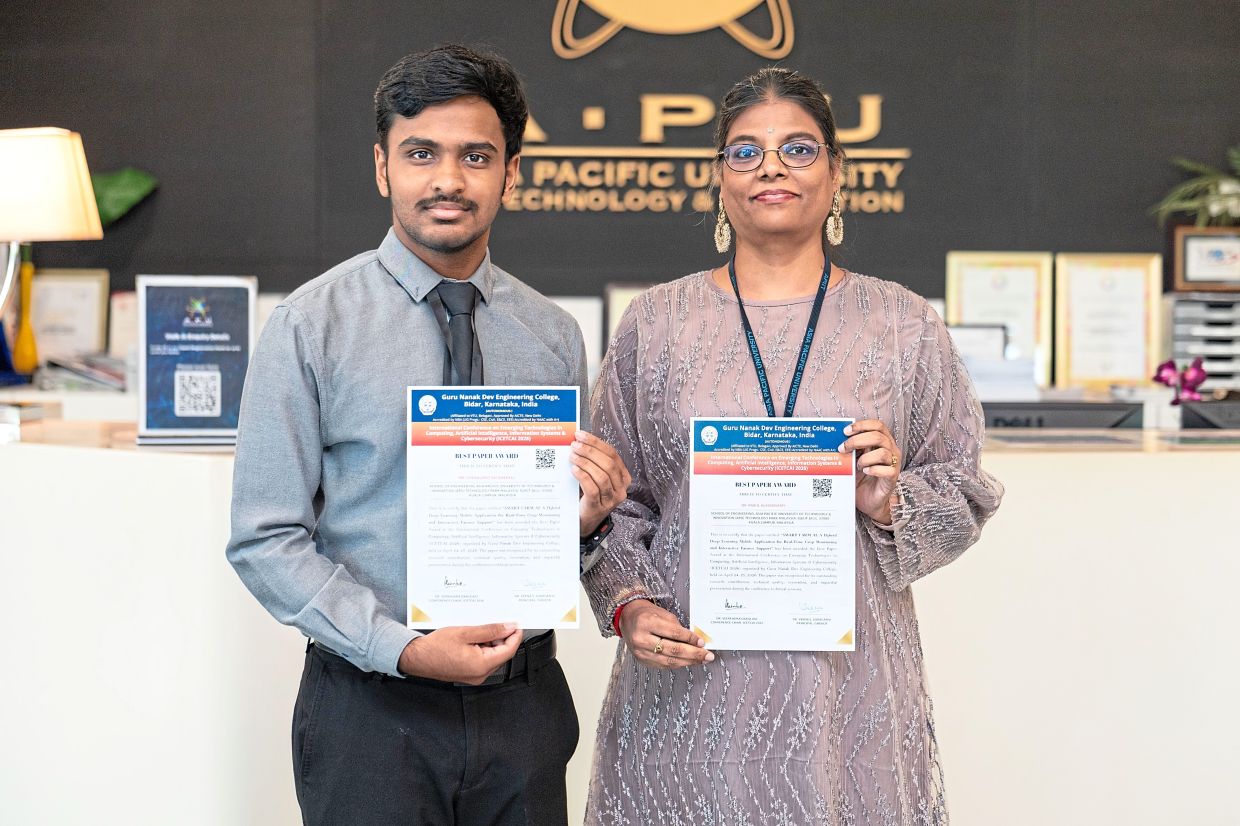
Aiming to help smallholder farmers, the duo from Asia Pacific University of Technology and Innovation (APU) has devised a solution that provides access to advanced agricultural tools for crop disease detection, soil-based crop recommendations, resource optimization, and multilingual advisory support.
This research project, developed by Bachelor of Computer Engineering (Hons) student Chennupati Sai Dheeraj under the guidance of his mentor, APU School of Engineering (SoE) Assistant Professor Dr. Mukil Alagirisamy and with the encouragement of APU SoE Dean Dr. Siva Kumar Sivanesan, was recently recognized at the International Conference on Emerging Technologies in Computing, Artificial Intelligence, Information Systems and Cybersecurity (ICETCAI). 2026).
The study, titled “Smart Farm AI: Hybrid Deep Learning Mobile Application for Real-Time Crop Monitoring and Interactive Farmer Support,” won the best paper award at an event organized by Guru Nanak Dev College of Engineering held on April 24-25 in Bidar, Karnataka, India.
The project stood out among 50 research proposals presented at the conference, which brings together researchers, academics, and industry experts from around the world to exchange ideas and showcase advances in AI, machine learning, advanced computing, information systems, and cybersecurity.
Dheeraj said the international recognition strengthened his resolve to continue developing innovative solutions that address real-world challenges, particularly in agriculture and regional development.
Reflecting on his journey, he emphasized the importance of perseverance, curiosity, and meaningful guidance to achieve success.
“I would like to express my sincere gratitude to Dr. Mukil for his unwavering guidance, the SoE for his continued encouragement, and the ICETCAI 2026 Organizing Committee for giving me the opportunity to present my research and the honor of receiving the Best Paper Award,” he said in a June 15 press release.
Dheeraj’s research journey began with the belief that technology should benefit communities and improve lives.
The mobile application he and his mentors envisioned incorporates four key AI-powered features designed to address several critical agricultural needs.
Crop disease detection allows farmers to use their smartphone camera to take images of their crops, and a hybrid deep learning model analyzes the images to identify diseases across 38 crop categories.
The soil analysis and crop recommendation feature uses a random forest classifier to assess soil conditions and recommend the best crops for the available land.
Resource optimization features employ genetic algorithms to determine the ideal amount of fertilizer and water needed for each field, helping farmers maximize productivity while minimizing waste.
Trilingual chatbots allow farmers to communicate in English, Malay or Tamil and get farming advice and answers to farming questions.
To ensure accessibility even in rural environments, the system is designed to run directly on a smartphone without the need for an internet connection.
Dheeraj said it was a “very rewarding experience” to present at an international conference while continuing his undergraduate studies.
“The online format facilitates seamless networking with researchers and academics from India, Malaysia, and other parts of the world, giving us a unique opportunity to connect with leading experts in the field.
“The questions and constructive feedback we received during the sessions not only deepened our understanding of agricultural edge AI, but also facilitated the development of new ideas for our ongoing work,” he said.
Mukilu expressed pride in his mentees’ accomplishments, saying they exemplify APU’s commitment to developing not only technically competent graduates, but also socially conscious innovators who seek to leverage technology for the greater good.