image:
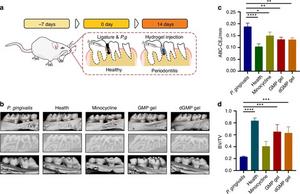
Mouse models used to test GMP and dGMP hydrogels for periodontitis prevention. We demonstrate ligation-induced disease, hydrogel injection, and alveolar bone preservation compared to untreated periodontitis.
view more
Credit: Hang Zhao, Xu Hao Image link: https://doi.org/10.1038/s41368-026-00438-3
Periodontitis is one of the most common chronic inflammatory diseases worldwide and the leading cause of tooth loss in adults. This disease, caused by harmful bacteria that damages the gums and supporting bone, often requires treatments that can simultaneously eliminate infection, reduce inflammation, and promote tissue repair. Biomaterials such as hydrogels have emerged as promising platforms for topical treatments, but the discovery of formulations that combine potent antimicrobial activity with safety and biocompatibility has traditionally relied on trial-and-error experiments, which are time-consuming, expensive, and labor-intensive.
In search of a faster and more systematic solution, researchers at Sichuan University led by Professor Hao Xu and Professor Hang Zhao developed a machine learning-based strategy to identify bioactive nucleoside hydrogels for periodontal therapy. Corresponding author, Prof. Mr. Xu says:By integrating artificial intelligence-based predictive models with newly developed molecular scoring methods and experimental validation, we aimed to computationally screen thousands of candidate molecules and focus clinical testing on only the most promising molecules.” This study was published in Volume 18. International Journal of Oral Sciences May 11, 2026.
To accomplish this, the researchers combined computer screening with laboratory validation. They first compiled nine large-scale bioactivity datasets from public databases and trained a machine learning model that predicted properties such as antimicrobial activity, toxicity, antiviral properties, and anti-inflammatory effects based on thousands of molecular descriptors. We also introduced two new metrics. The Molecular Bioactivity Specificity Index (MBSI), which identifies the key biological properties of a molecule, and the Composite Molecular Attribute Score (CMAS), which combines multiple desirable features such as gelling potential, antimicrobial activity, and biocompatibility into a single ranking system. After screening thousands of candidates, the highest ranked molecules were synthesized and experimentally tested for hydrogel formation, mechanical properties, and antibacterial activity. Porphyromonas gingivalisbiocompatibility, and efficacy in a mouse model of periodontitis.
This AI-guided workflow ultimately identified two standout candidates: guanosine monophosphate (GMP) and deoxyguanosine monophosphate (dGMP). “Both candidates successfully formed stable supramolecular hydrogels with good mechanical properties such as self-healing and shear-thinning behavior.” says Professor Zhao.In laboratory experiments, the hydrogel effectively inhibited Porphyromonas gingivalis while exhibiting excellent biocompatibility and minimal toxicity.” In a mouse model of periodontitis, the treatment reduced bacterial load and inflammation, preserved alveolar bone, and promoted tissue repair, demonstrating efficacy comparable to the antibiotic minocycline. When administered early, the hydrogel also helped prevent disease progression.
In addition to identifying two promising therapeutic materials, this research also focuses on how artificial intelligence can transform biomaterial discovery. Rather than relying primarily on empirical testing, researchers can use predictive models to quickly narrow down the vast chemical space and prioritize candidates with the highest likelihood of success. The introduction of MBSI and CMAS further strengthens this approach by allowing multiple performance properties to be evaluated simultaneously, providing a practical framework for balancing efficacy, safety, and functionality during material design. These advances have the potential to shorten development schedules, reduce research costs, and increase efficiency in creating clinically relevant biomaterials.
Its impact extends beyond periodontitis. The same computational framework can be applied to develop hydrogels for drug delivery, wound healing, tissue engineering, tissue engineering, and other oral health applications. As larger datasets become available and more sophisticated artificial intelligence techniques are incorporated, this approach may enable increasingly accurate predictions and also support the design of biomaterials customized to specific therapeutic needs.
Overall, this study demonstrates the power of combining machine learning and experimental validation to accelerate the rational design of multifunctional biomaterials. By successfully identifying and validating GMP- and dGMP-based hydrogels for periodontal therapy, researchers provide a proof-of-concept for a data-driven strategy that can reshape how the next generation of therapeutic hydrogels are discovered and developed across a wide range of biomedical fields.
reference
Original paper title: Machine learning discovery of therapeutic nucleoside hydrogels for periodontitis
journal: International Journal of Oral Sciences
Doi: https://doi.org/10.1038/s41368-026-00438-3
About Sichuan University
Sichuan University is a research university located in Chengdu, China, and is widely recognized as one of the country’s leading higher education institutions. It was established through the merger of several historic universities, including the former West China Medical University, giving it a strong foundation in medicine and health sciences. The university offers a wide range of disciplines spanning medicine, engineering, natural sciences, humanities, and social sciences. The West China Medical Campus, especially the West China Stomatology Hospital, is internationally recognized for its dental and biomedical research. Sichuan University is part of China’s elite “double first class” initiative.
Website: https://en.scu.edu.cn/
About Professor Hang Zhao of Sichuan University
Professor Hang Zhao is a researcher affiliated with the West China School of Stomatology, Sichuan University, China. His research focuses on novel oral formulations and targeted delivery systems. He received state and government youth talent grants in 2019 and 2018. He has published more than 30 high-level papers in top journals, led more than 10 national research projects, and holds 30 patents (5 US patents). 5 patents have been industrialized, transformation revenue of RMB 12.8 million has been obtained, and 2 related products have been sold. He received the second prize of the Huaxia Medical Award and the first prize of the Sichuan Natural Science Award.
About Professor Xu Hao of Sichuan University
Professor Hao Xu is a researcher at the West China School of Stomatology, Sichuan University, China. His research focuses on accurate diagnosis and treatment of oral diseases based on diverse data. He has published 33 papers as first or corresponding author in journals such as Nature Communications and the Journal of Dental Research. He has been selected as an Elsevier Highly Cited Chinese Researcher and is leading two general program projects supported by the National Natural Science Foundation of China.
Funding information
This research was supported by the National Key Research and Development Program of China (number 2022YFC2402901 to Hang Zhao). National Natural Science Foundation of China (No. 82571160 to Hang Zhao and No. 82370962 to Hao Xu). Central government-led local science and technology development fund project (number 2024ZYD0176 to Hang Zhao). Research funding from the National Key Research Institute of Oral Diseases of West China School/Stomatology Hospital of Sichuan University (numbers RCDWJS2026-14, SKLOD-2025KP001, and SKLOD-R011 to Hang Zhao). Natural Science Foundation of Sichuan Province, China (No. 2026NSFSC1587 to Weiqi Li and No. 2026NSFSC0489 to Hao Xu). China Postdoctoral Science Foundation (CPSF, number 2025M781704 to Weiqi Li). and CPSF Postdoctoral Researcher Program (No. GZB20250442, Weiqi Li).
journal
International Journal of Oral Sciences
Research method
experimental research
Research theme
animal
Article title
Discovery of nucleoside hydrogel for periodontitis treatment using machine learning
Article publication date
May 11, 2026
Conflict of interest statement
The authors declare no competing interests.
Disclaimer: AAAS and EurekAlert! We are not responsible for the accuracy of news releases posted on EurekAlert! Use of Information by Contributing Institutions or via the EurekAlert System.