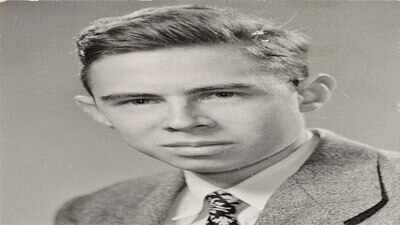
The use of artificial intelligence has fundamentally changed the way computers understand reality. This has given rise to phenomena such as facial recognition, image analysis in medicine, self-driving cars, and visual search. However, although highly complex, all of these innovations stem from something much simpler.Namely, in 1958, American psychologist and computer scientist Frank Rosenblatt announced his invention, named the Perceptron, at the Cornell Aeronautical Laboratory in Buffalo, New York. Development was funded by the US Navy. This was an important step forward because it showed that computers could learn and improve from experience, rather than just following pre-programmed instructions. The perceptron itself could only do simple things. Still, it became the basis for machine learning and eventually gave rise to artificial neural networks and computer vision.Machines learned from examplesBefore the advent of perceptrons, computers functioned primarily on the basis of explicit programming. Hard rules had to be set for each task, limiting the opportunity for the machine to adapt to new data. This time, scientists have proposed something completely new. Taking inspiration from how neurons work, he developed a model that can change its own settings based on example-based learning. In its first public demonstration in 1958, the Perceptron used an IBM 704 computer and punched cards to distinguish between cards marked on the left and cards marked on the right. Although this task may seem fairly simple now, it was one of the first demonstrations of a machine self-adjusting to new data through training, rather than just predefined programming.Public interest in this invention was sparked by the suggestion that machines might one day be able to recognize patterns and objects and make decisions independently. Rosenblatt defined a perceptron as a system whose ability to learn allows it to perceive and recognize its surrounding environment. Although the goal was beyond what was achievable with technology at the time, this invention fundamentally changed the way people viewed artificial intelligence research. This is often seen as an important step towards machine functionality based on data analysis rather than simply programmed algorithms.research on Perceptron theory can predict accuracy of neural networks It identifies the perceptron as the ancestor of modern artificial neural networks and explains that its learning process relied on adjusting numerical weights based on labeled examples. This study argues that this principle is at the heart of modern machine learning, where neural networks continuously refine their internal parameters during training to improve predictive accuracy. Today’s AI models contain millions or even billions of parameters, but they follow the same basic concepts first demonstrated by Rosenblatt’s machine in 1958.From simple classifiers to modern computer visionAlthough the original perceptron introduced some breakthrough concepts, it had some significant limitations. First, it could not handle more complex classifications. These shortcomings came to widespread attention in the late 1960s. Therefore, people doubted whether neural networks could live up to the expectations they raised. Nevertheless, the core idea of Perceptron never disappeared. On the contrary, it inspired many scientists to invent multilayer neural networks that could avoid the shortcomings of early perceptrons.One of the contributions of the perceptron is that it showed that visual recognition can be achieved by learning from examples. Instead of programming computers to manually identify every possible feature, researchers are increasingly focusing on training systems using large collections of labeled images. This approach helped shape modern computer vision, allowing AI to recognize faces, classify medical scans, detect objects in self-driving cars, and interpret satellite images. Today’s convolutional neural networks are much more sophisticated than Rosenblatt’s original design, but they inherit the same basic philosophy. In other words, machines improve by learning patterns from data.A brief review of deep learning for computer vision describes the perceptron as one of the major historical milestones that paved the way for deep learning and image recognition. The review notes that although perceptrons themselves were not capable of performing modern visual tasks, they established a conceptual framework that later researchers extended to advanced neural network architectures. In retrospect, Rosenblatt’s invention did not solve computer vision. This helped advance the field’s potential by demonstrating that machines can learn to classify patterns through experience rather than explicit programming.
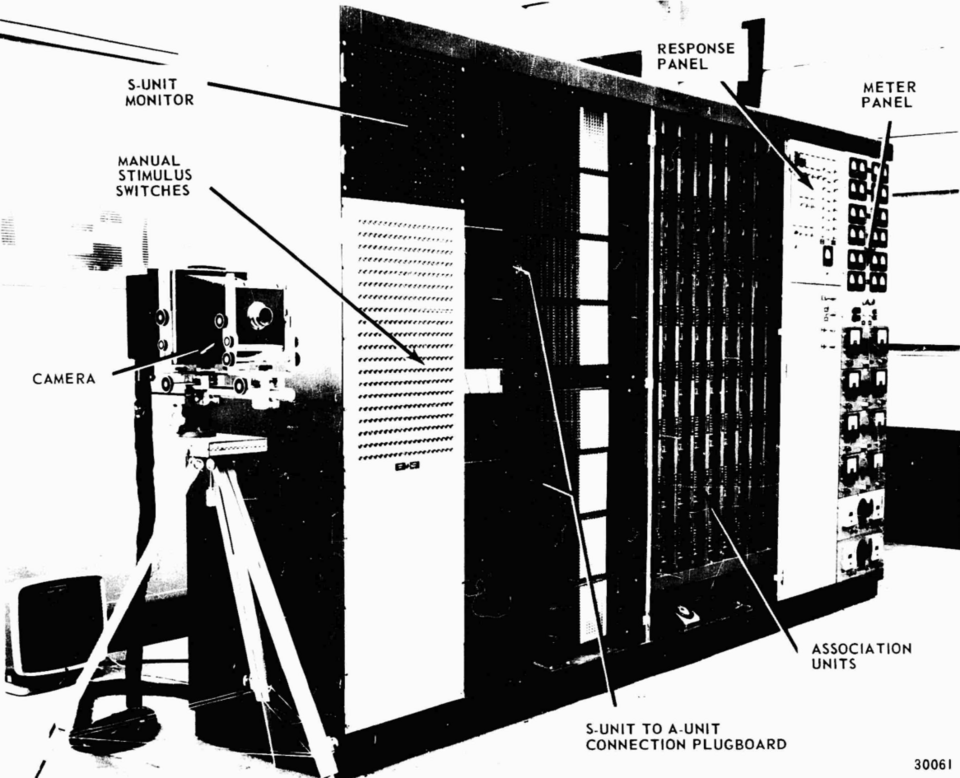
One of the earliest machine learning systems, the Mark I Perceptron, demonstrated that computers could learn how to recognize patterns from examples, rather than relying solely on programmed rules. Image credit: Wikimedia Commons
A legacy that continues to shape artificial intelligenceWhat made the Perceptron truly special today was not its technical features, but the idea behind it. This has moved artificial intelligence away from rigid programming and toward flexible learning based on collected information. The methodology applied to perceptrons can be applied to several areas of artificial intelligence, including natural language processing, recommendation systems, robotics, and computer vision.The development of the perceptron is considered one of the most important events in the history of artificial intelligence. The reason is that it presents a completely new concept of building intelligent machines through training, rather than programming them from scratch.