

If Colombia’s next president is chosen based on a successful digital strategy, the undisputed winner will be Abelardo de la Espriela. Beyond the ethical risks, the far-right candidate managed to articulate his case during the campaign, while his rival, left-wing senator Iván Cepeda, struggled to integrate his message on social media. With less than three days left until the vote on Gustavo Petro’s successor, the progressive camp is rushing to redesign its strategy.
Below are four key points where de la Espriela outperformed Cepeda in the digital battle.
The role of influencers
Both candidates’ strategies have been shaped by the influencers who burst onto the scene during the last presidential election and dominated attention on social platforms. “After 2022, the role of secondary accounts has become fundamental. The right, which was once dominated by the left, has learned a lot about it. De la Espriela brought in influencers and financed them,” explains Jessica Blanco, co-founder of the consultancy Sonante and one of former candidate Sergio Fajardo’s social media contacts.
Far-right candidates are surrounded by a group of influencers who accompany them to events and help spread their message, but above all to establish a narrative and run a contrast campaign. “Abelardo’s campaign modus operandi has several steps. It consists of creating a rumor, positioning it, and building a snowball effect in public opinion until it creates a buzz. When ready, the candidate makes the final blow,” explains José Paz, a digital strategist and colleague of Blanco’s at Sonante. Eugénie Richard, a lecturer at Externade University, said these techniques “allow campaigns to do and say things that candidates themselves cannot say,” highlighting one of the ethical and democratic risks of these strategies.
The most recent example occurred this week, when several accounts published a video asking progressive candidate Cepeda to disclose his medical exam, raising questions about his health. In the end, to counter these, leftist senators held a press conference and released a document dispelling those doubts and proving that he is “in perfect condition to carry out the office of president.”
In contrast, influencers supporting Cepeda have been relegated to a secondary role. Content creators and celebrities, including political scientist Karol Solis Menco and congressman Alfredo Mondragon, publicly complained to the campaign and its director, fellow congressman Gabriel Becerra, calling for stronger collaboration with influencers to implement the proposal. In the second round, Pass noticed a change. “In the first round, we did not identify any organization around the campaign’s message. In the second round, yes, it was perceived as a self-organizing process rather than a directed one.”
Viral videos and sophisticated speeches
The candidates chose diametrically opposed strategies to get their messages across. De la Espriela prioritized short, emotional videos on social media. According to authors like sociologist Mauricio García Villegas, these are favored by algorithms and are detrimental to democratic deliberation. “The people are not stupid, they are smart. The people have buried Petro and his accomplices,” dela Espriela said in October 2025, when the left won a historic vote in the party’s primaries and selected Cepeda as its candidate. The far-right candidate even opened a bottle of wine on camera to celebrate. “I will make Peter and his accomplices pay for their sins without a shadow of a doubt and with determination.”
Cepeda made the exact opposite choice. He refused to dance on TikTok, instead posting his full statement on social media instead of opting for short, potentially viral clips. “He’s someone who tends to have complex thoughts and long reflections. He’s not used to communicating in headline-worthy language,” says Richard. Leftist candidates read out pre-written speeches. They tried to offer a counter-proposal to Petro’s improvisations, but failed to evoke much passion or help his digital strategy.
That’s why de la Espriela steam-fried the cepeda. The most telling evidence is that left-wing candidates began filming more short videos for social media after the first round of voting. One photo shows uniformed Colombian national team supporters gathered in an apartment. “Who should we root for?” someone asks. “What do you mean? Who are you? Ivan!” they answer in unison. Then the door opens and the candidate appears. “Forever!” he cries. He also posted a behind-the-scenes video of a similar scene in which Cepeda made a mistake and asked to be re-recorded, explaining that it was very difficult for him. His YouTube channel is currently filled with short videos under 30 seconds.
For experts, it’s too little, too late. “You can’t fix something that hasn’t worked for months in three weeks. Digital strategies take time, as candidates get used to being on camera and trying out new languages. That’s why what we’re seeing feels forced. It’s clear he’s not used to recording or smiling, and that’s saying a lot,” Paz says. The expert said that although Mr. Cepeda has increased advertising spending on YouTube, it will not be able to outperform rivals that offer more targeted videos to viewers. Meanwhile, de la Espriela is sending out a message more powerful than ever. “Next time we meet, I’ll be your boss!” he exclaimed in an audio shared on WhatsApp.
Utilization of AI
The advent of artificial intelligence has set the pace for digital strategy. This has lowered the cost of content production and increased the amount of material. One of the most notable works was a video showing various political leaders, including former presidents Alvaro Uribe and Juan Manuel Santos, and former Bogotá mayor Claudia López, in their rural mansions. The clip ends with a phrase coined by de la Espriera, “the usual one,” suggesting he is trying to influence a far-right campaign. AI has made it possible to create scenes that would be unimaginable in real life, prompting complaints and cross-messages on X, unleashing feuds between dissidents and leading the establishment right to accuse the far right of unethical behavior.
Other AI-generated videos created by De La Espriela supporters capitalize on the pre- and post-World Cup soccer fever. One of the images shows members of the Historical Accord political group, including Gustavo Petro, Holman Morris, and Juliana Guerrero, being announced in a tongue-in-cheek manner. [Daniel] Quintero. At the front is Juliana Guerrero, a goal-scoring machine.” That blend of criticism, humor and satire is positively reflected in the characters of the far-right campaign. In another video, a player from the Colombian national team appears, scoring a goal in the blink of an eye as de la Espriela scores in front of a jubilant stadium. The title of the video is “The match that Petrista doesn’t want you to win.”
For Paz, there is nothing wrong with using AI as long as it is not used to generate disinformation or blur the line with reality. Experts call for “political actors to take responsibility and rebuild trust” to avoid increasing social distrust. But for Richard, AI has so far “not really pushed the ethical boundaries of campaigns that much.”
military salute and heart gesture
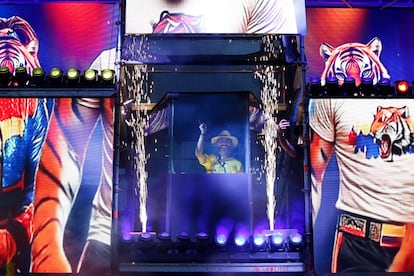
Your digital strategy is woven around the narrative that supports your message. De la Espriela constructed a series of symbols that reinforced his patriotic epic and the slogan that his followers were “defenders of the motherland.” He incorporated the colors of the Colombian flag into his palette and emphasized the salute at the end of his exit on social media, emphasizing the exclamation: “Stand resolutely for your country!” While maintaining its essence for more than a year, we added elements of renewal. He has moved from a “confident tiger” to a populist message that contrasts “usual suspects” with “newcomers.” He ended up with a “miraculous homeland,” an ideal Colombia instilled with ideals of patriotism, a tough stance against criminals, and the upholding of the traditional family.
Cepeda belatedly searched for his own symbol. The equivalent of the military salute, where the index finger and thumb are crossed to form a heart, is borrowed from K-pop fans. Candidates and their supporters repeat it as a sign of loyalty. They also popularized the jaguar as an antidote to the far-right candidate Tiger. The phrase “I’m running for my life!” It aims to summarize our commitment to the environment and human rights. The problem is that these symbols were developed in just a few weeks compared to de la Espriela’s year-long development. Moreover, it was not a campaign-planned strategy, but one that emerged spontaneously among his grassroots supporters. Depending on who is doing the evaluation, this can be an advantage or a disadvantage. Left-wing candidates showed pride in it. “In some way, Iván Cepeda wanted this to happen: for the people themselves to run the campaign. […] Thousands of us are contributing original ideas!!” reads a widely shared post about X.
register to our weekly newsletter Get more news coverage in English from EL PAÍS USA Edition


