
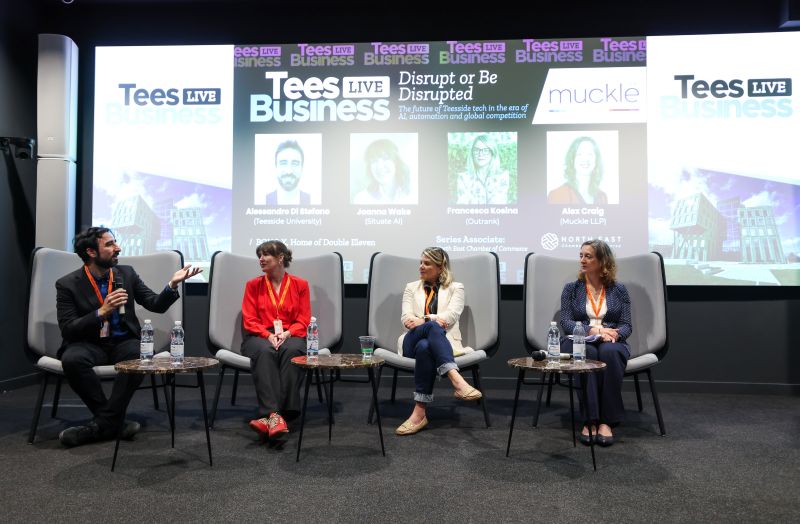
Companies are not yet fully prepared for the scale of change that artificial intelligence will bring, but those willing to adapt and develop new skills are best placed to succeed. This was one of the key messages from the latest Tees Business LIVE event.
Experts from academia, technology, digital marketing, and law came together to discuss the future of business in an AI-driven world.
The event, held in partnership with Muckle LLP, explored the theme ‘to disrupt or be disrupted’, with panelists considering both the opportunities and challenges posed by rapidly evolving AI technologies.
The preparedness discussion (full video below) was led by Alessandro Di Stefano, Associate Professor of Artificial Intelligence at Teesside University, who believes organizations are struggling to keep up with the speed of change.
He suggested that instead of asking whether AI will replace jobs, companies should consider how humans and AI can work together.
“As Aristotle said in the Metaphysics, the sum is more than the parts,” he said. “It’s not just a matter of having a task and delegating that task to an AI agent.
“It’s important to put things together and look at the whole process.”
Although AI is advancing at an unprecedented rate, Alessandro believes the solution is not to resist it, but to adapt thoughtfully and strategically.
“It’s important to adapt,” he said. “If you want to embed AI, that’s fine. You can start small and then grow.
“But we need to do it properly, adapting to current processes, and that will make a difference.”
Joanna Wake, founder of new AI training business Situate AI and UK ambassador for She AI, agreed that education and skills development is key for businesses to get the most out of AI.
Joanna said many companies have only scratched the surface of the possibilities when it comes to the work of training organizations to use tools like Claude and Copilot.

“I think skills improve over time,” she said. “Models are evolving very rapidly, and because we’re doing it using humans’ own language, the barriers are relatively low compared to previous technological advances.”
Joanna highlighted how AI can lower the barrier to entry for entrepreneurs and small businesses that have traditionally not had access to expensive technology or expert support.
Reflecting on her experience setting up her business more than a decade ago, she said technology that once cost thousands of pounds was now available at a fraction of the cost.
“The barriers are a little lower for people,” she said. “I think the bigger the business gets, the more people evolve. The key is to use AI in the right places.”
But she cautioned organizations against allowing technology to create divisions among employees.
“My advice is to make your staff feel comfortable,” says Joanna.
“Focus on what you can do with your existing tools. Focus on what your own people can decide because they are the best people to make decisions.
“Our biggest asset right now is our staff. They are irreplaceable. AI is not loyal.”

For Francesca Kosina, Director of Operations at Outrank, one of the most important changes is already happening in the world of search and digital marketing.
Francesca explained that AI-powered search tools are fundamentally changing the way customers discover businesses online.
“AI has completely changed search engine marketing,” she said. “Over the past 18 months, we no longer search the way we used to.”
This change brings both opportunities and challenges.
While AI-powered search is helping some organizations reach new audiences, it is also reducing website traffic as consumers increasingly receive answers directly from search engines rather than clicking through to websites.
“People just stay in the Google overview,” Francesca says. “And don’t follow people’s websites all the way through.”
As a result, businesses need to think differently about how they build online visibility and engagement.
Alex Craig, head of commercial and principal at event partner Mackle LLP, said organizations should avoid making technology decisions based solely on hype.
Instead, she urged business leaders to take a long-term view.
“It actually requires a little bit of technology planning,” Alex said. “You have to think: Where will this organization be in five years? What will success look like?”
Alex believes that companies should focus on identifying areas where AI can eliminate repetitive tasks and inefficiencies, allowing employees to focus on higher-value work.
“There are a lot of things you can do to speed things up,” she said. “Think about it and think about where you want to get to and what really sets you apart.”
*For more information on Tees Business LIVE in June, please visit:
Embrace, not replace – why people remain our most valuable asset
Tees Business LIVE – Image Gallery


