
Bangkok — As Southeast Asia’s agriculture sector faces climate uncertainty, labor shortages, and increasing pressure to increase productivity, a new generation of developers is turning to artificial intelligence (AI) for answers.
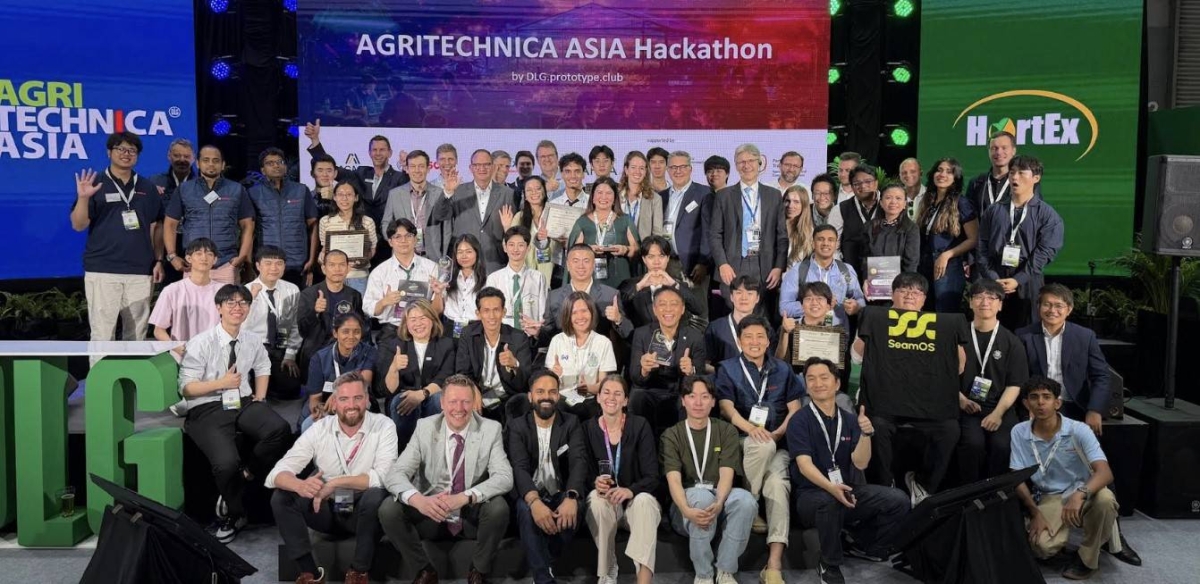
That trend was on full display at the Agritechnica Asia Hackathon held during the 2026 Agrinovate Southeast Asia Summit, where 47 participants from seven countries spent a day building AI-powered solutions designed to address real-world agricultural challenges.
The event brought together students, engineers, programmers, and aspiring entrepreneurs from the Philippines, Myanmar, Indonesia, South Korea, Thailand, Timor-Leste, and Vietnam to develop technology that helps farmers make better decisions, improve operational efficiency, and maximize the value of agricultural data.

Young innovators Students from Southeast Asia developed AI-powered agricultural solutions at the AgriTechnica Asia Hackathon in Bangkok, demonstrating how emerging technologies can help farmers improve productivity, efficiency and resilience. search photos
Unlike many technology competitions that focus on conceptual AI applications, participants were tasked with working with data from real farm machinery and solving practical problems related to farm equipment, connectivity limitations, and precision agriculture.
The resulting project highlighted how AI is moving from labs and corporate offices to one of the world’s oldest industries.
Four teams were recognized for developing solutions with strong potential to improve agricultural management.
Team BiCPAL from South Korea won the “Master of Plowing” category, while Team The Plot Twist, made up of participants from Thailand, Myanmar and Vietnam, won the “Smart Farmer Monitoring” challenge. Team Chicken Wings from Thailand won the “Surprise Box” category and Team BPD won the “Where is my machine?” category. Challenge.
Although each team was working on a different problem, the projects shared a common goal. It’s about transforming data generated by agricultural machinery into actionable insights that help farmers increase productivity while reducing costs and inefficiencies.
The competition reflects the broader changes taking place across global agriculture, as advances in artificial intelligence, machine learning, sensors and connected equipment make farms increasingly data-driven.
Modern agricultural machinery can generate vast amounts of information about field conditions, equipment performance, and operational efficiency. AI systems can analyze this data in real-time, allowing farmers to optimize cropping schedules, monitor equipment health, improve resource utilization, and identify problems before they become costly failures.
For many developing countries in Southeast Asia, such technologies could help address persistent challenges such as labor shortages, rising input costs, and climate-related disruption.
“What made this hackathon truly special was that it brought together international perspectives, innovative thinking, and strong partners within a collaborative ecosystem,” said Prototype Club CEO Christian Schweitzer.
Participants were encouraged to go beyond simple demonstrations and develop solutions that work realistically in agricultural environments, where internet connectivity, technical expertise, and budget are often limited.
A focus on practicality is one of the reasons why the Southeast Asia Regional Agricultural Research Center (Searca) created the Agrinovate Farmer-First Award, which recognizes technologies that are designed around the needs of farmers, rather than for the sake of the technology itself.
“The Farmer First Award reflects Searca’s commitment to ensuring innovation is grounded in the realities and needs of the farming community,” said Emil John Cabrera, program director for growth innovation at Searca.
The event was co-organized by Searca, DLG.prototype.club, Bosch and Nevonex and supported by the German Federal Ministry for Economic Cooperation and Development through the “Partners in Transformation Program”.
According to Gernot Hofmann, head of technology at Nevonex powered by Bosch, these projects have demonstrated how modern digital platforms can create new applications for agricultural equipment while simplifying farmers’ operations.
Beyond recognition, winning teams will gain access to incubation, mentoring and innovation support programs designed to propel promising concepts toward real-world implementation.
The technology on display in Bangkok may still be in its infancy, but it signals an even bigger transformation underway across agriculture. As AI becomes more accessible and connected farm equipment becomes more common, future breakthroughs are likely to come not just from established technology companies, but from young innovators developing solutions for the sector where food is grown.


