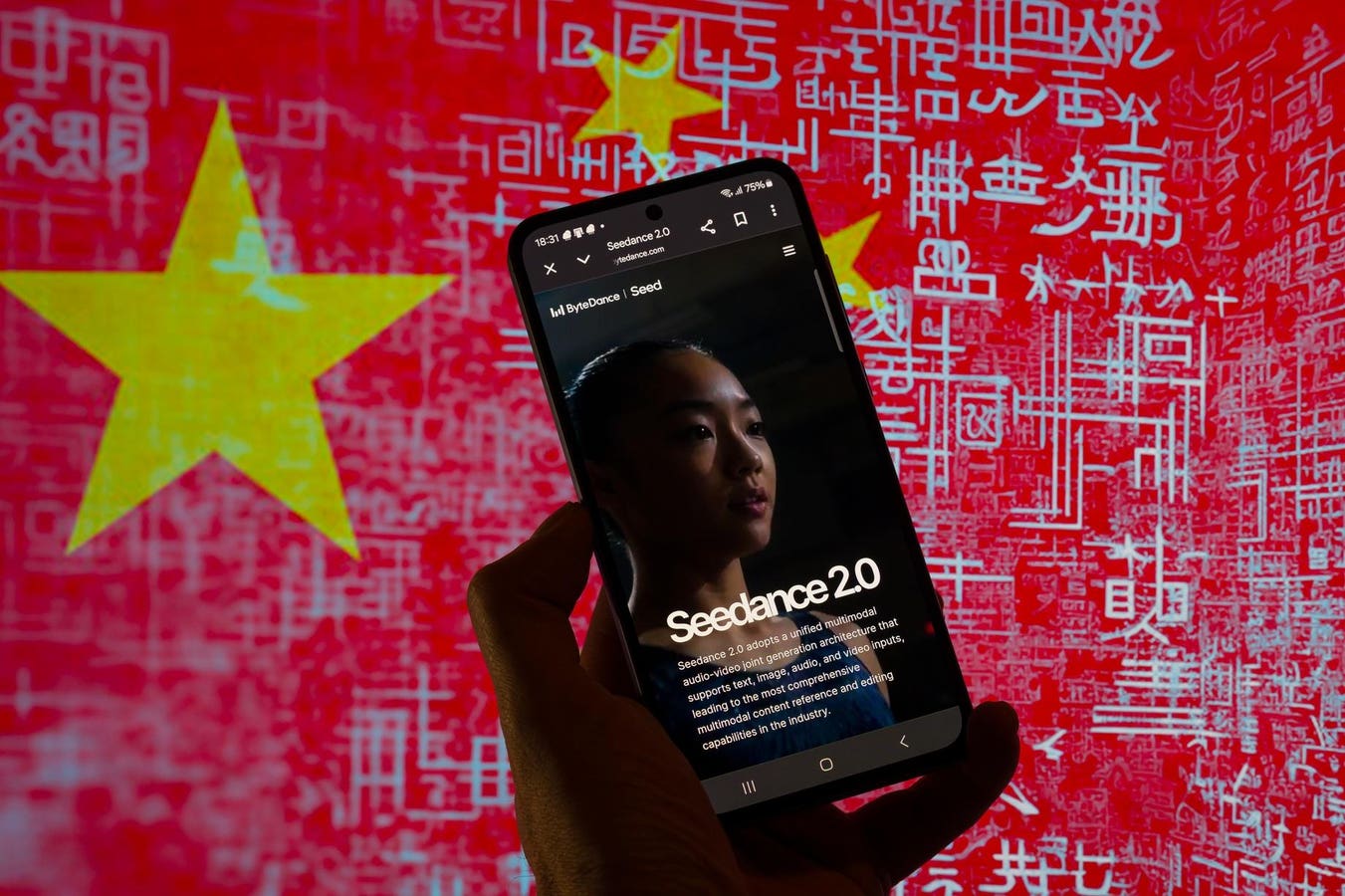

Bytedance’s Seedance 2.0 is the leading AI video generation model.
NurPhoto (from Getty Images)
It’s been a while since OpenAI shut down one of my favorite apps, Sora, apparently because the economic situation was simply unsustainable. Sora reportedly costs an estimated $15 million per day to operate, with lifetime revenue of just $2.1 million.
Injected into that void are five Chinese integrated video AI stacks that are more capable, cheaper, and commercially available than the one OpenAI shipped. They are ByteDance’s Seedance, Alibaba’s Wan and Happy Horse, Kuaishou’s Kling, MiniMax’s Hailuo AI, and Tencent’s Hunyuan. Together, they are driving an industrial-scale AI-generated content economy, with 470 AI microdramas now produced every day.
How these Chinese labs won the video AI race is more than just good engineering, although the engineering is truly remarkable. This is a story of structural advantages such as data scale, vertical integration, government support, aggressive pricing, and a domestic market that has become the most demanding audience in the world.
Here are five forces that explain why Silicon Valley is losing its lead on one of the most commercially important AI capabilities in 2026.
1. Datamote: Train anything, unconstrained
The most important competitive advantage these Chinese video AI labs have is their training data. The amount, variety, and quality of labeling of the video footage used to train the models is vast, and they operate under a very different legal regime than their US counterparts.
In the United States, AI laboratories constantly face intellectual property lawsuits. Getty Images sued Stability AI. The New York Times sued OpenAI. Disney and Universal sued Midjourney. The practical result is that many American laboratories have become far more risk-averse about the data they use for training.
ByteDance’s Seedance, by contrast, can leverage the vast video corpus of Douyin, the Chinese version of TikTok, which generates billions of clips every month. Kling benefits from Kuaishou, another huge short video platform. The same theory applies to what YouTube is to Google.
2. Vertical integration: The lab is the platform and the studio is the studio
Runway ML is a great video AI company, but at its core it’s still a tools company built for creators and Hollywood studios.
ByteDance, Kuaishou, and Tencent are more than just tool companies. These are vertically integrated entertainment platforms that also allow you to build models. ByteDance built Seedance to power Douyin’s creator economy and Red Fruit microdrama platform. Kuaishou built Kling to support their short-form drama studio. The content produced by these models is immediately deployed at scale across your own apps.
It also means that the business model is fundamentally different. It is not centered around subscription fees from individual creators. This is driven by advertising, paid drama subscriptions, and virtual goods sold within its own apps to billions of users. For Western AI labs, it is unimaginable to treat inference costs as marketing expenses. Marketing spend drives content creation on your app and drives advertising revenue.
That video AI flywheel doesn’t exist in the West and is very difficult to replicate.
3. Microdrama is the first to use video AI on an industrial scale
Microdramas are the first true mass-market use case for AI-generated video, watched by hundreds of millions of Chinese users, with a new AI short drama created approximately every 90 seconds. Yes, 90 seconds is not a typo.
A microdrama is a series of short videos designed for vertical mobile viewing, typically 60 to 90 seconds per episode and 80 to 100 episodes per series. The genre emerged around 2020, and by 2023 it was already generating more revenue in China than the domestic theatrical box office. By 2025, deadline The market reported annual revenue of $9.4 billion in China alone.
Owl & Company predicts that the global vertical video economy will generate $150 billion in revenue in 2026 (excluding China), and AI will further change the economic landscape. Before the advent of AI video, an 80-episode microdrama typically cost 1.4 million to 2 million yuan, or about $200,000 to $280,000, and took three to four months to produce with a staff of 20 to 40 people. With tools like Seedance 2.0, you can now create a comparable series in less than a month for 50,000 to 100,000 yuan, or approximately $7,000 to $14,000. In some cases, independent creators with scripts and AI tools can produce competitive series.
This is important because Chinese consumers have already proven they are willing to pay for mobile soap operas. ByteDance did not test video AI in the lab. It had already deployed it in a market worth hundreds of billions of yuan.
Western video AI labs do not have comparable testing grounds. In the West, sophisticated media buyers tend to move slowly, negotiate carefully, and represent relatively few large contracts. ByteDance, by contrast, can sell into an ecosystem of hundreds of thousands of microdrama studios serving hundreds of millions of viewers every day.
4. Supporting video AI is government industrial policy
Local governments in Shenzhen and Shanghai have identified AI-generated microdramas as part of a broader industrial strategy to dominate the multibillion-dollar digital entertainment market, offering state subsidies of up to 2 million yuan (about $275,000) to individual productions.
China’s National Development and Reform Commission has also included video generation infrastructure in its AI industrial infrastructure financing program.
Runway’s investors include General Atlantic, Google, Nvidia, and Salesforce. In contrast, China’s leading video AI labs are backed by government and state-linked capital with a level of patience and duration that most venture funds can match.
5. Open source franking strategy
Meta pioneered open-weight, large-scale language models using Llama as a strategic counterweight to OpenAI and Google. Alibaba appears to be making a similar play in a video.
Alibaba’s Wan 2.7 is open weight and its model parameters are publicly available. It’s a deliberate strategy. By openly releasing capable models, Chinese labs can accelerate global developer adoption and position their architectures as the default reference point for the next generation of fine-tuned models. It also builds friendships with the creator community and puts pressure on the revenue models of private Western competitors that rely on charging for API access.
liquidation
Sora was ultimately doomed by America’s deeper structural problems. If the only revenue model is subscriptions from individual creators, large-scale video generation becomes a loss-making business. You only become a true profit center if you also own a platform to monetize your content. OpenAI tried that and failed miserably.
In contrast, ByteDance owns the Red Fruit-style distribution channels of Douyin, TikTok, and RedNote. Google may pursue a similar strategy, although it remains subject to much tighter oversight of U.S. intellectual property.
The result is a world of dual content. Chinese research institutes are capturing the mass market creator economy and microdrama segments through price and vertical integration. Google and Runway are positioned to win in the corporate, agency, and Hollywood spaces where compliance, provenance, and creative control are more important. As with much of today’s U.S.-China technology competition, two markets, two technology stacks, and two very different incentive systems are now precariously coexisting.