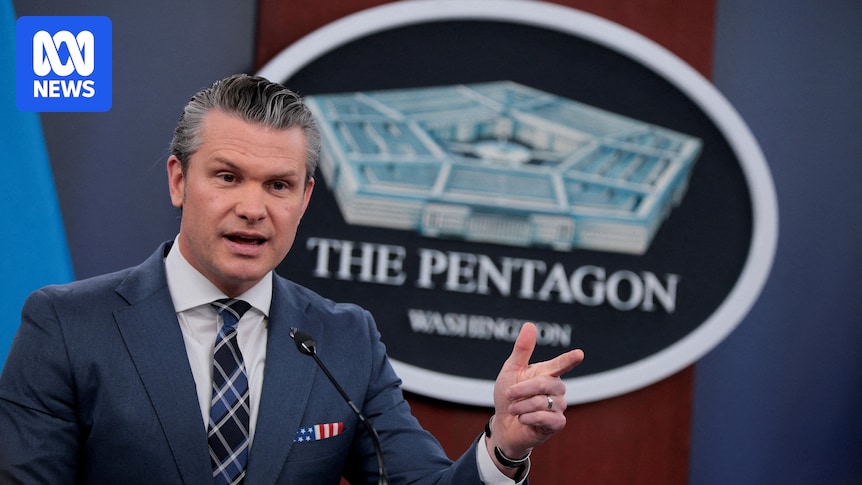
The White House announced it will accelerate the development and use of artificial intelligence for national security applications.
The news comes as major AI companies warn of the increasing risk of “humans losing control of AI systems.”
The Trump administration announced the plan while stressing that the technology should not be used to conduct illegal surveillance.
Earlier, it asked major AI developers to voluntarily submit their most capable models to government cybersecurity tests before making them available to the public.
“Under my Administration, the United States can and will responsibly accelerate the use of AI across the intelligence and warfighting domains, consistent with American values,” President Donald Trump said in the National Security Memorandum.
Trump said Defense Secretary Pete Hegseth has 90 days to update existing directives on autonomy for weapons systems “to ensure intentional deployment of AI systems that respect the chain of command.”
The US president added that national security companies should not develop or use AI technology “to censor free speech or conduct unauthorized or illegal surveillance activities.”
AI is increasingly developing other AI systems, Anthropic warns
The Trump administration’s AI plan comes as Anthropic warns that companies are increasingly delegating AI development to other AI systems.
The company said in a blog post that if this trend progresses sufficiently, it could lead to “AI systems that can design and develop their own successor systems fully autonomously.”
This post raises the latest warning from Anthropic, where Anthropic co-founder Christopher Olah recently praised Pope Leo for releasing an encyclical on the rise of AI.
As of May 2026, more than 80 percent of the code merged into Anthropic’s coding system was created by the company’s chatbot, Claude.
He also said that research suggests that by 2027, Claude will be able to perform tasks that would take a human several weeks.
“These trends have major implications. AI that can be built automatically would be a major advance in the history of technology, with the potential to bring enormous benefits to the world in science, medicine, and other fields,” the magazine writes.
“However, fully recursive self-improvement may also increase the risk that humans will lose control of AI systems.
”When a system is fully capable of building its own successors, how you secure it, monitor it, and shape its behavior all become more important.”
This blog post comes after a conflict between Anthropic and the Department of Defense.
The Department of Defense issued a formal supply chain risk designation to Anthropic in March after Claude refused to lift its ban on being used for autonomous weapons or U.S. mass surveillance.
The Pentagon said it should be able to use the technology if necessary, as long as it complies with U.S. law.
Anthropic further stated in the post that although Claude’s code had improved, many of its staff believed that “the quality of the code Claude wrote at Anthropic in late 2025 is still inferior to code written by humans.”
That situation could soon change, the report suggested globally, “options to slow or temporarily halt the development of frontier AI to allow social structure and coordination research to catch up with technological advances.”
He said he would work with other institutes to build systems to tolerate this slowdown.
“A meaningful slowdown or shutdown would require multiple well-resourced laboratories located at or near the frontier in multiple countries to agree to halt under the same conditions,” the authors write.
“Each will also need to be able to confirm that the other has actually stopped.”
A “meaningful slowdown” requires multiple labs to agree on the idea. (Reuters: Dado Lubitsch)
He noted the difficulty of this approach, given that AI is “much easier to hide than missile silos.”
“None of this is necessarily impossible in principle; the world has built verification regimes for other complex technologies (such as the Intermediate-Range Nuclear Forces Treaty), but those regimes have taken decades to build both the infrastructure and trust,” the blog post concluded.
“We don’t have that long.
“In contrast, a unilateral suspension by one lab would be immediately achievable, but it would accomplish much less. It would change who the front-runners are, but it would not create the broad deliberative process that is currently missing.”
Reuters/ABC