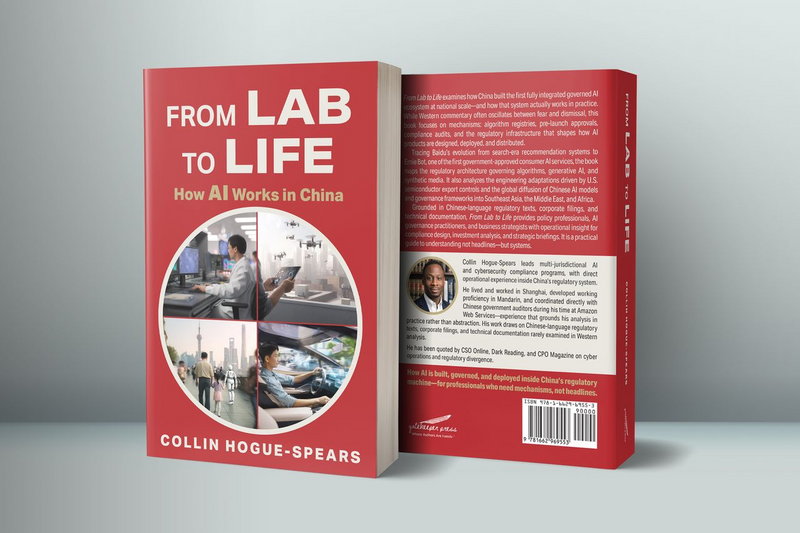
From Lab to Life launches a new book examining how China’s AI systems move from development to deployment through institutional processes that shape compliance, procurement, and global market access and distribution outcomes.
— From Lab to Life announces its next release. From the lab to life: How AI works in China By author and independent researcher Colin Hogue Spears. Scheduled for publication on Tuesday, August 4, 2026, the book examines how China’s artificial intelligence moves from model development to market deployment through a system shaped by regulatory filings, pre-launch approvals, compliance audits, and government procurement. This release presents a framework for readers seeking to understand how governance functions as a market infrastructure in China’s AI sector.

A book centered around market dynamics
From the lab to life: How AI works in China is centered around a central claim that differs from the general Western discussion of AI in China. Rather than treating the subject primarily as a question of strategic rivalry or benchmark performance, this book focuses on the institutional processes that determine which products to launch and which companies gain distribution. In this account, functionality, compliance, and distribution work together rather than as separate layers.
The book is based on Chinese-language regulatory documents, company filings, peer-reviewed technical papers, official statistics, and research from institutions on both coasts of the Pacific. Track the evolution of China’s AI ecosystem, from Baidu’s early machine learning efforts to new systems such as Ernie Bot, DeepSeek, and other leading AI models. Openweight models are AI models that are released with downloadable parameters that allow outside organizations to run, adapt, or evaluate them more directly than closed commercial systems.
According to the publisher’s materials, the target audience includes policy experts, AI governance practitioners, and business strategists who need an operational understanding of how AI systems are actually built, reviewed, approved, and distributed. The book also includes an end-chapter “Strategic Lens” section designed as an explanatory tool for readers evaluating market structure and launch conditions.
Direct experience behind the analysis
The author’s professional background is a noteworthy part of this release. Mr. Hogue Spears studied Chinese at Shanghai University of International Studies and later worked in Shanghai as a senior business analyst at Merkle. At Amazon Web Services, he was a senior manager and coordinated with Chinese government auditors on MLPS cloud compliance. MLPS (Multi-Level Protection Scheme) is China’s mandatory cybersecurity classification system used to evaluate and manage information systems according to security requirements.
“We have coordinated with Chinese government auditors regarding cloud compliance,” Hogue Spears said. This book takes what that research taught me and applies it to AI. ”
That experience is presented as a practical basis for this book’s analysis of how Chinese authorities qualify technologies before they are brought to market. Hogue Spears currently leads federal compliance and product strategy for an enterprise application security company. His work spans U.S. federal licensing programs and European regulatory frameworks such as DORA, the Digital Operational Resilience Act, and the EU AI Act.
Hogue Spears said:
“Competence without compliance cannot ship. Compliance without capability cannot compete.”
He also said:
“Western analysts are considering Chinese models and benchmarks. The system is running on applications, approvals and procurements.”
Beyond the familiar AI story

A key differentiating factor highlighted in the announcement is that the book rejects the common “AI race” framework. The release states: From the lab to life: How AI works in China is designed to move beyond the who-is-first debate and map the mechanisms that shape product launches and adoption. The mechanism includes algorithm registries, approval gates, audits, and procurement systems, and is operated across the China Cyberspace Administration, Ministry of Industry and Information Technology, Ministry of Public Security, and State Administration of Market Regulation, and determines whether a model becomes a widely distributed product.
The release argues that this is a layer that many outside observers overlook when evaluating China’s AI. Rather than presenting governance as an external constraint on innovation, this paper describes regulation as part of an industry’s operating structure. In this formulation, governance is not external to the market. It helps structure the market itself. A highly regulated ecosystem still produces a model that follows America’s borders in months rather than years, a gap that “repression theory” alone struggles to fully explain.
Hogue Spears said:
“China didn’t build governance into the AI sector; it built the sector into governance.”
The announcement also notes that the book uses reproducible source material rather than anecdotal access. The publisher’s materials describe the research base as based on primary documents and archives, offering readers an avenue for research rather than a closed insider account.
Global issues beyond China’s borders
This announcement also places the book in a broader international context. The report notes that Chinese models and infrastructure bundles are expanding into Southeast Asia, the Middle East, and Africa. Infrastructure bundles in this context refer to packages containing cloud services, models, deployment tools, and related technology systems that are delivered together for adoption in other markets.
While these packages can be easily exported, the governance system supporting them in China does not transfer easily, raising questions about the rules and standards built into the packages.
Hogue Spears said:
“Infrastructure bundles and price advantages are easily exported. Governance that enables work from home does not cross borders.”
He added:
“The most important export is not the models or the hardware. It’s the rules.”
The release says this theme is particularly relevant to readers who track standards bodies, government procurement patterns, and intergovernmental forums where technical and governance templates can spread over time.
Tools for research, publishing, and leadership
The book includes a field reference library with practical tools described as a governance map of the regulatory stack, an Open-Weights Evaluator for company valuation of models such as Qwen, DeepSeek, GLM, and Kim, and a 15-year view timeline covering developments from 2010 to 2025.
The author’s recent publication record is also listed in the release. Hogue Spears is described as an independent researcher and author with 20 years of experience in the technology field. Since 2025, his work has appeared in more than 50 articles in 27 publications, including bylines in Compliance Week and Information Week. His analysis has also been cited in media outlets such as The Wall Street Journal, Politico Pro, Observer, and Dark Reading.
From the laboratory to life
Collin Hogue-Spears is an independent researcher and author with 20 years of experience in technology, compliance, and strategic analysis, working operationally with both Chinese and Western regulatory systems. His work focuses on the intersection of artificial intelligence, governance, cybersecurity, compliance, and market structure. Since 2025, his analysis has appeared in more than 50 articles across 27 publications, including Compliance Week and InformationWeek, and has been cited in media outlets including the Wall Street Journal, Politico Pro, the Observer, and Dark Reading.
His forthcoming book, From Lab to Life: How AI Works in China, examines how China’s artificial intelligence systems move from development to deployment, through regulatory reviews, compliance processes, and market distribution mechanisms. For more information, please visit: From the laboratory to life Please send by email admin@collinhoguespears.ai.
Format: Hardcover, Paperback, and Ebook ISBN: 9781662976049 (Hardcover). 9781662969553 (paperback); 9781662969560 (ebook)
Available from: Amazon, Barnes & Noble, Bookshop.org, major e-book retailers, and library platforms. Here is the complete distribution list: Colinhoguespears.ai/press
Contact information:
Name: Colin Hogue Spears
Email: Send email
Organization: From laboratory to daily life
Website: https://collinhoguespears.ai/
Release ID: 89193880
If you identify any errors, concerns, or inconsistencies in the content shared in this press release that need to be addressed, or if you would like assistance with removing a press release, we strongly encourage you to notify us promptly by contacting us at error@releasecontact.com (it is important to note that this email is the authorized channel for such issues, and sending multiple emails to multiple addresses will not necessarily help expedite your request). Our team of experts is committed to addressing your concerns within 8 hours by diligently taking the necessary steps to fix the identified issues or assisting you with the removal process. Providing accurate and reliable information remains our top priority.