
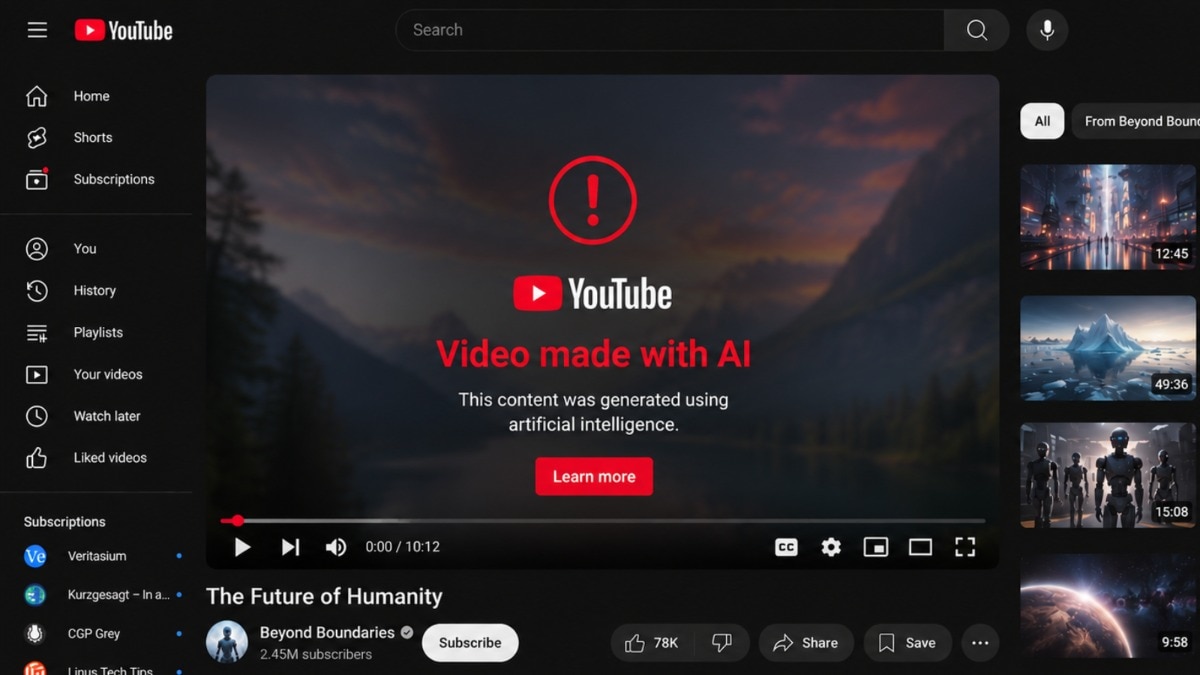
AI-generated videos are increasingly being shared on the internet, especially on platforms like YouTube. Some AI “slop” channels like Bandar Apna Dost are reportedly earning billions of rupees just by posting AI-generated videos. Previously, creators had to disclose that they used AI in their YouTube videos to indicate that they were created using AI. But now YouTube is changing the way it labels such videos.
YouTube has announced that it will now automatically detect AI to make AI disclosure more clear to viewers. But before we get started, keep in mind that the auto-labeling feature only applies to videos that have “heavy photorealistic AI,” meaning videos that look real but are created using AI. As a result, “bad” videos featuring animated characters are not automatically labeled, at least not yet.
YouTube automatically detects AI videos
YouTube said on its website that it is rolling out new internal signals to help identify AI-generated content. YouTube’s systems will automatically apply a label if it detects “significant photorealistic AI use,” even if the creator doesn’t specify whether AI was used.
If your uploaded video is incorrectly identified as being generated by AI, you can update its disclosure status in YouTube Studio.
However, YouTube says that in some cases the disclosure is permanent. These include content created using YouTube’s own AI tools like Veo and Dream Screen, as well as content that includes C2PA metadata to indicate it’s fully generative AI.
The platform also says creators will still need to manually disclose when realistic AI is used. Disclosure labels themselves do not affect how a video is recommended or whether it is eligible for monetization.
More prominent AI labels
YouTube is also changing where labels appear. For long-form videos, the AI label now appears just below the video player and above the description. For short videos, it will appear as an overlay on top of the video.
YouTube said the updated labels target content that is photo-realistic and may mislead viewers. On the other hand, disclosures of unrealistic, animated, or only slightly modified content will continue to appear in the expanded description.
The update comes as YouTube expands other AI-related measures on its platform. Earlier this month, the company said it was expanding its Similarity Detection program to all creators over the age of 18, aimed at helping users detect and control how AI is represented on YouTube.
Creators enrolled in the program can use YouTube’s systems to identify videos that may contain altered or synthetic facial caricatures, and then request removal of unapproved content through YouTube Studio.
– end


