

As AI-generated videos become harder to distinguish from reality, YouTube is taking a more aggressive approach to transparency. The platform announced that it will now automatically label videos containing “significantly photorealistic AI” even if the creator did not publish them themselves.
The move marks a major shift in YouTube’s AI moderation strategy.
Until now, the platform has largely relied on creators to voluntarily disclose when their AI has been used in a way that could mislead viewers. Going forward, YouTube says its proprietary detection system will proactively identify content that is generated or altered by AI and automatically apply labels.
The company also plans to make these labels more prominent on both long-form and short-form videos. Rather than hiding disclosure information in the expanded description, the label will now appear directly below the video player on classic videos and as an overlay on short videos.
The goal is simple. It’s about making sure you don’t miss out on AI-generated content.
YouTube first introduced AI disclosure requirements more than two years ago, asking creators to label content that depicts realistic people, places, and events generated by AI. Clearly fictional or stylized content, such as animated fantasy worlds or surreal edits, will continue to be excluded.
What changes now is enforcement.
With increasingly evolving models that allow us to create highly realistic videos, YouTube no longer wants creators to be the sole gatekeepers of information disclosure. This announcement comes days after Google unveiled Gemini Omni at Google I/O. Gemini Omni is a new family of multimodal AI systems that can generate highly detailed video outputs that are contextualized in physics, culture, science, and history.
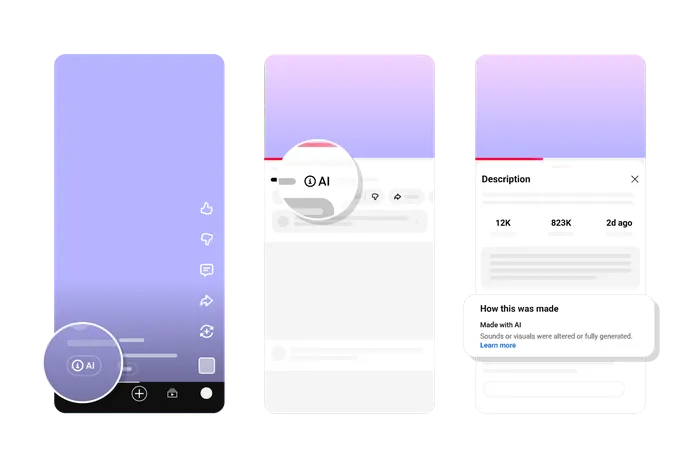
As a practical matter, creators are still expected to manually disclose their use of AI, but YouTube says it will intervene if they don’t.
Also, in some cases, labels can be permanent.
Videos generated using YouTube’s own AI tools like Veo and Dream Screen are automatically given an AI label that the creator can’t remove. The same goes for content that includes C2PA metadata, an industry standard designed to authenticate AI-generated media. OpenAI recently joined the C2PA initiative with companies like Nvidia, Kakao, and Eleven Labs.
This update coincides with an expansion of YouTube’s AI deepfake detection system. After initially testing its detection tools on celebrities, politicians, and public figures, the company is now allowing any adult to scan YouTube and associate AI-generated facial matches with their likeness.
Importantly for creators, YouTube says these labels have no impact on monetization or recommendation algorithms. At least for now, the mere presence of AI-generated content is not punishable.
Culturally, change is important.
For years, platforms have treated AI disclosure as the responsibility of creators. YouTube’s decision shows that AI transparency will become an infrastructure-level policy rather than an honor system.
And as photorealistic AI video becomes increasingly accessible, visible labels could soon become the norm, as do sponsored content disclosures and copyright claims.
The bigger question is no longer whether AI-generated content belongs on the platform. It’s whether viewers can understand what they’re watching without the platform intervening first.


