The Electron-Ion Collider (EIC) records 500,000 collisions per second. At that speed, machine learning classifies, filters, and reconstructs what’s happening inside the detector. Those requirements shaped the design of the entire facility.
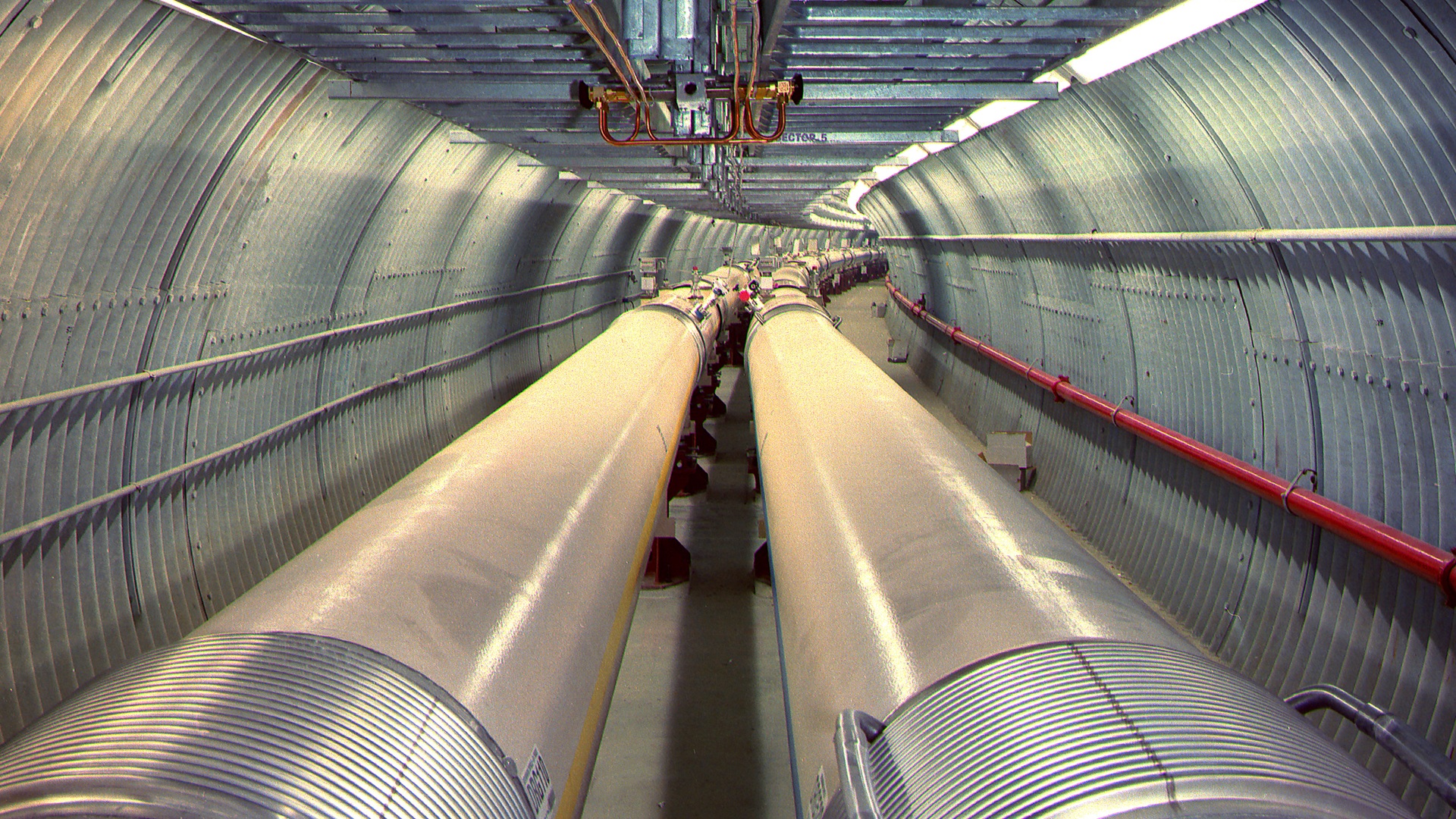
The collider under construction at New York’s Brookhaven National Laboratory is the first of its kind and the first particle collider to integrate AI and machine learning into both the accelerator and detector systems from the start. It is a joint project between Brookhaven and the Department of Energy’s Thomas Jefferson National Accelerator Facility, and more than 300 agencies around the world are collaborating.
Prices range between $1.7 billion and $2.8 billion. Operation is targeted for the mid-2030s.
Teach the accelerator to autotune
Previous particle physics facilities, including Brookhaven’s own Relativistic Heavy Ion Collider, which closed in February 2026, incorporated AI tools several years after construction. At EIC, a multi-institutional group called EIC-BeamAI uses Brookhaven’s live accelerator hardware to develop machine learning systems.
This challenge is significant. Keeping a particle accelerator stable means managing tens of thousands of parameters simultaneously across two beams running in opposite directions around a 2.4-mile ring at near-light speeds.
“It’s very difficult for a human to keep track of all these settings and beam characteristics,” said Georg Hofstetter de Torquat, a professor at Cornell University with a co-appointment with Brookhaven. “With machine learning, what we create is essentially a computer monitor. The system monitors conditions and automatically adjusts controls.”
BeamAI has already proven its concept. In RHIC’s pre-accelerator, machine learning algorithms matched the beam quality typically achieved by a skilled human operator.
The system also produces a digital twin of the accelerator, a real-time virtual model that allows researchers to test changes without touching the actual machine. Identical twins can detect abnormal behavior of the magnet early and trigger a controlled shutdown before anything is damaged.
Rethink detector design
Building a particle detector means running countless simulations before manufacturing a single component, testing its shape, materials, and configuration against countless impact scenarios. A DOE-backed project called AID2E, which spans Brookhaven, The Catholic University of America, Duke University, Jefferson Institute, and William & Mary, is applying machine learning to the process.
Algorithms trained to predict how design changes will affect particle identification allow researchers to run far more configurations with lower computing costs and energy usage than standard simulation workflows allow.
data problem
When the EIC comes online, its detectors (home-sized devices called ePICs) generate up to 100 gigabits of data per second. The AI-powered system classifies that stream in real time, separating the signal from the noise when a collision occurs. Deep learning models reconstruct what happened at each event. It converts the faint traces left by particles in the detector into usable measurements of energy and momentum.
Related Brookhaven projects published in the journal patterndemonstrated an algorithm that can compress collision data at scale without losing the granularity required for physics analysis, built and tested on RHIC hardware.
“The goal is to ensure that when the EIC becomes operational in the mid-2030s, we will have AI-enabled systems in place to accelerate the path to discovery,” said Abhay Deshpande, associate director of Brookhaven’s Institute for Nuclear and Particle Physics and EIC scientific director.