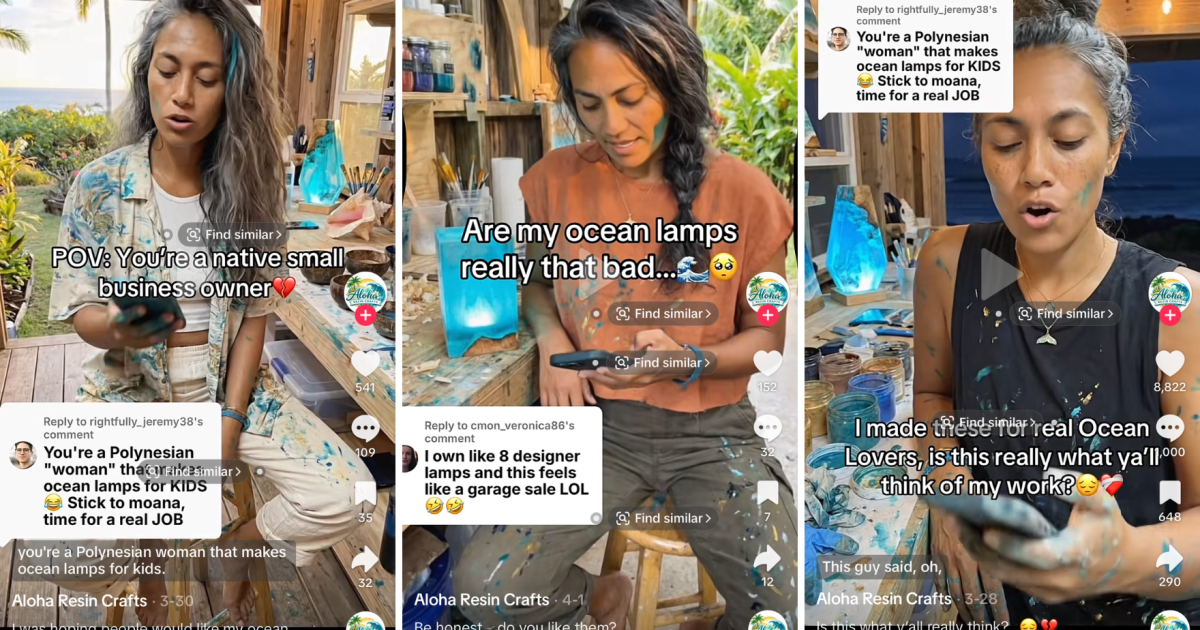
A woman with wavy hair and brown eyes creates resin artwork by reading TikTok comments from her phone. Sad music is playing in the background.
“Oh, are you a Polynesian woman making ocean lamps for kids? Stick around Moana. Time for some real work,” she reads.
Her followers leave supportive comments defending her work. “Let’s keep designing lamps! Let’s send aloha!” reads one. Others ask where they can buy her products.
But experts told HPR that the woman was not real. In reality, she may be an avatar created using artificial intelligence to look like a Pacific Islander. The website linked to her account’s profile includes a disclaimer: “Promotional content may use fictional storytelling.”
Artificial intelligence is being used to promote fake small businesses online, a trend that is causing concern among Hawaiian artists.
“There’s a trend of AI videos: fake, handmade artists creating products to sell online. They pretend to be artists you want to empathize with and support,” says Jeremy Carrasco, a national journalist who covers AI-generated media.
He estimated there could be tens of thousands of accounts purporting to depict Pacific Island women. Carrasco said scammers are using AI-generated sympathetic avatars to pose as small businesses and sell their products.
Daniel Kawila Mahi is a Native Hawaiian artist specializing in printmaking. He said a growing number of non-Native creators are using AI to sell fantasy versions of Pacific cultural practices.
“No one is really paying attention to what pedigree this issue comes from,” he said. “They are not giving mana to the people being represented, to the ancestors who developed these crafts and had these visuals, and even to the practitioners who are actively doing many of the arts that AI is trying to replicate.”
Other AI video accounts pose as black women making lobster bags and goth girls selling Godzilla lamps. The pattern known as “digital blackface” has flourished in the age of AI. The term typically refers to non-Black creators who claim a Black identity. In the case of AI-generated avatars of Pacific Islanders peddling resin lamps, Carrasco said the term could be applied more broadly to the appropriation of cultural identity.
“In this case, it seems like they’re creating a caricature of Hawaiians and what they do and what they sell, which obviously is offensive to many people who have that identity,” he added.
Mahi said it’s hard enough for local artists to make a living. And now they have to compete with AI slop.
“When you have an AI slop or a viral AI video that appropriates our own practices and styles, it deprives us of the same opportunities and opportunities that other people coming up may be trying to find. It facilitates appropriation in a way that didn’t necessarily exist before,” he said.
TikTok requires users to label all AI-generated content, including realistic images, audio, and video. However, some videos purporting to show Pacific Island women selling resin lamps are not labeled as containing AI-generated content. Carrasco said individuals need to increase their AI literacy to avoid falling for scams.
“I think it’s really helpful to know the trends. So in this case, it’s understanding that there’s a sad AI character like this sob story, oh, can you buy my handmade product? This kind of manipulative marketing requires people to have some level of media literacy,” he said.
Hawaii Public Radio exists to serve all of Hawaii, and the people of Hawaii keep us independent and strong. Please donate now. Mahalo, thank you for your support.