Video conferencing market overview
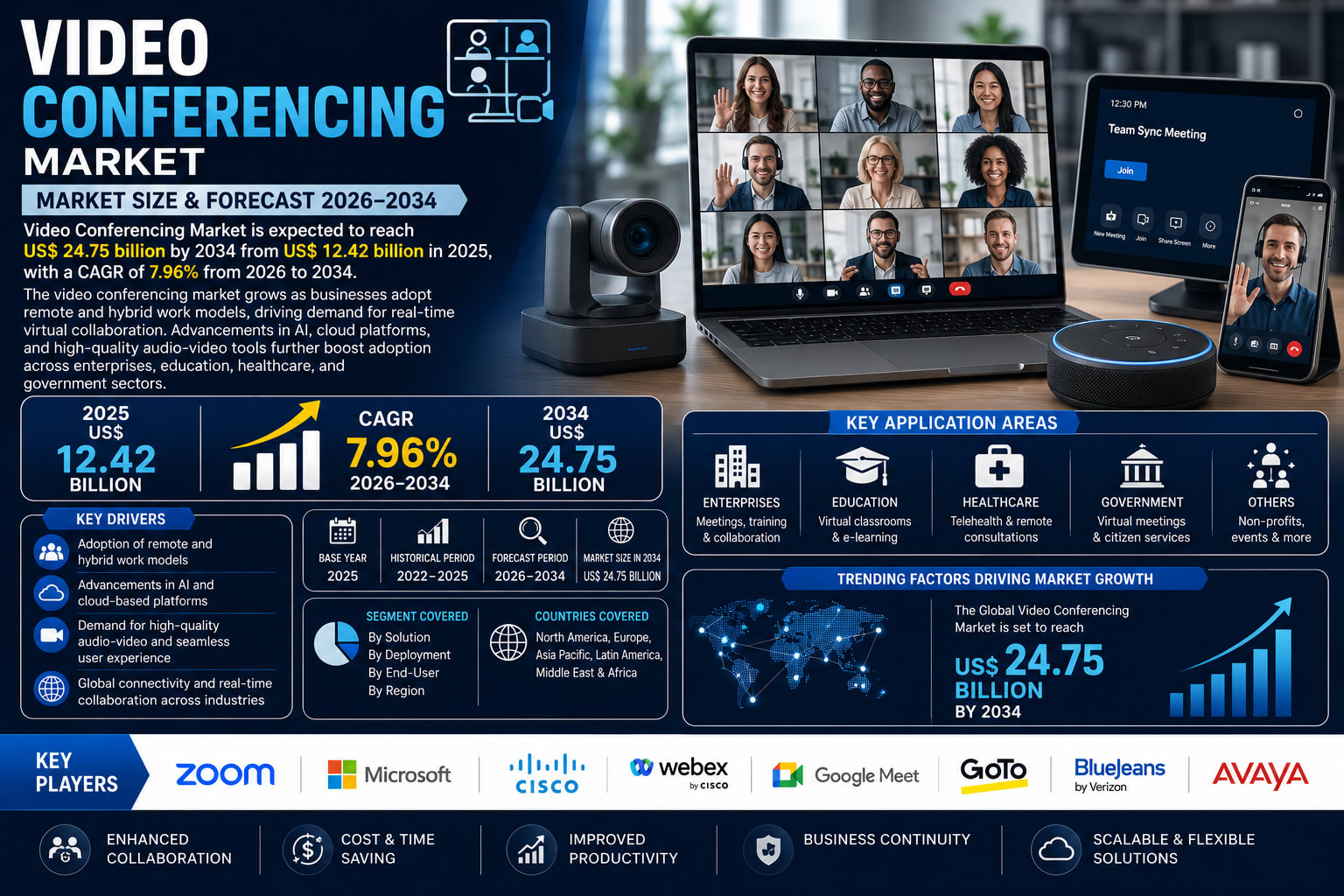
The global video conferencing market is evolving into a cornerstone of modern communication with the proliferation of hybrid work models and digital collaboration tools. What started as a convenience for remote meetings has now become a critical infrastructure for businesses, education systems, healthcare providers, and government agencies. According to Renub Research, the market is expected to grow from wave to wave. USD 12.42 billion in 2025 and USD 24.75 billion by 2034, reflecting a CAGR of 7.96% from 2026 to 2034.
Video conferencing technology enables real-time audio and video communication over the Internet, allowing users to collaborate regardless of their location. Core components include cameras, microphones, software platforms, and connectivity systems. Modern platforms offer advanced features such as screen sharing, virtual whiteboarding, AI-based enhancements, and seamless integration with productivity tools. These features make video conferencing essential in today’s digital-first environment.
Download free sample report
Video conferencing market growth drivers
One of the key drivers of market growth is the increasing adoption of hybrid and remote work models. Organizations now need flexible communication tools that support distributed teams, real-time collaboration, and secure content sharing. Video conferencing platforms provide a scalable solution to meet these needs while reducing travel costs and increasing productivity.
Artificial intelligence is playing a transformative role in improving the video conferencing experience. In October 2024, Adobe introduced video capabilities to the Firefly generated AI family, highlighting the growing importance of AI-driven visual tools. These technologies enable real-time enhancements such as noise suppression, automatic framing, lighting adjustments, and transcription, making virtual meetings more professional and efficient.
Cloud-based platforms are also accelerating adoption. In September 2024, GoTo launched GoTo Connect CX, an AI-enabled customer experience platform that unifies communications, automation, and analytics. This reflects a broader trend toward unified communications ecosystems that combine video conferencing with messaging, voice, and customer engagement tools.
AI and intelligent hardware to drive innovation
Advances in hardware are further shaping the market. In September 2024, HP introduced an AI-powered video conferencing solution designed to improve the quality and productivity of communications. These innovations include smart cameras, noise-cancelling microphones, and AI-powered processing to improve the user experience during virtual meetings.
AI-powered devices can automatically adjust video frames, detect gestures, and provide real-time translation to create a more immersive and inclusive communication environment. These features reduce meeting fatigue and increase engagement, especially for large or global teams. The overall quality of video conferencing continues to improve as organizations invest in smarter hardware.
Video conferencing market challenges
Despite strong growth, the market faces several challenges. One of the most important is connection limits. High-quality video conferencing requires a stable internet connection, which isn’t always available in rural or emerging areas. Issues such as lag, dropped calls, and poor audio quality can impact user experience and productivity.
Security and privacy issues are also major challenges. Video conferencing platforms handle sensitive data and are therefore potential targets for cyberattacks. Risks include unauthorized access, data breaches, meeting interruptions, and more. Organizations must implement strong security measures such as encryption, authentication, and compliance with global regulations to ensure secure communications.
US video conferencing market
The United States is one of the leading markets for video conferencing, supported by advanced digital infrastructure, high enterprise adoption rates, and strong investment in cloud technology. Businesses across a variety of sectors rely on video conferencing for remote work, customer engagement, and collaboration.
Leading U.S. technology providers offer advanced capabilities such as AI-powered transcription, analytics, and integration with enterprise software. Despite challenges related to cybersecurity and data privacy, the country’s strong innovation ecosystem continues to drive market growth.
German video conferencing market
The German video conferencing market is influenced by the focus on digital transformation and Industry 4.0. Companies in sectors such as manufacturing, automotive, and public services are deploying secure and compliant communication tools to support remote operations.
Strict data protection regulations, including GDPR compliance, play a key role in shaping the market. While these regulations may slow adoption, they also ensure a high level of security and trust in video conferencing platforms.
China’s video conferencing market
China is one of the fastest growing markets for video conferencing due to rapid digitalization and strong government support. This technology is widely used in education, healthcare, e-commerce, and public services.
Advances in 5G and AI technology are further accelerating adoption. Features such as real-time translation, voice recognition, and smart meeting controls are becoming standard on many platforms. Despite challenges related to regulation and platform fragmentation, China continues to be a major growth driver for the global market.
Saudi Arabia Video Conferencing Market
Saudi Arabia’s video conferencing market is rapidly expanding as part of the Vision 2030 digital transformation initiative. Government agencies, educational institutions, and businesses are increasingly deploying virtual communication tools to support remote operations and service delivery.
Investments in infrastructure, smart cities, and digital services are driving demand for reliable and secure video conferencing platforms. Although challenges remain such as connectivity gaps and cybersecurity risks, the market outlook is solid.
Recent trends in the video conferencing market
Innovation continues to shape the market landscape. In April 2025, Avaya LLC launched the Avaya Infinity platform, designed to unify customer experiences and integrate AI-driven communication tools.
In April 2024, Adobe introduced Frame.io V4 to power creative collaboration workflows. Zoom also launched Zoom Workplace, an AI-powered platform aimed at improving productivity and team collaboration.
Other developments include partnerships and product launches with Zerify, RingCentral, Qualcomm, and Cordoniq. All of these are aimed at improving the security, performance, and user experience of video conferencing solutions.
Market segmentation
The video conferencing market is segmented by component, conference type, deployment model, enterprise size, application, and end use. Components include hardware, software, and services, and deployment models are divided into on-premises and cloud-based solutions.
Applications range from corporate communications and training to marketing and customer engagement. End users include businesses, educational institutions, healthcare providers, government agencies, and media companies.
Key players in the video conferencing market
Key players in the market include Adobe Inc., Amazon Web Services Inc., Avaya Inc., Cisco Systems Inc., GoTo Group Inc., HP Inc., Huawei Technologies Co. Ltd., Logitech International SA, and Microsoft Corporation. These companies are driving innovation through AI integration, cloud platforms, and advanced collaboration tools.
final thoughts
The video conferencing market has become an important part of the global digital ecosystem. As hybrid work, AI innovation, and cloud technology continue to evolve, video conferencing will continue to be a key enabler for communication and collaboration.
With strong growth forecasts and expanding applications across industries, this market is well-positioned to shape the future of how people connect, work, and interact in an increasingly digital world.