
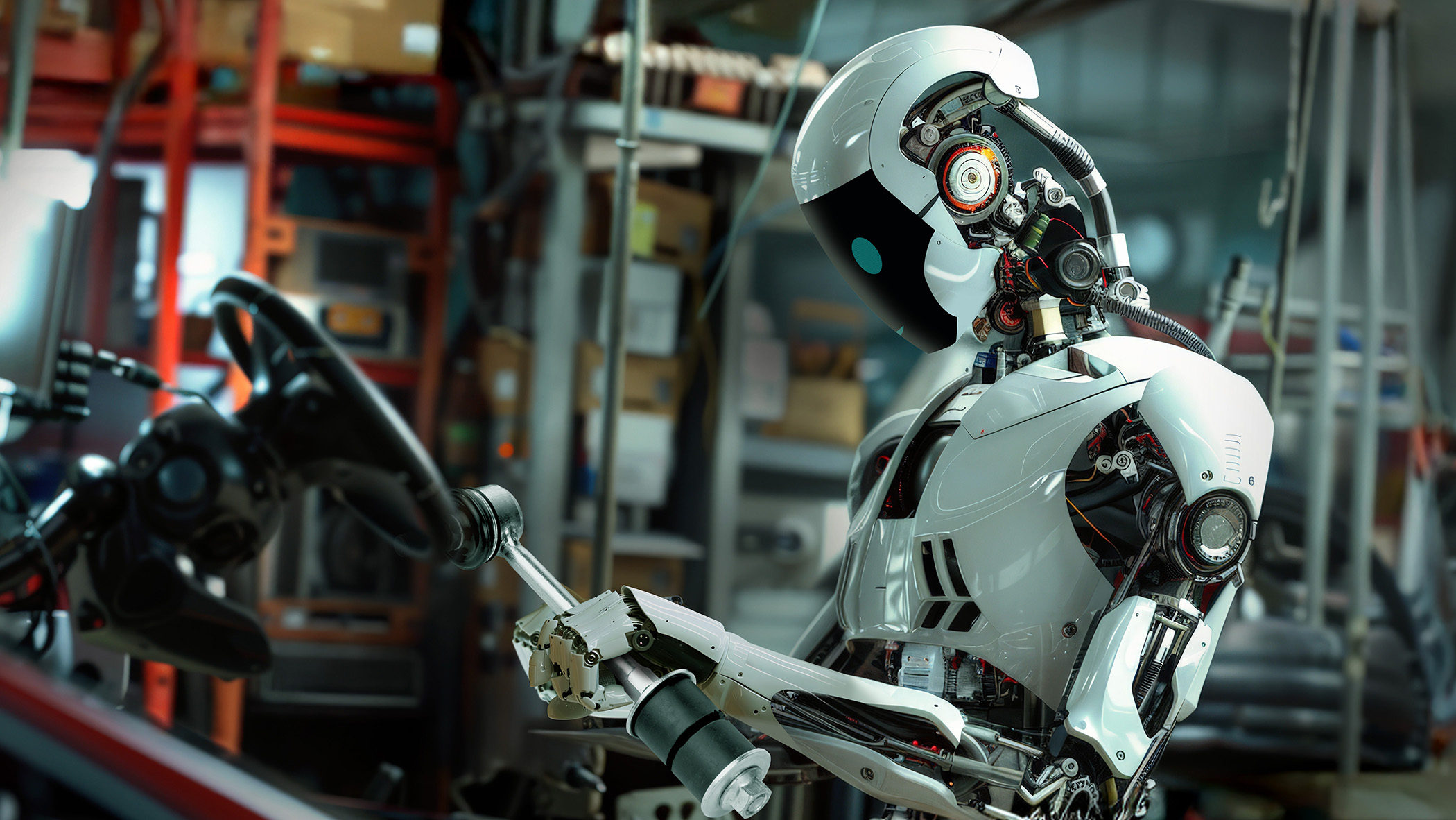
The current robotics story is focused on artificial intelligence (AI). A common assumption is that more parameters, larger models, and better reinforcement learning pipelines will eventually give machines human-like dexterity. This belief has shaped our research agenda, funding priorities, and public expectations.
But for engineers like Amazon Robotics, who design hardware that must withstand millions of high-speed cycles, a different truth is evident. In the lab, the focus is on the brain, but in production, robots fail much more often for mechanical reasons than due to algorithms.
In high-duty cycle environments, the main contributors to unplanned downtime are wear, compliance, thermal drift, misalignment, and mechanical fatigue. These are not failures of perception or planning. No amount of tuning a neural network can compensate for a linkage that flexes under load or an end effector that cannot maintain repeatability. As the industry continues to pursue AI-centric solutions, it risks overlooking the fundamental engineering disciplines that determine whether robots succeed in the physical world.
The robotics community is at a crossroads. While machine learning has made impressive advances over the past decade, the physical reliability of robotic systems has not kept up. As a result, the gap between what robots can demonstrate in a controlled environment and what they can maintain in real production is widening.


Closing this gap requires a change in mindset. The next leap forward in robotics won’t come from bigger models or more training data. It comes from better mechanics, better actuation, and better physical architecture.
reliability gap
The industry has spent a decade optimizing the brain while ignoring the body. This imbalance creates what can be called a credibility gap. As a technical judge for MassChallenge and for the college capstone programs at Worcester Polytechnic Institute and Boston University, I have observed a repeating pattern.
Startups and student teams often present systems that perfectly segment objects in simulations, classify scenes with surprising accuracy, and demonstrate impressive reinforcement learning policies. However, when these systems are deployed in the physical world, they fail after only a few hours of operation.
The reason is simple. AI amplifies robot capabilities, but its mechanisms define physical boundaries. The unpredictable hysteresis caused by the kinetic chain prevents the software from correcting towards a reliable solution. Once the transmission loses its rigidity under load, no amount of recognition accuracy can restore positional integrity. Even the most advanced grasping models will fail if the end effector cannot generate a stable contact force.
The robotics industry needs to recognize practical realities. Software and AI are essential, but they cannot overcome fundamental mechanical limitations. The most successful robotic systems in history were not the ones with the most sophisticated algorithms, but the ones with the most decisive mechanical movements. Reliability is not a sudden property of software. It is built into the physical system from the beginning.
Determinism and the philosophy of the navigator
True industrial progress requires a return to mechanical rigor, and in particular a focus on what can be called deterministic mechatronics. This philosophy suggests that the most successful robotic systems are those designed with passive stability, predictable behavior, and graceful failure in mind. A useful analogy comes from deep space engineering.
Launched nearly half a century ago, Voyager 1 continues to operate in one of the harshest environments imaginable. NASA may upload new command sequences, perform resets, and adjust subsystems to extend its lifespan. These interventions are successful because the underlying mechanical and electrical systems are designed for extremely high reliability. A spacecraft’s long lifespan is not the result of software or hardware alone, but the synergy of robust physical design and intelligent controls.
Industrial robots need to adopt this same mindset. The next leap forward in automation will come from kinematic architectures that reduce inertia, high-precision transmissions that maintain sub-millimeter accuracy under load, and actuation strategies that prioritize physical determinism. The goal is not to reduce the role of AI, but to ensure that AI is built on a stable mechanical foundation.
Deterministic mechanisms reduce cognitive and control burdens. It narrows the solution space. Transform difficult control problems into manageable problems. When physical systems behave predictably, software becomes simpler, more robust, and more efficient.
Case study: Apparel challenges
The manipulation of non-rigid materials such as apparel provides a clear example of this principle. Handling folded fabrics has traditionally been considered an AI problem. There is a common assumption that managing the noise introduced by folds and wrinkles requires complex pose estimation, dense depth reconstruction, and sophisticated visual models.
However, breakthroughs in this field, including those protected by U.S. Patents 11268223 and 11939714, demonstrate that the solution is primarily mechanical. By designing a compliant yet deterministic grip architecture, you can use the physics of the material to your mechanical advantage.
When kinetic chains are designed to minimize shear forces, physical interactions become predictable. When the mechanism restricts the degrees of freedom to match the natural behavior of the material, the need for complex recognition is reduced.
AI still plays an important role in these systems. Identify features, guide ordering, and handle variability. However, this is successful because the underlying mechanism provides a stable substrate. Machines do the heavy lifting so software can maintain efficiency. This balanced approach is what the industry needs. Rather than using software to compensate for mechanical unpredictability, mechanisms are designed to reduce the burden on the software.
This approach is scalable. It’s sturdy. Repeatable. And that’s the foundation on which industrial-grade automation needs to be built.
A new hierarchy of design
To open up the next phase of automation, the engineering community will need to rebalance its priorities. The design hierarchy must change.
First, the industry needs to invest in mechanistic research and development with the same intensity it brings to AI. For every dollar spent on perception, equal resources must be allocated to transmission, linkage, and end effectors. Mechanism is not a solved problem. They are the frontiers that will determine the progress of the next decade.
Second, the industry must build architectures that prioritize reliability. Robots need to be designed with the life cycle of an aerospace system in mind, rather than the life cycle of a household appliance. This requires a shift in thinking. Reliability is not a feature. It’s a design philosophy.
Third, the industry needs to develop a new breed of roboticists. The next generation of engineers will need to be equally adept at kinematics and PyTorch, equally adept at finite element analysis and neural network training, and equally invested in mechanical determinism and algorithmic efficiency. The future belongs to engineers who can bridge the physical and digital realms.
Finally, the industry must resist the temptation to chase demos. The goal is not to create a system that works well in a controlled environment, but to create a system that works reliably in the real world. The measure of success is not a viral video, but a robot that runs millions of cycles without failure.
The next decade of robotics
Artificial intelligence is an extraordinary amplifier, but it is not the basis of robotics. Intelligence is only as effective as the physical vessel on which it acts. The next decade of robotics will be defined by engineers who recognize that mechanisms, transmissions, and physical architecture are not secondary considerations. These are the core of the system.
The future of robotics does not belong to an AI-first or mechanism-first approach. This belongs to integrating both into a single, reliable and definitive system. As the body and brain evolve together, automation will finally achieve the scale, reliability, and functionality that the industry has long sought.
This is the future of mechanism-centric robotics. And it’s long overdue.
Santosh Yadav is a Senior Mechanical Engineer and Robotics Researcher with the ASME MBE Standards Committee.
Special Feature: Smart Factory


