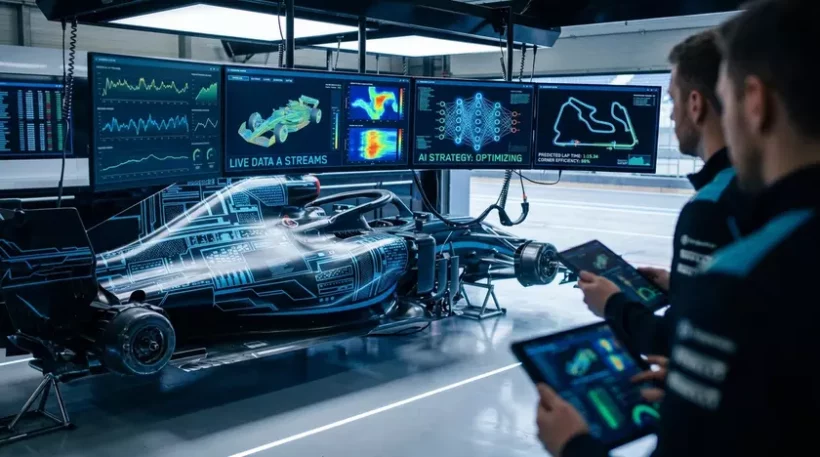
While spectators follow the battles on the track and debate the behavior of the cars around the corners, inside F1 teams, the very logic of race preparation is slowly changing. Engineering departments are increasingly relying on both traditional telemetry and simulation systems, but also on artificial intelligence tools that are beginning to participate in real-time data analysis. According to Ampere Analysis, the team has signed new deals with AI developers in recent months, with the technology company establishing itself as one of the championship’s key financial and technology partners.
Technology partnerships go beyond sponsorship
The role of IT companies in F1 is gradually shifting from traditional sponsorship to deeper integration into team processes. This language is no longer limited to placing the brand on the car. Technology partners are increasingly accessing data and participating in the development of decisions that influence race strategy.
Investments from the technology sector increased significantly last season, reaching hundreds of millions of dollars. These funds will go towards not only marketing, but also the implementation of computing systems that will allow teams to process large amounts of data during races.
One example is the Williams team’s collaboration with Anthropic. The partnership will use Claude’s language model to analyze internal processes of teams such as logistics, training, and strategic planning elements under time-constrained conditions between sessions. Within the team, such tools are seen as a way to speed up information processing and make decision-making more efficient.
From analysis to independent algorithms
The use of artificial intelligence in F1 is gradually moving to a new level. In many teams, systems are no longer limited to passive data processing and are starting to make their own recommendations.
Oracle Red Bull Racing is testing an approach where algorithms analyze telemetry, weather conditions and vehicle parameters to provide engineers with off-the-shelf solutions in real time. This form of working allows us to react more quickly to changing conditions on the track, reducing the time from analysis to action.
A similar process is observed with other participants in the championship. Aston Martin works with CoreWeave for high-performance computing, while McLaren uses Google Gemini generative models for data analysis and strategic scenario development. The general trend is to gradually transform AI from an auxiliary tool to a full-fledged element of a team’s engineering structure.
Budget constraints strengthen the role of algorithms
One of the factors accelerating the use of artificial intelligence is financial constraints. Current budget constraints require teams to allocate resources rigorously to reduce costs for day-to-day processes.
When it comes to algorithms, they are responsible for some of the tasks such as analyzing regulations, processing telemetry, and modeling race conditions. This allows engineers to focus on the more complex and creative aspects of development, where automation cannot yet replace human involvement.
F1 as an AI test environment
Farmula-1 itself is actively developing its technology in parallel with the team. Machine learning systems are used in conjunction with Amazon Web Services to process broadcast data, create graphics, and build probabilistic models of on-track events such as overtaking predictions.
Artificial intelligence is also being used to shape the visual and analytical elements of television broadcasts, gradually changing the format of the viewing experience. Indeed, racing series provide a testing ground for data processing techniques at high speed and under conditions of high uncertainty.
By the end of the season, F1’s sponsorship value had reached billions of dollars, putting the championship on par with the world’s biggest sports leagues.
Don’t miss interesting news
Subscribe to our channel to read tech news and test announcements.