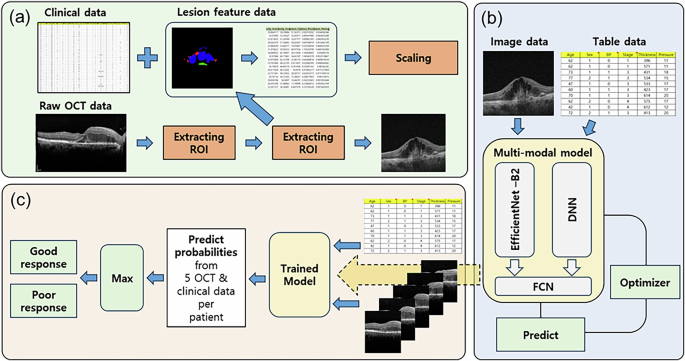
objective
To develop and validate a multimodal deep learning model to predict treatment response to intravitreal anti-vascular endothelial growth factor (anti-VEGF) injections in patients with diabetic macular edema (DMO) by combining optical coherence tomography images and clinical data.
method
This study included 107 DMO patients who received three consecutive anti-VEGF treatments. Model performance was evaluated using area under the receiver operating characteristic curve (AUROC), accuracy, sensitivity, and specificity. The model’s predictions were compared with the retina specialist’s predictions.
result
Of the 107 patients, 65 had a good response to treatment and 42 had a poor response to treatment. The multimodal model achieved an AUROC of 0.962 (95% CI, 0.945 to 0.979), accuracy of 0.953 (95% CI, 0.933 to 0.973), sensitivity of 0.969 (95% CI, 0.951 to 0.987), and specificity of 0.928 (95% CI, 0.928). 0.903–0.953) with internal validation. The model outperformed retinal specialists, achieving accuracies of 0.571 to 0.857.
conclusion
We demonstrated that a multimodal deep learning model predicts anti-VEGF treatment response in DMO patients with high accuracy. This approach may enable more individualized treatment strategies and optimal resource utilization in ophthalmic care. Further validation with larger multicenter datasets is warranted to confirm its clinical utility.