As millions of Muslim pilgrims from around the world flood into Saudi Arabia for the annual Hajj pilgrimage, a series of posts falsely claim authorities have banned photography and videography at the holy site. Authorities encourage pilgrims to concentrate on prayers and be considerate of other worshipers, but do not prohibit photography or videotaping. The image that accompanied the post, which allegedly depicts a prohibition sign, was also generated by AI.
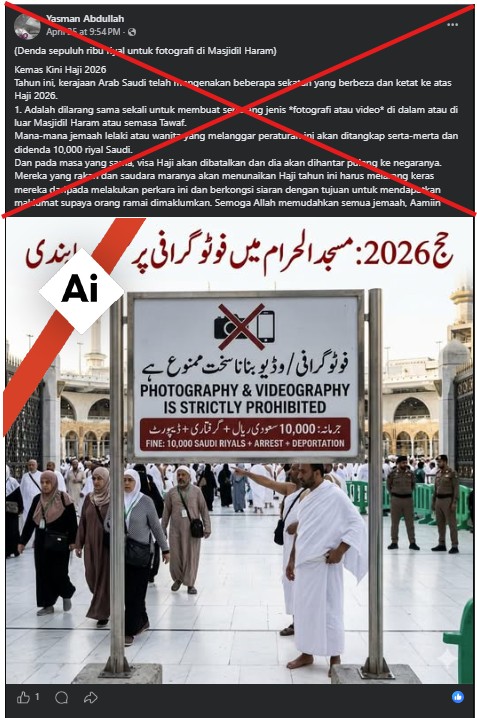
A Facebook post shared on April 25, 2026, claims that Saudi Arabia has introduced some new rules for people performing the Hajj this year.
“Taking photos and videos inside and outside the Grand Mosque is strictly prohibited. Pilgrims who violate this rule will be subject to immediate arrest and a fine of 10,000 Saudi Riyals,” the Malay-language post said, adding that violators will have their pilgrimage permits revoked and be sent home.
The post was accompanied by an image purporting to show a sign regarding the ban at the Grand Mosque.
Screenshot of a false post taken on May 4, 2026, with red X and AI label added by AFP
Similar posts using the same image were also shared elsewhere on Facebook, Instagram and threads ahead of the annual Hajj pilgrimage, which takes place in the last week of May. The Hajj pilgrimage is expected to be completed by all Muslims at least once in their life if they have the means (archive link).
The pilgrimage to Mecca involves believers gathering at the holy site for several days of rituals, retracing the Prophet Muhammad’s final pilgrimage.
Saudi Arabia’s Hajj and Umrah Ministry has issued an information guide on how pilgrims should behave at the holy site, but authorities do not prohibit photography or videography (archive link).
“While we appreciate your enthusiasm for capturing these priceless moments, preoccupation with photography can distract from prayers, invade the privacy of others, and cause inconvenience to visitors to the Two Holy Mosques,” it wrote, referring to the Great Mosque in Makkah and the Prophet’s Mosque in Madinah, which pilgrims often visit during the Hajj.
“Please be considerate of the comfort of other worshipers and refrain from taking photographs.”
Another keyword search turned up a Facebook post from the department from January 1 asking visitors to be considerate when taking photos and videos (archive link).
Head of the Malaysian Hajj delegation, Mohd Hisham Harun, also told local news outlet Astro Awani that while photography and videography were not prohibited, he reminded pilgrims to focus on prayer while in the mosque (archive link).
Analysis of the images accompanying the false posts revealed that they were generated by AI.
A watermark from Gemini, Google’s AI tool, can be seen in the bottom right corner of the image (archived link).
The text on the sign banning photos and videos is also written in Urdu, Pakistan’s national language, rather than Arabic, Saudi Arabia’s official language. The font size also appears to be inconsistent.
Screenshot of AI-generated image with visual anomalies highlighted in blue by AFP
AFP has previously debunked other misinformation surrounding the hajj.