
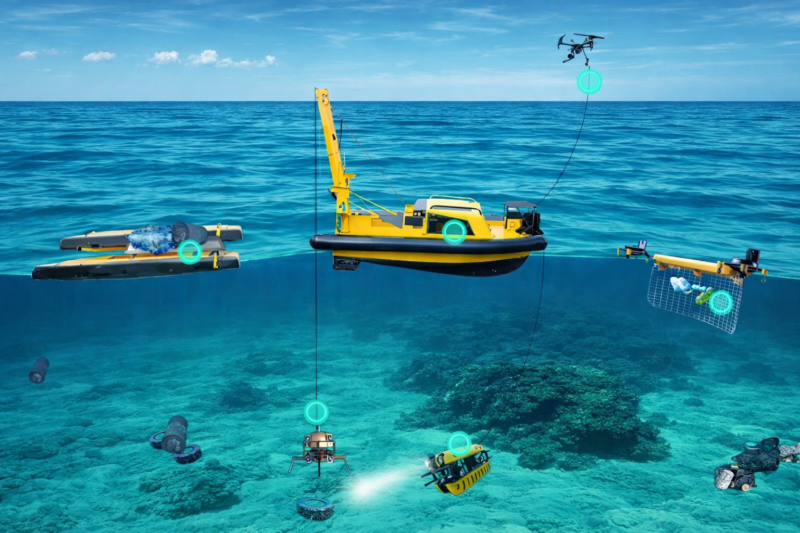
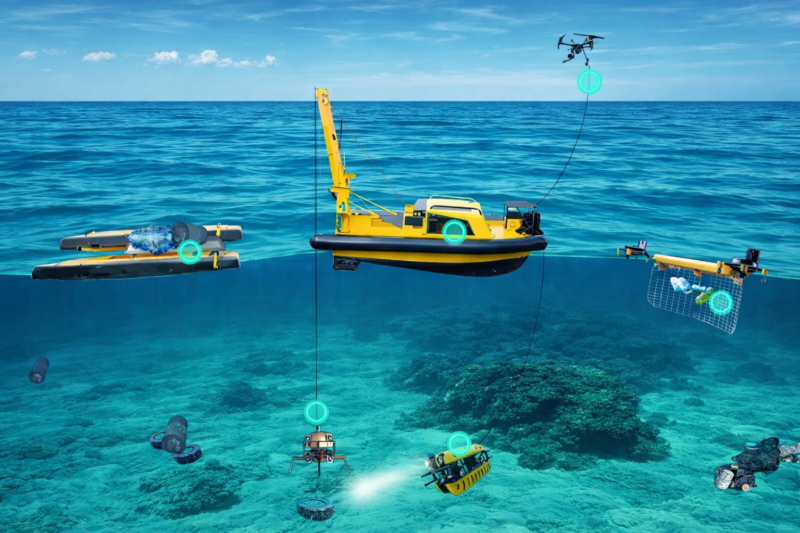
Meet the fleet. Image via SeaClear project (used with permission).
AI-powered robots are currently helping scientists clean up Europe’s ocean floor. Combining human-led efforts with artificial intelligence and robotics, the EU-funded SeaClear2.0 initiative is taking a collaborative approach to one of the ocean’s most persistent environmental problems.
Unlike many existing cleanup projects that focus on trash on the surface, this system targets waste that has already sunk to the ocean floor. By tackling this deeper layer of contamination, researchers aim to address some of the problems that have long been overlooked.
The autonomous system includes an aerial drone to detect waste, an underwater rover to find waste on the ocean floor, and a robotic gripper to lift waste to the surface.
Peer-reviewed research published in Engineering applications of artificial intelligence This system is described in detail on April 15, 2026.
focus on the ocean floor
Most marine debris eventually sinks and accumulates on the ocean floor, where it can remain for years. Over time, plastic breaks into smaller pieces and spreads throughout the ecosystem as microplastics, making them even more difficult to remove.
To address this, researchers on the SeaClear 2.0 team are focused on detecting and recovering larger debris before it breaks down. The company’s AI system processes camera and sonar data to distinguish objects such as tires, metal structures, and plastic waste from natural features such as rocks and marine life.
Human operators will continue to control the mission, while autonomous systems will handle most of the detection and collection tasks.
A group of robots working as one system
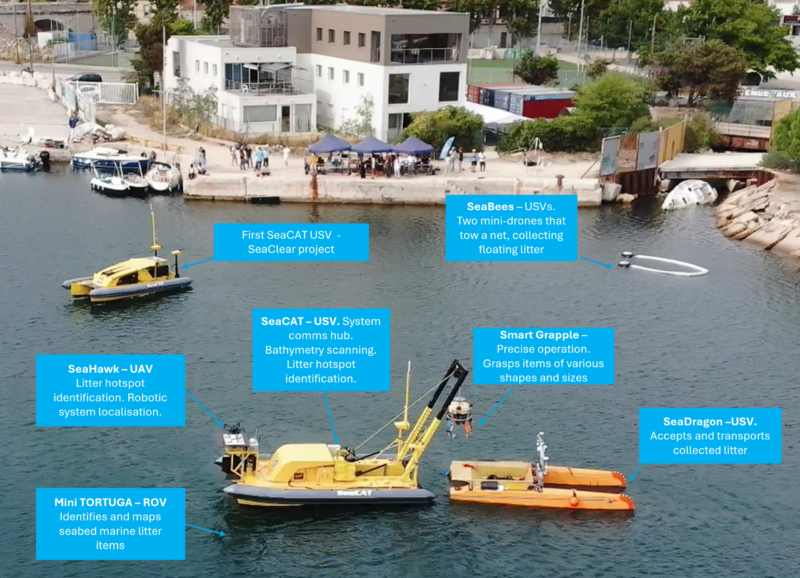
At its core is an unmanned surface vessel called SeaCAT, which acts as the system’s command hub. From there, it coordinates a network of robotic units, each responsible for a different stage of the cleaning process.
An aerial drone called SeaHawk scans the ground to identify potential waste hotspots. The compact underwater probe “Mini TORTUGA” (Spanish for turtle) maps the ocean floor and pinpoints the location of trash before collection begins. Small, agile units such as SeaBees move through tight or complex areas and use nets to collect light waste. For heavier objects, a robotic gripper lifts the debris from the ocean floor, and another surface vessel transports the collected material to shore.
Bart de Schutter, professor at Delft University of Technology and coordinator of the SeaClear and SeaClear2.0 projects, said the team aims to expand collection capacity.
SeaClear2.0 aims to collect larger debris. Tests have already removed rubber tires, metal fences and ship parts. Surface ship cranes can lift even heavier objects.
Improving the safety and efficiency of cleaning operations
Removal of seabed waste has traditionally required divers, making the process time-consuming, expensive and potentially dangerous. Autonomous systems offer a safer alternative, especially when operating in poor visibility, rough weather, and complex underwater conditions. Yves Chardard, CEO of French company Subsea Tech and partner on the project, commented:
The key is safety, efficiency and cost-effectiveness. Drones can help clean up areas that are currently too expensive or dangerous to tackle.
Field testing reflects steady progress. Early tests in Hamburg, Germany, revealed its limitations when lifting very heavy objects proved too difficult. That led to improvements to the grip system, which will pay off in the next test in Marseille, France, Shardahl said.
It took 30-40 minutes to scan and clean the area. Within an hour, we picked up tires, fences, car seats, and other large debris. It went much better than Hamburg.
SeaClear2.0’s mission: To restore our oceans and waters. Video via SeaClear project.
Beyond ocean cleanup
Although marine debris remains the main focus, the same technology could support other underwater applications. Researchers are considering whether this could be useful in detecting unexploded mines, or in port surveillance and security operations. Mr. de Schutter said:
You can detect these objects, so that’s one possible use. We are also considering security-related applications such as port monitoring and detection of illegal or dangerous activities.
Development continues, with further trials planned in Venice (Italy), Dubrovnik (Croatia) and Tarragona (Spain). Mr. Chard explained:
We are not where we want to be yet, but we are not far off. The current goal is to streamline technology.
Demonstration of SeaClear2.0 in Marseille. Video via SeaClear project.
Toward deployment in the real world
The researchers aim to improve the system by the time the project is completed by the end of 2026. The goal is to integrate autonomous robot swarms into real-world operations through local governments across Europe.
If successful, these systems could reduce the long-term accumulation of waste on the ocean floor and support the gradual recovery of the marine environment.
First live showcase of the SeaClear2.0 robotic system. Video via SeaClear project.
Conclusion: An AI-powered robotic system is helping researchers find and remove waste from Europe’s seabed, making underwater cleanup safer and more efficient.
Source: SeaClear System: Intelligent multi-robot solution for autonomously cleaning marine debris on the seabed
Via Horizon: EU Research & Innovation Magazine
Via CORDIS: EU research results
Read more: Sea turtles are as old as dinosaurs: Lifeform of the week


