
Wall Street and Silicon Valley are betting that generative AI will initiate a paradigm shift on the scale of the industrial revolution. And who do business leaders call when they need to make a change?
consultant.
Anthropic is partnering with some of Wall Street’s biggest investors to create a $1.5 billion joint venture for “AI-native enterprise services” or, in plain language, “the McKinsey of AI,” said one person with direct knowledge of the deal.
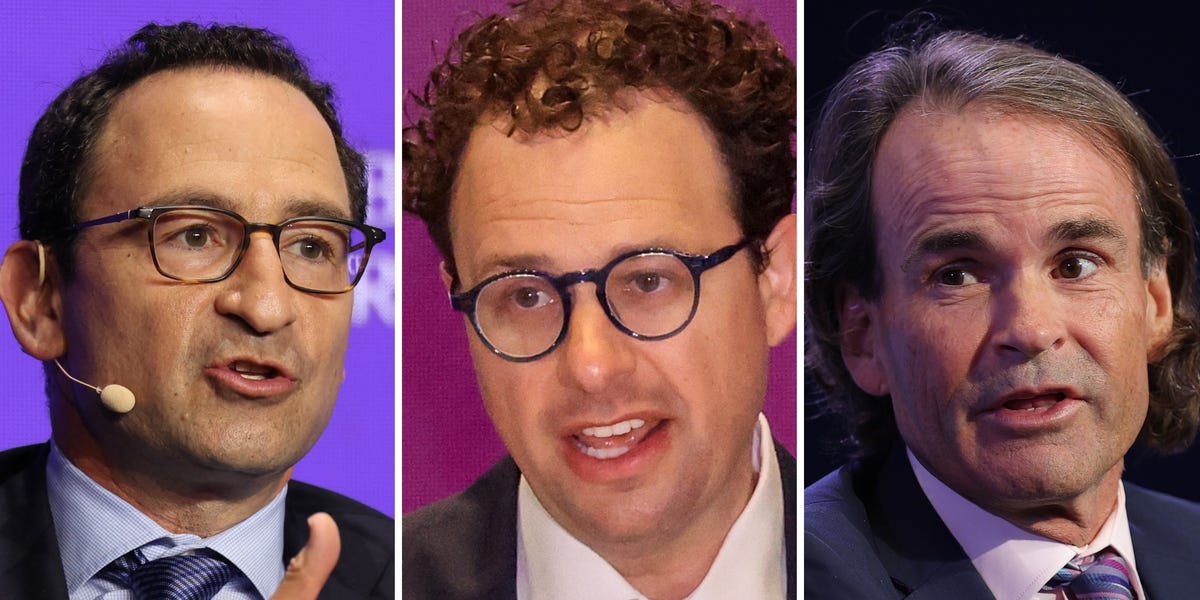
Founding partners Anthropic, Blackstone, Hellman & Friedman and the wealth management arm of Goldman Sachs announced the deal on Monday. The first three companies each invested $300 million in the deal, with Goldman contributing $150 million, the people said. The remaining funding will come from a consortium of major investors including Apollo, General Atlantic, Leonard Green, GIC and Sequoia Capital.
“This is a rare combination: a huge market need, Anthropic’s unparalleled AI technology capabilities, and a consortium of investors capable of rapidly scaling up,” Hellman & Friedman CEO Patrick Healy said in a media release accompanying the announcement.
This anonymous AI company is a way for backers to drive revenue across their portfolio companies, create strategies for technology-enabled transformation, and ultimately justify the huge sums of money these companies are pouring into AI infrastructure.
“We have 275 companies,” Blackstone President John Gray told CNBC on Monday. “They’re very interested in using Anthropic’s enterprise technology, but they’re saying, ‘Can you help us get there? Can you help us change our workflow?'”
And for investors like Gray, helping them isn’t just a matter of altruism. That can have a significant impact on your bottom line. He said the cost of labor is $60 trillion a year, adding: “If we can make people 15% more efficient, that’s $9 trillion.”
Private equity firms have longer holding periods and are under pressure to generate profits. Almost 40% of companies have now held their shares for more than five years, up from 29% in 2019, according to Bain.
“Demand is extraordinary,” said Brian Mulberry, chief market strategist at Zacks Portfolio Management, who sees the business as a combination of forces: increased computing power due to the proliferation of data centers, an urgency for financial sponsors to shed aging assets, and rising costs due to rapid token consumption.
“As computing power increases, more data centers will come online,” he said. “Using this AI as a tool to improve productivity is highly scalable.”
Anthropic’s growing foothold on Wall Street
A core part of this venture involves working closely with Anthropic’s engineers to incorporate AI into workflows and reengineer internal processes. In practice, it could involve introducing AI-driven agents into existing systems to help companies complete tasks faster, according to another person familiar with the logistics of the deal.
Another person familiar with the partnership said another benefit for the company’s customers is access to the latest upgrades to Anthropic’s models, adding that advance access to these models before the general public gets them could help address growing cybersecurity concerns. Part of that concern is related to the unprecedented features of Anthropic’s own product.
Anthropic’s Mythos model, an advanced LLM that has raised concerns among U.S. officials in recent weeks, has become an obsession for banks and large corporations. They are trying to protect themselves from its unprecedented cyber capabilities.
billions of dollars are at stake
If new ventures can figure out how to bring businesses into the AI era, they are likely to become very valuable companies. Spending on large-scale language models by Blackstone’s own portfolio companies has increased 15x in the last year.
“This is an upward trend,” said Thomas T. Thomas, CEO of private equity AI value creation company Terragonia. His company has built a software platform for mid-market private equity firms to apply AI insights to their businesses, targeting a market with multi-trillion dollar companies.
Thomas said that while this may be a large market, it is also a difficult market, pointing to the challenge of transforming a business holistically within a time frame for private equity investors.
“These companies need to exit, or there needs to be a liquidity event within about 60 months, or sooner if possible,” he said. “Doing that is one thing, but telling the AI value creation story in a consistent way is another.”
There are also long-term rewards.
Blackstone said it is the world’s largest data center investor, with more than $150 billion invested in data centers around the world and a $160 billion pipeline of potential deals. The big four, Amazon, Microsoft, Meta and Google, plan to spend $725 billion this year, and some are concerned about the size of their bet.
Private equity has long influenced corporate strategy. This has been done first by breaking up midcentury conglomerates into focused businesses and then by running the companies with a radical focus on increasing profits.
If the field can create a repeatable strategy for artificial intelligence transformation, the data center bet is likely to pay off.