


Sophia Nicole Salivio
news editor
Australian sole traders are increasing their use of artificial intelligence tools, according to new research data from Hnry. According to the latest Hnry Sole Trader Pulse, 74% are now using AI tools, up from 58% in 2024.
The survey found that 41% use AI daily or weekly. Business use also rose from 49% to 69%.
The findings suggest that self-employed people are increasingly using AI to run their own small businesses, especially for administrative tasks and routine knowledge tasks. Hnry’s internal data shows that customer spending on AI tools has doubled every year since 2023.
The most used AI tool among Hnry customers was OpenAI, followed by Anthropic and Gemini. Regular use of AI at work has more than doubled in less than two years, rising from 18% in June 2024 to 37% in March 2026.
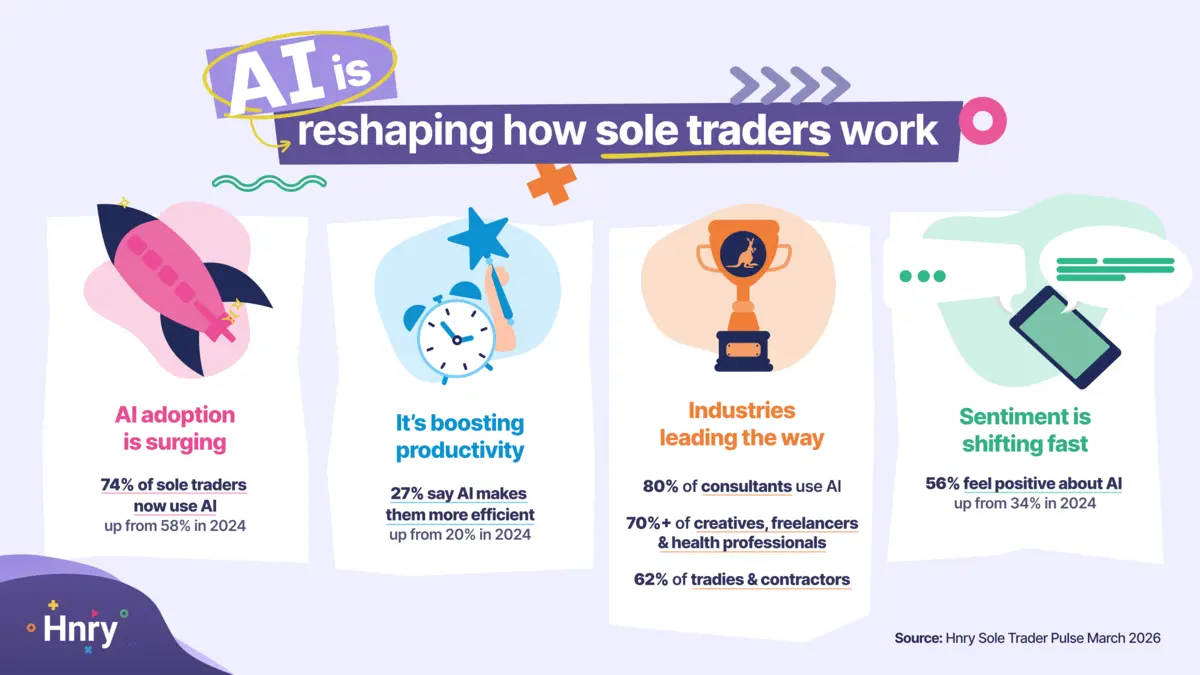
sector division
The adoption rate was highest among consultants, with 80% saying they had used AI in their work. This compares to 72% of freelancers and health and wellness professionals and 62% of contractors.
Sentiment also improved over the study period, with positive views of AI rising from 34% in 2024 to 56% in March 2026.
The research is based on research into Australia’s self-employed market, which Mr Hnry estimates is 1.7 million people. The field survey was conducted from March 8 to 16, 2026, and had a maximum margin of error of plus or minus 4.4 percentage points.
Case studies included in the release suggest that much of the appeal of AI lies in the time it saves for operators who manage all aspects of their business independently. For many independent contractors, this means using AI not only for customer-facing tasks, but also for quoting, communication, and planning.
Joe Tomalin, a handyman and gardener from South Australia’s Eyre Peninsula, said admin time has been significantly reduced. “We used to spend about 10 hours a week on administrative tasks, but with AI we can eliminate that in two hours,” says Tomalin.
He also outlined the scope of work that is currently being handled with the help of AI. “I use it to estimate work, draft emails, create business plans, and generally make my life easier. I like that it understands me, anticipates my needs, and provides advice to avoid making costly mistakes,” Tomalin said.
Another user cited in the findings was Melbourne-based graphic designer Simon Hart, who said AI tools had changed the scale and pace of his work.
“It has put me on par with a team of five graphic designers. I use AI tools for everything from asset creation to research to data analysis to error checking. This has accelerated my business by 300%,” says Hart.
Improved productivity
Karan Anand, managing director of Hnry Australia, said the data showed that rather than treating AI as a novelty, it was becoming ingrained in the day-to-day operations of self-employed businesses. He linked increased usage to direct experience with the tool.
“Regular use of AI at work has more than doubled in less than two years, from 18 percent in June 2024 to 37 percent in March 2026. More than a quarter say AI could help them work more efficiently and productively, indicating that AI is becoming a significant changer in the day-to-day operations of independent contractors,” Anand said.
He said this change will have far-reaching implications for the self-employment economy, as technology allows one person to do work that previously required large organizations.
“AI is no longer new; it is becoming the norm in the way the vast majority of independent contractors operate, and this is a pivotal moment for the independent contractor economy. A successful independent contractor in 2026 will be able to do what a six-person agency did in 2019.”
“For independent contractors, there is a tremendous opportunity to increase productivity and scale. Independent contractors who are early adopters of AI are gaining a competitive advantage in a market that is increasingly focused on productivity and efficiency,” Anand said.
Hnry provides accounting and tax services to sole traders in Australia, New Zealand and the UK. The company processes billions of dollars in payments each year and says it has raised nearly $100 million in investment since its founding in 2018.


