
As the natural world changes rapidly, humans depend on being able to reliably and accurately predict their behavior to minimize harmful impacts on society and the ecosystems that sustain it.
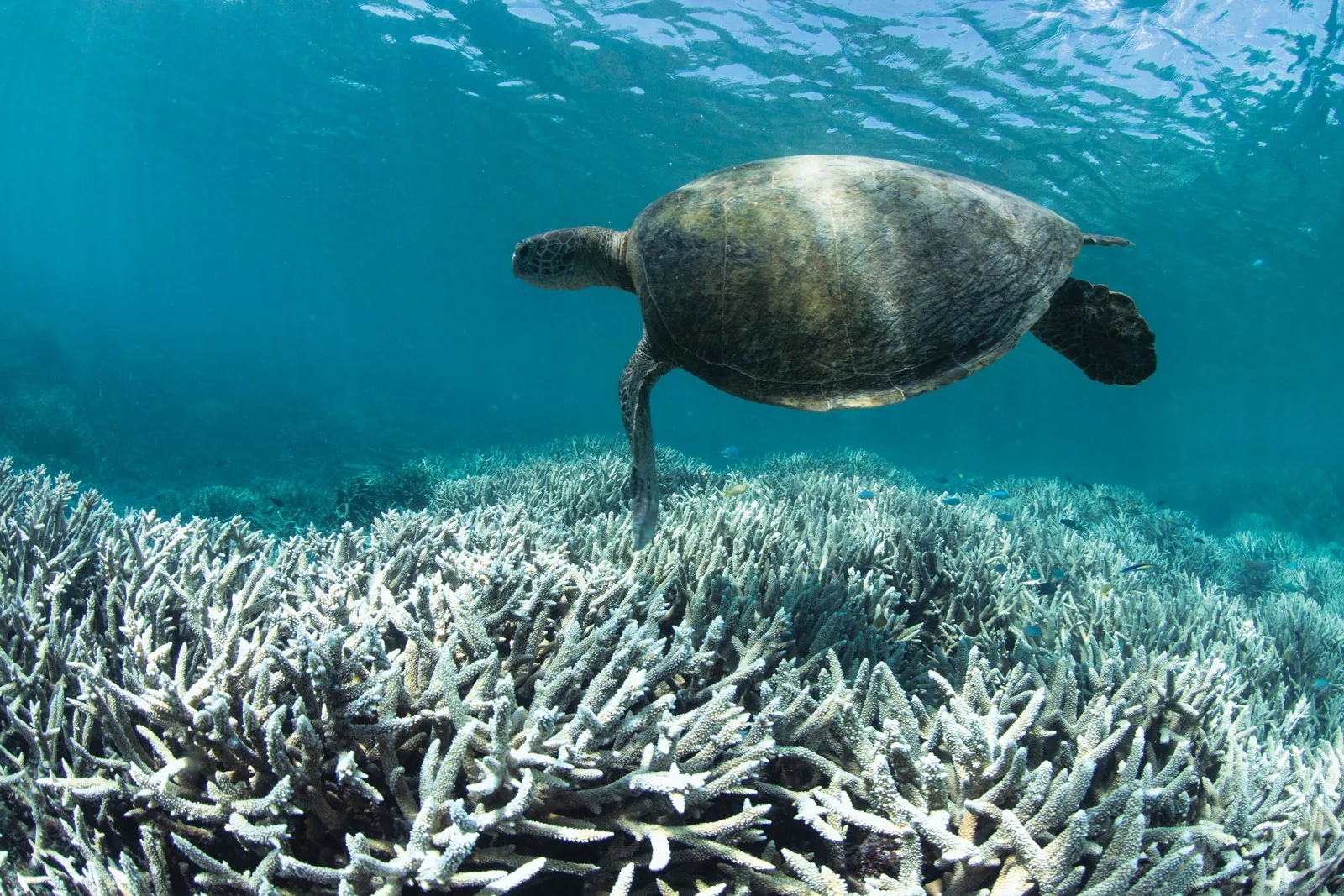
Ecosystems of all sizes are vulnerable to collapse. For example, coral reefs are being affected by rising water temperatures, pollution, and overfishing. 84% of the world’s coral reefs suffer from coral bleaching, a stress response to such impacts. These events harm humans by displacing or killing marine life that calls coral reefs home, reducing biodiversity, decimating tourism-dependent economies, and eliminating food supplies.
Predicting hazards is important for developing effective control and mitigation strategies. Modern artificial intelligence (AI) and machine learning can play a transformative role in this area.
However, the scarcity and incompleteness of ecological data make it difficult to effectively train machine learning models. Zheng-Meng Zhai, an electrical engineering doctoral student at Arizona State University, is focused on addressing this challenge, exploring ways to harness the power of AI to better predict and prevent ecosystem failures.
Zai, a student in the Ira A. Fulton School of Engineering, led a project focused on developing new ways to teach AI algorithms to make accurate predictions about ecosystems, where precise data is often scarce.
His research, conducted under his dissertation advisor, Professor Lai Yingchen of the ASU Board of Governors, was selected for publication in the prestigious research journal Proceedings of the National Academy of Sciences (PNAS) due to its impact.
A look to the future
“Machine learning typically requires large amounts of data to work well,” Zai says. “The discrepancy with the sparse data we typically get from ecosystems motivated us to look for ways to make good predictions even when data is lacking.”
His research has found a way to double the accuracy of machine learning algorithms using five to seven times less data than is typically required. This increased accuracy is applicable when using time series data to record measurements of the same variable over time. Zai points to climate research, such as modeling ocean currents, as an example.
“The Atlantic Meridional Overturning Circulation (AMOC) is a major ocean current system that helps keep northern Europe and eastern North America relatively warm and livable, but scientists have a short and incomplete record of how it behaves,” Zai says. “If the AMOC weakens or collapses, it could have major global consequences. Our method could help improve behavioral predictions in such cases.”
Beyond climate science, his research could also be applied to modeling the spread of disease, helping public health officials take necessary precautions to keep residents safe, and predicting traffic patterns to help transportation planners keep roads flowing smoothly.
Bringing AI to school
To address these challenges, Zhai and Lai developed a meta-learning technique that forces machine learning algorithms to learn in new ways. Traditionally, machine learning algorithms use a single robust dataset to complete one specific task. However, this poses a problem when the unpredictability of nature is involved.
Meta-learning works more like how humans learn, teaching algorithms to integrate experience from a large number of related tasks. Zhai trained the system using a variety of chaotic synthetic datasets that are computer-generated and designed to simulate realistic and unpredictable situations.
When exposed to these synthetic datasets, machine learning algorithms trained with meta-learning can “understand” how to interpret and make inferences about ecological systems with minimal data available. The algorithm’s learning is made possible by a special type of computer system designed to function like the human brain, known as a time-delayed feedforward neural network.
A bright future for machine learning
Zai’s development of meta-learning methods is the latest in a highly productive academic career as he prepares to defend his doctoral thesis. He has published more than 10 papers in journals such as Nature Communications and PRX Energy. He aims to continue his research in this area and expand his work to predict more types of system behavior, including further types of instability in the climate system, ecosystem collapse, and infrastructure networks.
“Zheng-Meng has become a leader in applying machine learning to complex, nonlinear, dynamic systems,” said Lai. “He is recognized as a rising star in this interdisciplinary field.”
Zai says he is honored to have his research published in such a prestigious journal as PNAS.
“Seeing our research recognized by PNAS is extremely rewarding and an important milestone in my academic journey,” he says. “We hope that publication in such a high-profile journal will introduce our approach to a broader scientific audience, foster collaboration, and provide inspiration for future research on data-limited systems.”


