
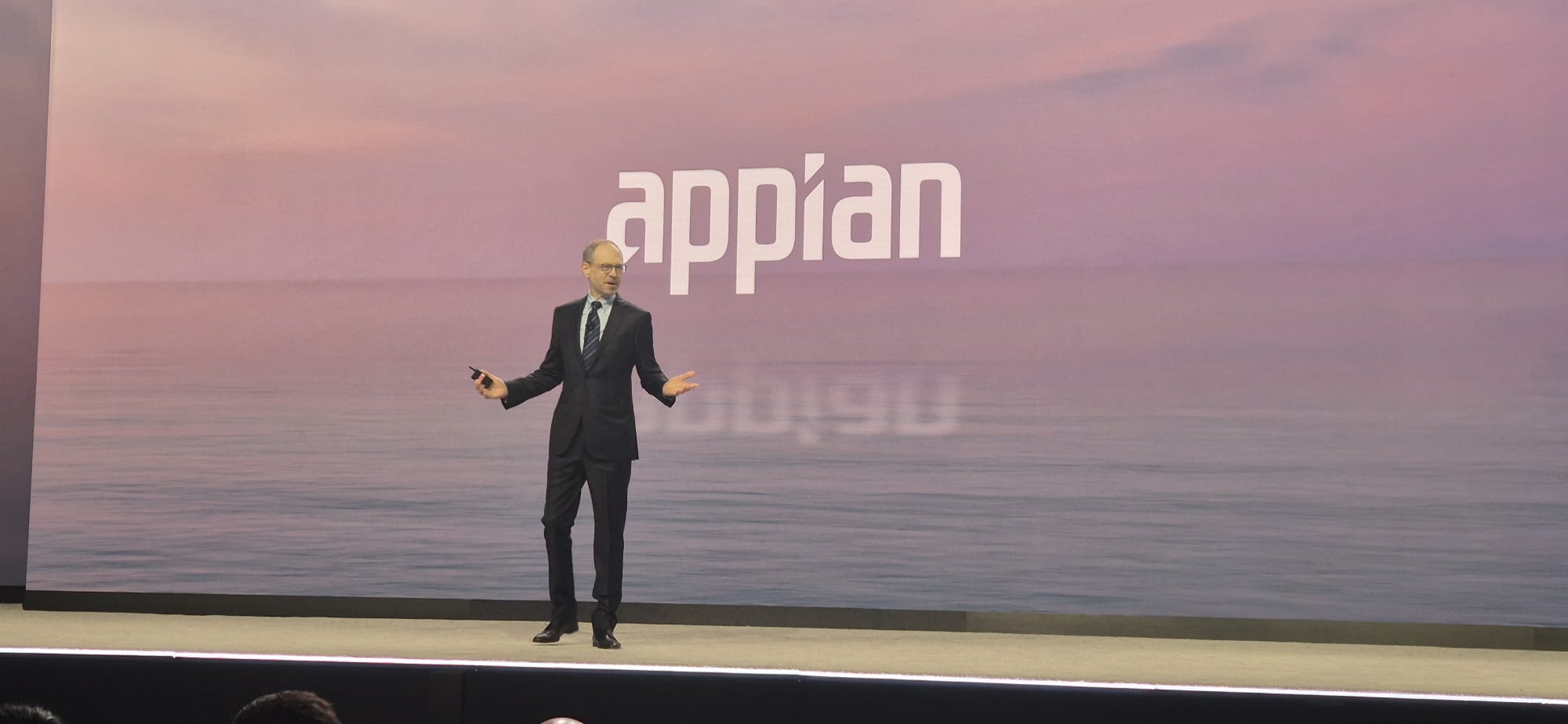
At Appian World 2026 in Orlando, everything revolves around one question. How can we ensure that AI operates at the center of the process, not on the side? With new capabilities in AI agents, a comprehensive approach to legacy modernization, and a partnership with Snowflake, Appian is demonstrating its focus for the next period.
Many organizations use AI as a standalone tool alongside their processes, rather than as an integral part of them. The promise of AI is high, but the reality is difficult. Many organizations struggle with the question of how to move AI from experimentation to real business value. This is the core of what Appian calls “full-fledged AI.” AI that actively participates in mission-critical work rather than experimenting on the sidelines. The announcement Appian is making today at Appian World 2026 is a tangible realization of that promise. These cover three areas: further development of our AI agents, new approaches to legacy modernization, and expansion of our data fabric through a new partnership with Snowflake.
Agents that learn and collaborate
Appian’s Agent Studio, which became generally available in November 2025, includes a variety of new features. Most importantly, the agent tracks its own performance and applies the acquired knowledge throughout the process to improve decision making. This may seem like a small step, but it addresses the fundamental problem your organization is currently facing. Agent tuning is still largely a manual process. Someone needs to review end-user feedback, manually adjust the prompts, and repeat the process. The announcement of automatic agent learning is a first step toward helping agents improve themselves within established limits.
Additionally, Appian is introducing AI guardrails across the environment. Instead of setting governance on a per-agent or per-application basis, organizations can now define policies that apply to everything related to AI within their Appian environment. Examples include protection against prompt injection, personal data leakage, or unwanted output. This is set at the environment level, rather than being set individually for each use case. Real-time insights into agent reasoning, combined with automatic resource limits, should justify AI adoption for security, compliance, and risk teams.
Multi-agent collaboration is the third pillar. Appian describes an architecture in which a “lead agent” dynamically summons specialized agents to perform specific tasks such as triage, document extraction, and approval routing, all within a single managed process boundary. This is a big step forward. Currently, most enterprise AI implementations still rely on isolated agents, each forming its own silo. Appian positions process orchestration as the binding layer that enables management of multi-agent systems.
Calkins also clarified when an agent is the right choice. “If you can apply rules within a process, it’s faster, cheaper, and more reliable.” He says agents are only useful when there’s a lot of ambiguity or in situations that are so diverse that rules are insufficient.
MCP as the key to interoperability
One of the most specific announcements is the adoption of Model Context Protocol (MCP), an open standard developed independently by Anthropic. MCP allows agents to securely communicate with external systems without requiring custom integration for each connection.
MCP works in two ways for Appian. Appian agents can connect to external systems via standards. This also opens the door to a new technology partnership with Snowflake. This partnership combines Appian with the Snowflake AI Data Cloud as an AI orchestration layer, allowing agents to work directly with large datasets and leverage Snowflake Cortex AI to make data-driven decisions. “Organizations don’t need new AI experiments; they need AI that delivers real business results based on data they can trust,” said Baris Gultekin, vice president of AI at Snowflake.
But the opposite is also true. External agents, built-in tools such as Google Vertex AI and LangGraph, access Appian’s data fabric, business rules, and process logic through the MCP. This is strategically important. Appian is opening its platform to external agents, thereby positioning itself as an orchestration layer within a broader multivendor AI environment rather than a closed system. “Composer complements Appian’s agent-based orchestration and data fabric with new conversational, iterative, specification-driven development tools,” said Mike Beckley, CTO and co-founder of Appian.
Legacy modernization
The second major announcement concerns the modernization of legacy applications. Appian is introducing AI-assisted spec-driven development. This is an approach where AI extracts specifications from existing legacy applications, even if they are poorly documented or the original developers have long left. These specifications are translated into visual blueprints for UIs, data models, and process flows that serve as the basis for rebuilding on the Appian platform.
This changes the calculus behind legacy modernization. According to Appian, organizations spend an average of 60-80% of their IT budget maintaining existing systems. The average company manages approximately 305 applications, but we typically underestimate that number by a factor of 2. Every application that remains in place is a system that requires security updates, consumes infrastructure, and, increasingly, does not support the latest AI capabilities. Modernization has always been expensive. Stopping is now more costly.
Appian cites insurance company Aon as a real-life example of this approach. The company had an outdated .NET application with virtually no documentation and almost no organizational knowledge. Instead of translating code line by line and inheriting inefficiencies and technical debt, Aon used AI to extract functional requirements directly from existing systems. The result was a structured specification that served as input to Appian Composer. Rather than just rewriting the same code faster, use the platform’s built-in governance to uncover your business logic and rebuild from there.
Vibe coding using guardrails
The third pillar has a surprising name: Vibecoding. Appian consciously chose to embrace this tendency rather than fight it. Developers are free to use Claude Code, their own CLI tools, or other AI development environments to build and customize Appian applications. Appian is introducing MCP Server for developers to enable this integration. However, Appian Composer’s built-in governance, visual architecture overview, structural error detection, and automatically upgraded platform-native objects serve as a layer that combines speed and manageability.
The message is clear. AI-generated code without structure creates the following technical debt: Appian aims to provide the speed of vibe coding with the control needed for enterprise environments.
Today’s announcement is consistent with Appian’s previous policy. Full-fledged AI is not a new product, it is a positioning. AI only works when it’s embedded in processes, supported by good data, and surrounded by governance. MCP interoperability, agent learning, specification-driven development, and the Snowflake partnership are specific components of that story. In October 2025, Gartner positioned Appian as a leader in the newly defined BOAT (Business Orchestration and Automation Technology) segment, alongside Pegasystems and ServiceNow. Whether the announced features can actually deliver on their promise is a question that will need to be answered in the coming period.


