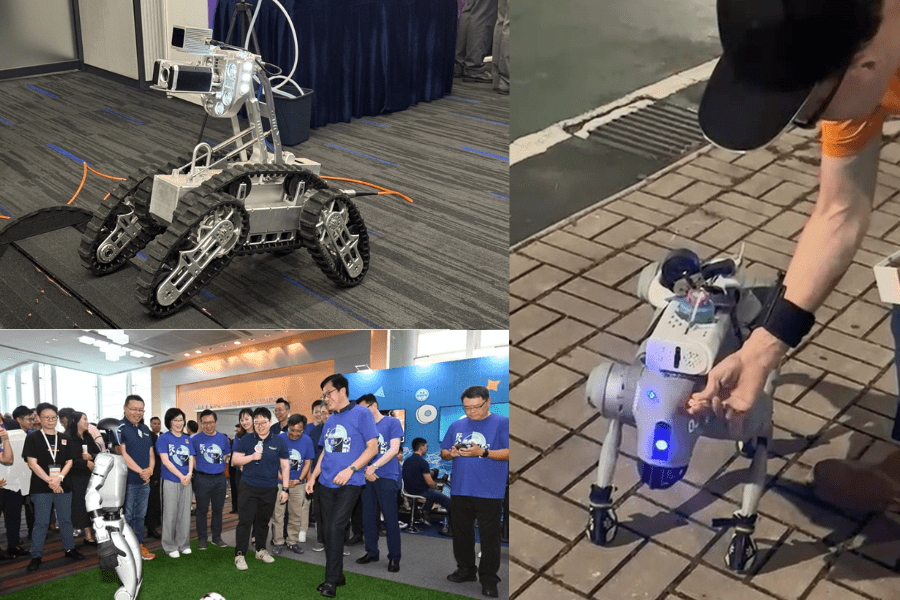
As AI-powered machines become more and more part of everyday life, the presence of robotic companions on sidewalks is increasing, creating a legal gap in liability for accidents, experts say.
Robots are starting to be used across the city in everything from government agencies to building security, but these “strange newcomers” appear to pose a potential safety risk to the public. The incidents range from a robot shocking an elderly woman in Macau to a tech expert in Hong Kong injuring his leg.
Recent scenes in Tseung Kwan O have raised further safety concerns. A man walking his robot dog nearly caused a collision when he suddenly braked to stare at his bicycle, almost colliding with another cyclist who was running towards him.
Additionally, some have highlighted concerns that robot dogs equipped with cameras could invade privacy or perform panty shots without the victim’s knowledge.
Francis Fong Pok-kiu, honorary president of the Hong Kong Information Technology Federation, described the experience of being stepped on by an out-of-control robot as “being hit with a hammer.”

Mr Fung believed Hong Kong needed urgent regulation based on the level of power, speed and autonomy of robots.
Hard to find someone to blame: legal experts
Under current law, owners can be held civilly liable if an AI-powered robot dog injures a passerby, especially if the dog was controlling the device at the time.
But lawyer Albert Luk Waifun warned of legal gaps when machines operate autonomously, likening it to dangerous driving without a driver, which he said poses challenges for prosecution.

Luk pointed to further challenges with anonymous operators being able to control the robot remotely from another location or even another country, making an investigation nearly impossible.
He is calling for early public consultation and dedicated legislation to govern robots.
Statutory constituency lawmaker Nicholas Chan Hieu-fung said responsibility for robot-related accidents can fall on multiple shoulders, including operators, programmers and manufacturers.

He acknowledged that many of the robot dogs available online from overseas platforms must meet Hong Kong’s electrical safety standards, but cross-border litigation remains a major hurdle.
However, Chan said, “We must balance safety with the need for technological advancement,” and urged caution against overregulation.
Currently, there is no law in Hong Kong
In response, the Department of Innovation and Technology Industry pointed out that there is currently no specific law regulating the application of robotics in Hong Kong.
However, it said related projects would need to comply with regulations in various sectors, citing the example of robots overseen by the Department of Health Development.
Regarding AI-related crimes, the ministry suggested that existing regulations could cover privacy and cybercrime.
The ministry acknowledged the legal gap and said its Digital Policy Office has developed an ethical AI framework and generative artificial intelligence technology application guidelines for AI technology development.
The European Union will regulate the use of AI technology in August 2024 with the world’s first comprehensive AI law, assessing and banning AI applications based on a risk-based classification system, according to reports.
As for Japan, the AI Act, which took effect last month, requires the government to promote responsible development and allows non-legally binding investigations when people’s rights are violated.
South Korea will implement an AI law in January 2025 that will require human supervision of AI used in nuclear safety, transportation, and healthcare, while requiring AI-generated content to be clearly labeled if it can be mistaken for reality.
Meanwhile, China released its first governance guidelines for humanoid robots and related standard systems in February 2026, covering the entire chain in the humanoid robot field.
↓