
Hong Kong
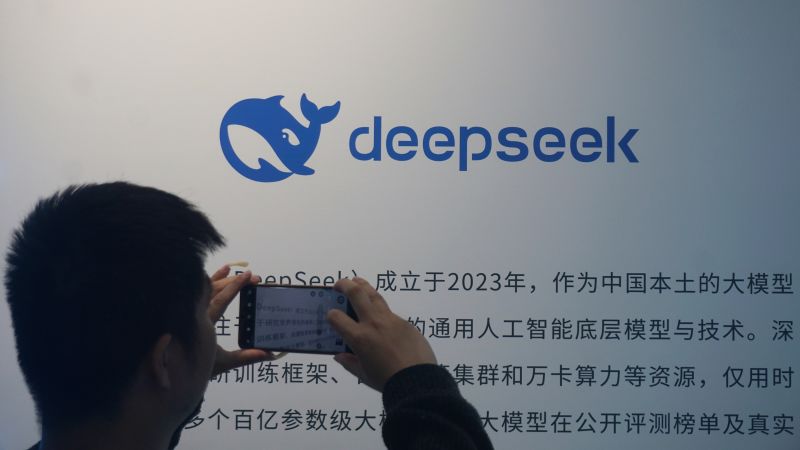
China’s DeepSeek unveiled a preview version of its long-awaited new model on Friday, promising to rival models from OpenAI, Anthropic and Google, a year after the then-little-known startup took the global AI industry by storm.
The Hangzhou-based company highlighted significant upgrades in its new model V4’s reasoning capabilities and agent capabilities that can act autonomously on behalf of users, including writing code. It also includes new features that make models more efficient in handling large amounts of tokens, the basic unit of information that AI models use to understand instructions.
DeepSeek became a symbol of China’s AI boom after releasing its breakthrough R1 model in 2025, which reportedly offered near industry-leading performance at a fraction of the price.
The huge success sent American AI stocks crashing and raised questions about the company’s ever-larger investment in data center expansion. At the same time, it increased confidence in Chinese technology and intensified technological competition with the United States.
But analysts said the new model was unlikely to send the market into the same frenzy as its predecessor.
“R1 was a shock to the U.S. market because no one expected the Chinese model to compete at that level,” said Ivan Hsu, senior equity analyst at financial services firm Morningstar. “V4 just continued the same trend, and the trend doesn’t make the headlines like a shock.”
Su added that stock markets have already factored in the reality that Chinese AI like DeepSeek will be competitive and cheaper than U.S. alternatives, so market reaction will be limited this time around.
Like DeepSeek’s previous models, V4 is open source. This means that, unlike most American models, anyone can use it. The “open” strategy has become one of the key channels through which China aims to compete with the United States, by rapidly expanding adoption and rolling out real-world applications in fields ranging from e-commerce to robotics.
The strategy also reflects the relative lack of financial resources of Chinese AI companies and limited access to cutting-edge chips under U.S. government export restrictions.
To overcome these limitations, Chinese developers are forced to work with domestic chipmakers, as cutting-edge AI processors from Nvidia and AMD remain out of reach. To meet V4’s computing needs, DeepSeek partnered with Chinese technology giant Huawei, which said in a statement Friday that it will support the AI startup with its “supernode” technology by combining large clusters of its “Ascend 950” chips to provide more computing power.
Wei Sun, principal analyst at market analysis firm Counterpoint Research, highlighted the fact that V4 runs on domestically produced chips from Huawei and another Chinese AI chip maker, Cambricon, compared to R1, which was trained on Nvidia hardware.
“This will allow us to build and deploy AI systems without relying solely on Nvidia, so V4 could ultimately have an even bigger impact than R1, accelerating adoption domestically and helping to accelerate AI development worldwide,” he said.

While homegrown U.S. models such as Anthropic’s Claude, OpenAI’s ChatGPT, and Google’s Gemini are currently at the top of the industry, there is no doubt that Chinese companies dominate open systems.
DeepSeek claimed in a statement Friday that V4 has the best agent coding capabilities of any open source model, delivering “world-class” inference capabilities.
The company said in a research paper that V4 outperforms other open models when it comes to broad knowledge of the world, but admitted it still lags behind industry leaders like Gemini.
However, there is some skepticism about DeepSeek’s progress since last year. Anthropic and OpenAI accused the startups of illegally extracting, or extracting, functionality from their models.
On Thursday, White House Science and Technology Policy Director Michael Crasios also accused foreign companies, primarily based in China, of waging an “industrial-scale” campaign to “extract” frontier AI models from U.S. companies. Although Kratsios’ memo does not directly mention DeepSeek by name, it puts the company back in the spotlight amid ongoing tensions between the two superpowers.
CNN has reached out to Deep Seek for comment on these accusations.

