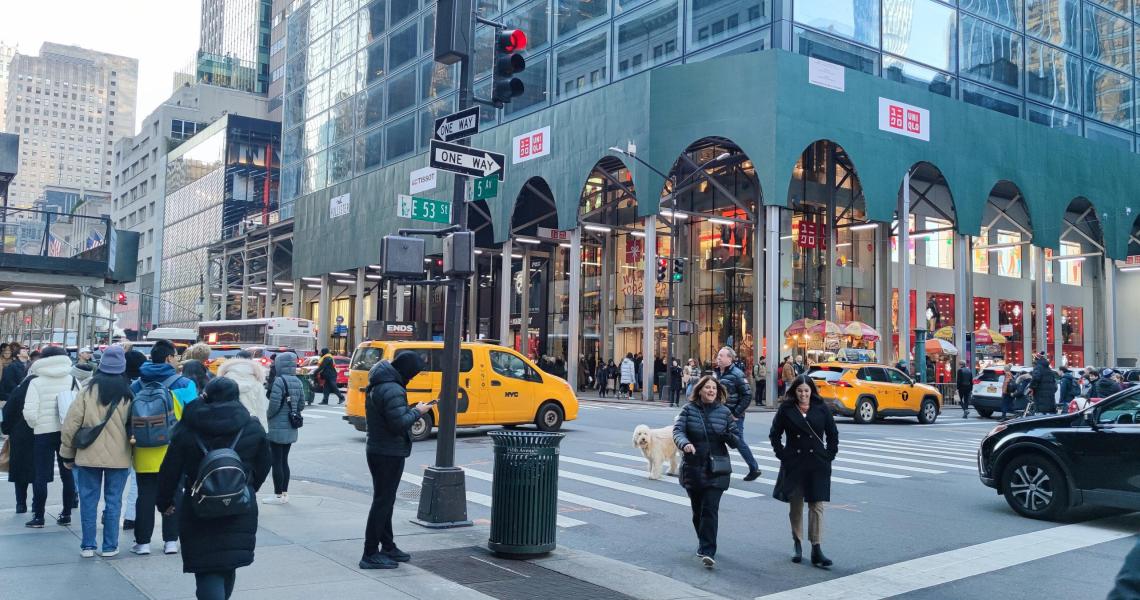
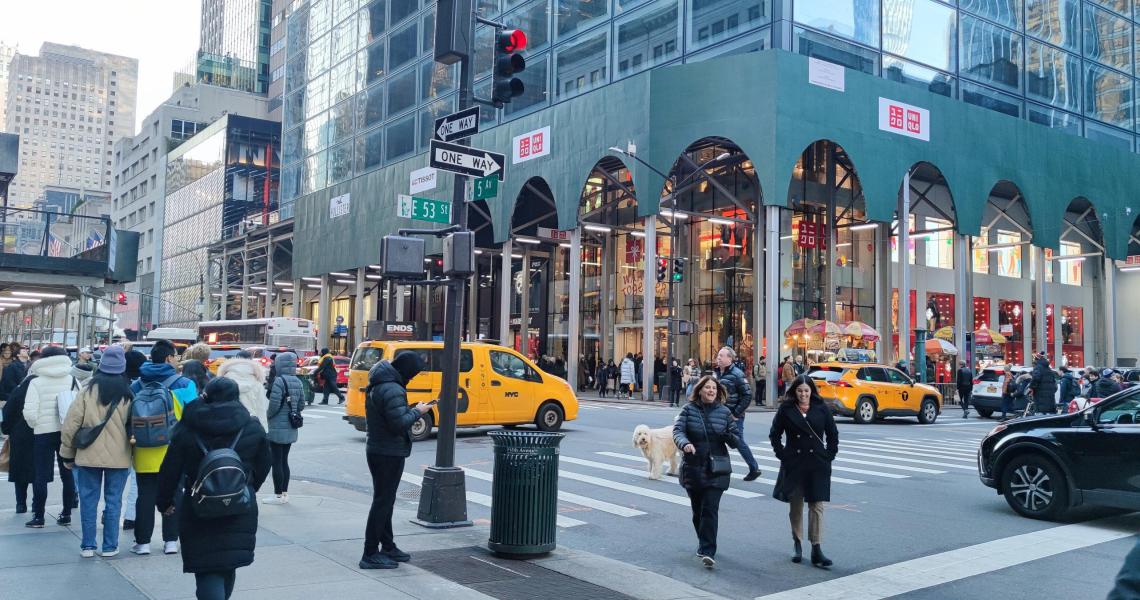
People walking in Manhattan. Public domain image from Wikimedia user Elbert Hampton
New Jersey Institute of Technology researchers are deploying artificial intelligence to understand how crowds and the individuals within them move around, leading to insights for applications in areas such as emergency management, pedestrian traffic planning, robotics, special effects, and even video games.
Tomer Weiss, an assistant professor of informatics in NJIT’s Yin Wu College of Computing, is leading research with graduate students to see if AI can complement the understanding of movement patterns in useful ways.
“It’s very difficult to come up with rules that realistically capture how crowds behave. There’s no Newton’s law like F=ma that tells you exactly what’s going to happen. But understanding how crowds behave is very important, for example, to prevent stampedes at large events,” Weiss said.
Traditional machine learning, and what is now primarily thought of as AI, can hypothetically compute rules from data. “The rules that an AI model learns cannot be written out as F=ma, but can be represented as a black box that learns patterns of crowd movement. These patterns give us more insight into modeling crowd behavior,” Weiss explained.
His team’s software creates thousands of parallel AI agents that represent humans walking through a crowd. Over time, agents learn to interact with each other and move accordingly. They may form groups or change direction. The software uses the common AI concept of deep reinforcement learning, which in this application instructs agents to walk toward a goal location or find a specific location on the most efficient path while avoiding collisions between agents.
Weiss said that in some cases, AI models perform better than human-designed rules. In a recent paper with graduate students Bilas Talkukdar and Yunhao Zhang presented at the ACM Siggraph conference, the authors say they “demonstrated the robustness of our method in multiple crowd navigation scenarios.”
Looking to the future, the research team points out several directions for research. One direction is to simulate pedestrian scenarios that exhibit different agent behaviors, such as walking slowly or rushing. The flow of dense crowds, such as when exiting the stadium or the movement of people in emergency situations, is in a different direction. Finally, they said that using new methods such as simulated vision, which is what a virtual agent sees in front of its eyes, could help discover new crowd behaviors.