This article has been updated.
- 4.5 billion people lack access to essential health services, and artificial intelligence can help close that gap.
- AI technology is already helping doctors spot fractures, triage patients, and detect early signs of disease.
- However, according to the World Economic Forum’s white paper, “The Future of Healthcare with AI: Leading the Way,” the healthcare industry is experiencing a “below-average” adoption of AI compared to other industries.
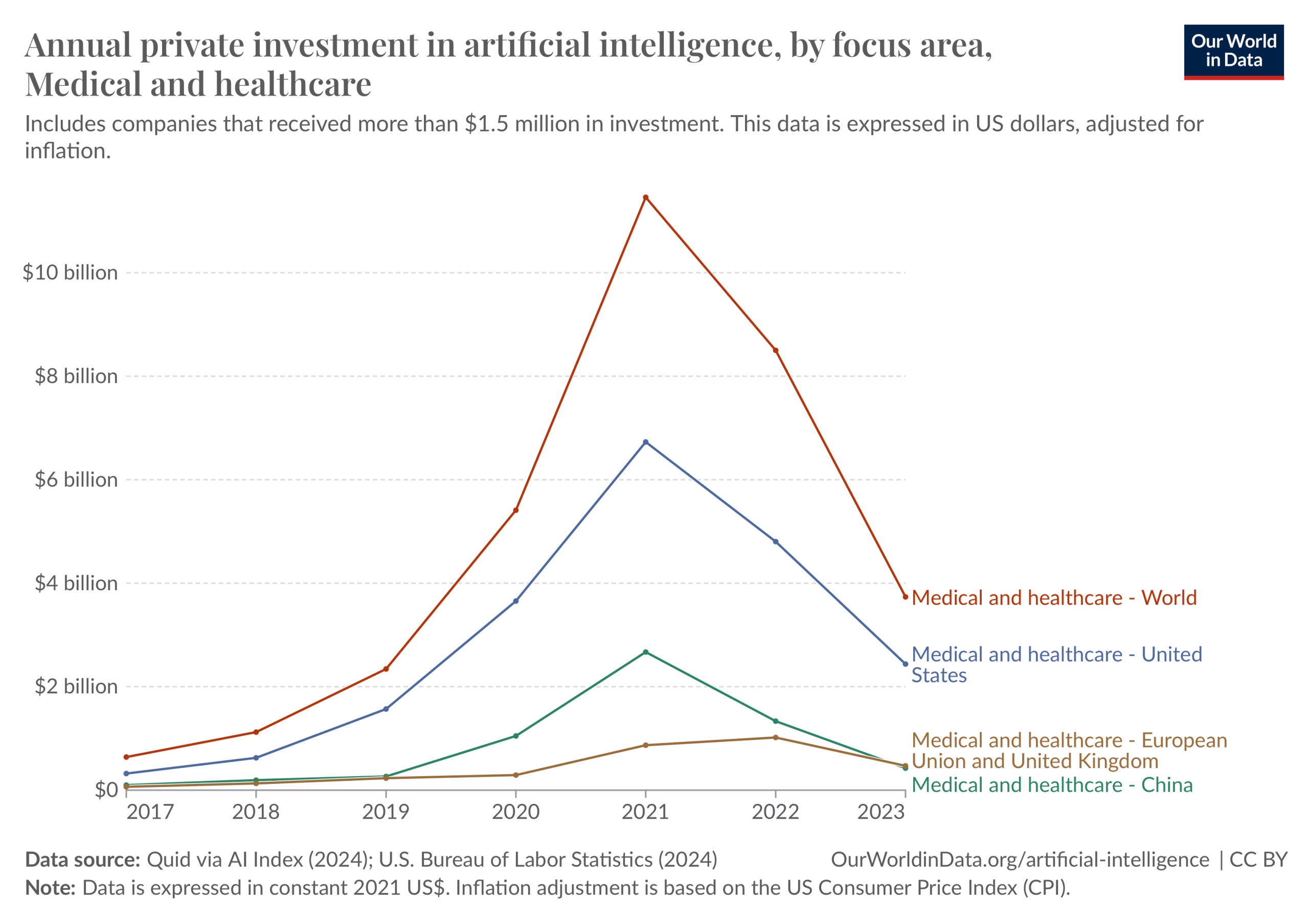
As the chart below shows, the level of private investment in AI in healthcare varies. Still, “AI digital health solutions have the potential to increase efficiency, reduce costs, and improve health outcomes globally,” the white paper says. Here are seven examples of how AI technology is already transforming the healthcare sector.
AI can interpret brain scans
New AI software is “twice as accurate” as experts examining brain scans of stroke patients. Two British universities trained their software on a dataset of 800 brain scans of stroke patients and then tested it on 2,000 patients.
The results were impressive. In addition to the AI model’s accuracy, the software was also able to identify the timescale over which the stroke occurred, an important piece of information for experts.
Dr Paul Bentley, consultant neurologist, said: health tech newspaper: “In most cases of stroke caused by a blood clot, both medical and surgical treatment can be performed within 4.5 hours of the stroke. Surgical treatment can also be performed within 6 hours, but it is difficult to determine whether these treatments are beneficial as more cases are irreversible after this point. Therefore, it is essential that doctors know both the time of initial onset and whether the stroke is reversible.”
AI can detect more fractures than humans
Surprisingly, emergency medicine physicians miss fractures in up to 10% of cases. Additionally, X-ray technicians are in short supply and overburdened.
Therefore, using AI to perform the initial scan could potentially avoid both unnecessary radiographs and missed fractures. The UK’s National Institute for Healthcare Excellence (NICE) says the technology is safe and reliable and can reduce the need for repeat visits.
However, there are concerns about the rapid deployment of AI in the medical field.
Dr Caroline Green, from Oxford University’s Institute of AI Ethics, told the BBC: “It’s important that the people using these tools are properly trained to do so. This means they understand and know how to reduce the risks due to technical limitations, such as the possibility of being given incorrect information.”
discover
How forums can help leaders understand AI and collaborate on responsible innovation
Assessing ambulance needs with AI
Around 350,000 people are taken to hospital by ambulance every month in the UK. It’s the paramedics who decide who goes and who doesn’t, and they do so while always being aware of how few beds are available.
A study conducted in Yorkshire, northern England, found that AI was able to accurately predict which patients needed to be taken to hospital in 80% of cases. The AI model was trained based on factors such as patient mobility, pulse and blood oxygen levels, and chest pain, and was also proven to respond without bias. However, NICE warned that further training was needed before it could be used more widely.
Detects early signs of over 1,000 diseases
Using medical data from 500,000 people in the UK Health Data Repository, the machine is now able to “reliably predict disease diagnoses many years in the future.”
Sleve Petrovsky, who led the study, told Sky News: “For many of these diseases, by the time a person becomes clinically symptomatic and seeks medical attention for illness or visible signs, it is long after the disease process begins.
“We can find signs in individuals that are highly predictive of developing Alzheimer’s disease, chronic obstructive pulmonary disease, kidney disease, and many other diseases,” he said.
Another study from the UK found that AI tools could detect 64% of epileptic brain lesions previously missed by radiologists. Trained on MRI scans of more than 1,100 adults and children around the world, the AI tool was able to not only spot lesions faster than doctors, but also detect small and hidden lesions that had escaped the human eye.
“It’s like finding a letter in five pages of solid black text,” lead researcher Dr Conrad Wagstill told the BBC. “Although AI can catch about two-thirds that doctors miss, the one-third is still very difficult to catch.” Combining AI discoveries with human oversight and expertise could speed up both diagnosis and treatment, the researchers said.
Clinical chatbot to guide medical decision making
Physicians need to make quick, informed medical decisions. AI has the potential to speed up these decisions, but it can also provide unreliable or biased information.
A US study found that standard large-scale language models (LLMs) such as ChatGPT, Claude, and Gemini are unable to provide clinicians with sufficiently relevant or evidence-based answers to medical questions. However, although ChatRWD is a search augmentation generation (RAG) system that essentially combines an LLM and a search system to improve output, 58% of the questions received useful answers (compared to 2% to 10% for LLM).
Digital interfaces are also increasingly being implemented to aid in patient triage. The 2024 Insights Report, part of the World Economic Forum’s Digital Health Transformation Initiative, found that a case study on the digital patient platform Huma has the potential to reduce readmission rates by 30%, reduce time spent seeing patients by up to 40%, and “reduce the workload of healthcare providers.”
The report predicts a future in which such technology could “dramatically change the patient experience. Generally healthy people can use self-monitoring devices to optimize their physical and mental health, while people with health problems have access to a wide range of digital solutions.”
AI and traditional medicine
India is the first country to launch a digital library of traditional knowledge that leverages AI tools to catalog and analyze indigenous medical texts. The country is also considering how AI and Ayurgenomics (a field that combines the ancient Indian medical system Ayurveda with modern genomics) intersect and what herbal formulations can help address modern diseases.
The global TCIM market is expected to reach nearly $600 billion in 2025, and AI will further accelerate that market. The new briefing paper emphasizes the importance of protecting Indigenous data sovereignty in the process.
“AI must not become a new frontier for exploitation,” said Dr. Yukiko Nakatani, WHO Deputy Director-General for Health Systems. “We must ensure that indigenous peoples and communities are not only protected, but active partners in shaping the future of AI in traditional medicine.”
AI for healthcare administrators
Administrative tasks are inevitable and time-consuming in the medical field. Using an AI co-pilot could potentially give clinicians more time to focus on their patients.
Microsoft recently announced Dragon Copilot, an AI healthcare tool that can listen to clinical consultations and take notes. And Google already has a suite of AI models specifically tailored to ease some of the administrative burden in healthcare. In Germany, an AI platform called Elea cuts testing and diagnostic times from weeks to hours, and its founders are determined to prove that the technology “can be an ally, not an obstacle.” Co-founder Dr. Sebastian Kass told EU-Startups: “No one enters the healthcare field to spend hours on administration.”
Of course, having an AI tool listen to your consultation and take notes won’t appeal to everyone. A recent survey conducted in the UK found that only 29% of people trust AI to provide basic health advice (although more than two-thirds are resistant to the technology being used to free up experts’ time). Then there’s the issue of accuracy. A report last year found that OpenAI’s Whisper, used by many hospitals to summarize patient meetings, was creating hallucinations in some of the transcriptions.
This is why regulating AI tools is so important. In the UK, AI-powered medical devices are highly regulated by the Medicines and Healthcare products Regulatory Agency. In the United States, the Food and Drug Administration (FDA) last year examined the regulation of AI in health care and concluded that while the FDA “continues to play a central role in ensuring safe, effective, and reliable AI tools,” it is also essential that “all parties…approach AI with rigor on the benefits this innovative technology brings.”