
–Artificial intelligence (AI) will be one of the most important technological changes of our time. It will fundamentally rewire corporate decision-making around business processes, organizational structures, talent strategies, and physical footprints. Understanding this structural and broader shift provides essential context for assessing the long-term trajectory of occupancy demand for the office and business park (BP) sector.
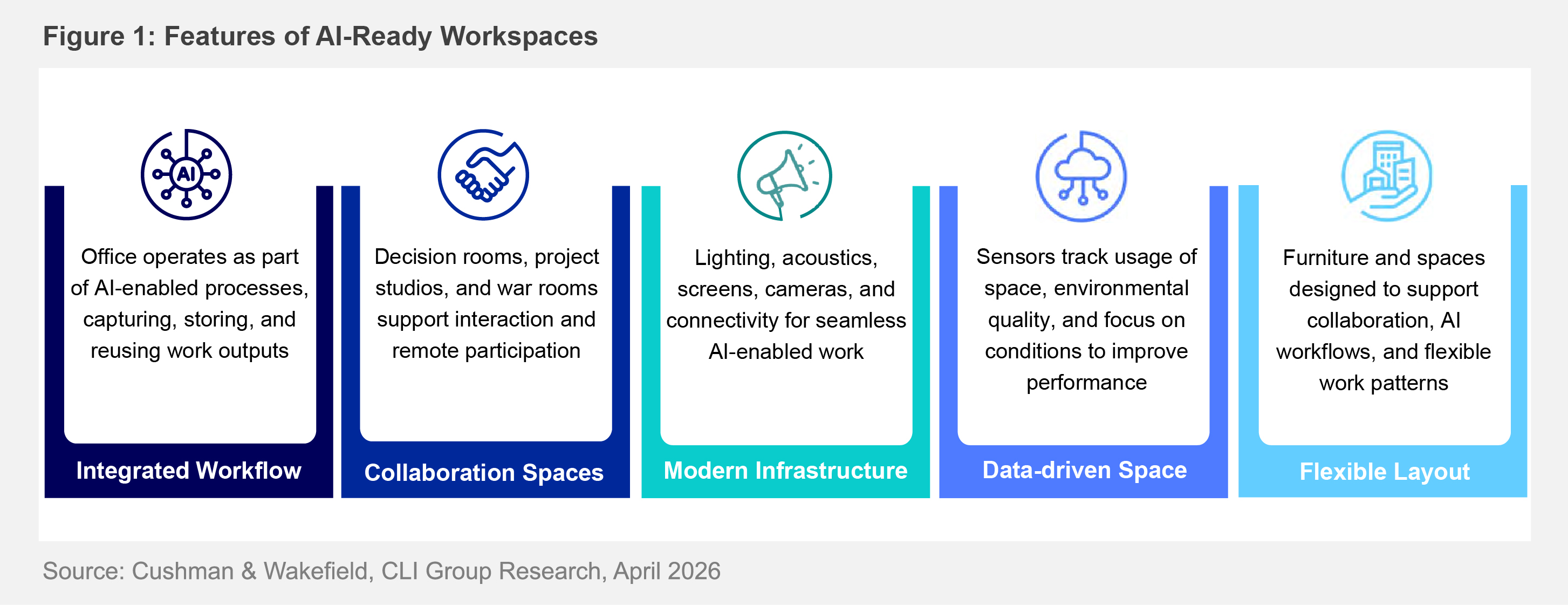
What kind of workspace will continue to be essential in an AI-enabled economy? Based on CapitaLand Investment (CLI)’s engagement with occupiers in Singapore, China and India, the new pattern is one of demand redistribution rather than widespread retrenchment. AI is accelerating the K-shape bifurcation. While high-spec, well-located, infrastructure-ready assets will continue to be essential to business operations, commoditized space will face structural pressures. The role of the workplace will shift from a place to perform mundane tasks to a platform for decision-making, innovation, and human-AI collaboration (Figure 1). Markets with significant supply pipelines or a high proportion of commoditized space will face challenges. Efficiency gains from AI are compressing the space needed for back-office and support functions, and some occupiers are aggressively consolidating their footprint as employee-to-desk ratios tighten.
Across CLI’s portfolio, tenant requirements are increasingly focused on infrastructure readiness, collaboration density, and the ability to support data-intensive workflows. These factors figure prominently in both new lease decisions and renewal negotiations. On the other hand, older inventory with limited upgrade possibilities faces declining occupancy and value over time, meaning that spaces that cannot meet these requirements are losing relevance faster than before1.
AI – not only to reduce headcount and costs, but also as a means of growth
AI isn’t just eliminating jobs, it’s redistributing them. Job losses due to AI are a widely discussed concern, but historical data shows a more mixed and ultimately more optimistic outcome.
Previous technological advances have eliminated certain tasks, but they have also created entirely new categories of work. Approximately 60% of U.S. workers now hold jobs that did not exist in 1940, and technology has driven 85% of job growth since then. AI represents the latest iteration of this dynamic – Don’t just delete tasks, replace them.
AI is automating daily tasks in many fields, and its implementation has the potential to not only reduce costs but also generate greater revenue and productivity. Industries with the highest impact on AI increased revenue per employee by three times compared to industries with the least impact on AI.5
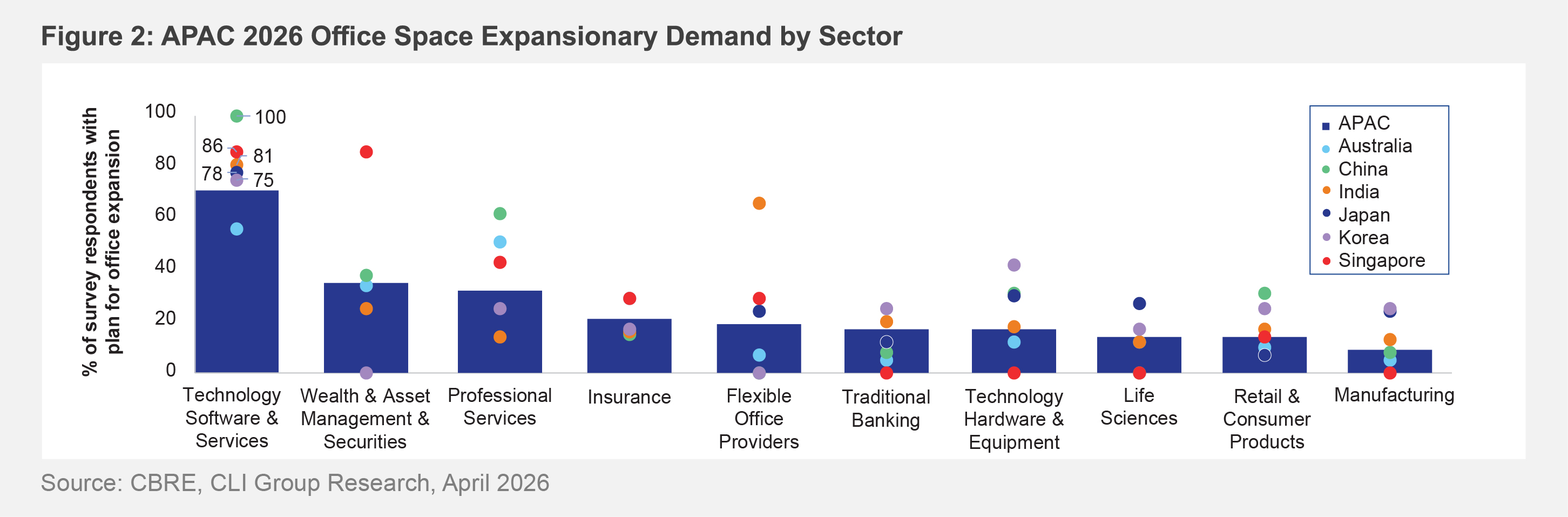
Companies that were early adopters of AI are also expanding their workforces in search of specialized, higher-skilled roles that can work alongside and leverage AI capabilities. Across the Asia-Pacific region, office employment is projected to grow steadily by 3.5% in 20266. However, expansion plans for office occupiers vary widely by country and sector. The technology sector (including big data and AI) had the highest proportion of occupiers planning to expand, led by China, Singapore and India. In contrast, less than half of tenants in other sectors indicated an intention to expand (Figure 2).
The transition to higher-value roles is not without its challenges, and some frictional job loss is to be expected as workers adapt and reskill. The pace and severity of adjustments will be shaped by labor market conditions and government reskilling efforts. According to the World Economic Forum’s 2030 Jobs Vision7, if AI advances faster than the workforce can deploy it, jobs could face greater volatility and systemic risk. On the other hand, if employees are ready to integrate AI development into various workflows, there is potential for further enhancements by reshaping value chains and business models through human-AI collaboration.
conclusion
AI is unlikely to make physical workspaces less relevant across APAC, but it will reshape their purpose and value. Demand will become more selective and focused on locations and assets that can support innovation, coordination, and nascent but increasingly complex human and AI workflows.
For investors, this strengthens a more selective allocation approach. Core capital should prioritize office and business parks with durable demand visibility, while also pursuing value-add opportunities to unlock relevance through asset repositioning. At the same time, capital should be directed away from structurally challenged equities and towards sectors and strategies that benefit from complementary capital structures such as AI-driven demand (data centres, technology-enabled logistics, etc.) and real estate private credit. As diversification increases, performance becomes increasingly dependent on asset selection and execution rather than broader market movements.
For more detailed market analysis on the impact of AI on the workplace in Singapore, India, and China, read the full report.
Note:
1. Source: JLL – “Futureproofing 4.0: Opportunity through Obsolescent”, April 2025.
2. Source: The Budget Lab – “Assessing the Impact of AI on the Labor Market: Current Status”, October 2025.
3. Source: Goldman Sachs – “How will AI impact the global workforce?” August 2025.
4. Source: PwC – “Navigating Uncertainty: How AI Will Impact the Workforce,” March 2026.
5. Source: PwC – “AI Will Suppress Employment Growth, Increase Productivity by 4x: PwC’s 2025 Global AI Employment Barometer,” 2025.
6. Source: CBRE – “Asia Pacific Real Estate Market Outlook 2026”, January 2026.
7. Source: World Economic Forum – “The Future of Work: Six Decision Makers on AI and Talent Strategy,” January 2026.
Source: https://news.marketersmedia.com/insights-from-cli-tracking-ais-impact-on-offices-and-business-parks-in-apac/89188446
Release ID: 89188446
If you encounter any issues, inconsistencies or concerns regarding the content provided in this press release that require your attention, or if you require the press release to be removed, please contact us without delay at error@releasecontact.com (it is important to note that this email is the authorized channel for such issues, and sending multiple emails to multiple addresses will not necessarily help expedite your request). Our response team is available 24 hours a day to respond to your concerns within 8 hours and take the necessary steps to fix any identified issues or guide you through the removal process. Ensuring accurate and reliable information is fundamental to our mission.


