Article Highlights | April 7, 2026
image:
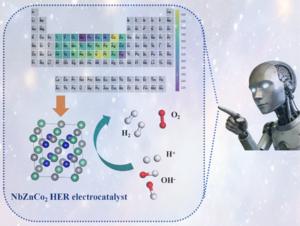
The “ML-DFT-Experiment” integrated strategy accelerates the design of high-performance multi-main alloy HER electrocatalysts through machine learning predictions. Density functional theory calculations and experiments validated the model and identified NbZnCo2 alloy as the best cost-effective candidate.
view more
Credit: Higher Education Press
Multiprincipal element alloys exhibit remarkable physicochemical properties that make them very promising candidates for hydrogen evolution reaction (HER) electrocatalysts due to the synergistic interactions between their components. Despite extensive experimental studies, the complex composition of multi-principal components and the absence of systematic machine learning (ML) screening pose major challenges in identifying the optimal elemental composition of electrocatalysts, thereby constraining the rational design and development of multi-principal alloy electrocatalysts.
In this study, NbZnCo2 Among 601 candidate alloys, a multi-principal alloy emerges as the best candidate. A combination of density functional theory (DFT) calculations and experimental validation confirms the reliability of the ML model using micrometer NbZnCo.2 Catalyst achieves ultra-low overvoltage of 20 mV at 10 mA cm−2 Remarkable stability over 60 hours. Furthermore, NbZnCo2 The nanoparticles possess excellent HER properties, proving the universality of NbZnCo.2 Element composition. Our study establishes a synergistic “ML-DFT-experimental” framework for precisely designing high-performance HER electrocatalysts.
The study, titled “Machine learning-guided discovery of multi-principal element alloys as electrocatalysts for hydrogen evolution reactions,” Acta Physico-Chimica Sinica (Published December 4, 2025).