
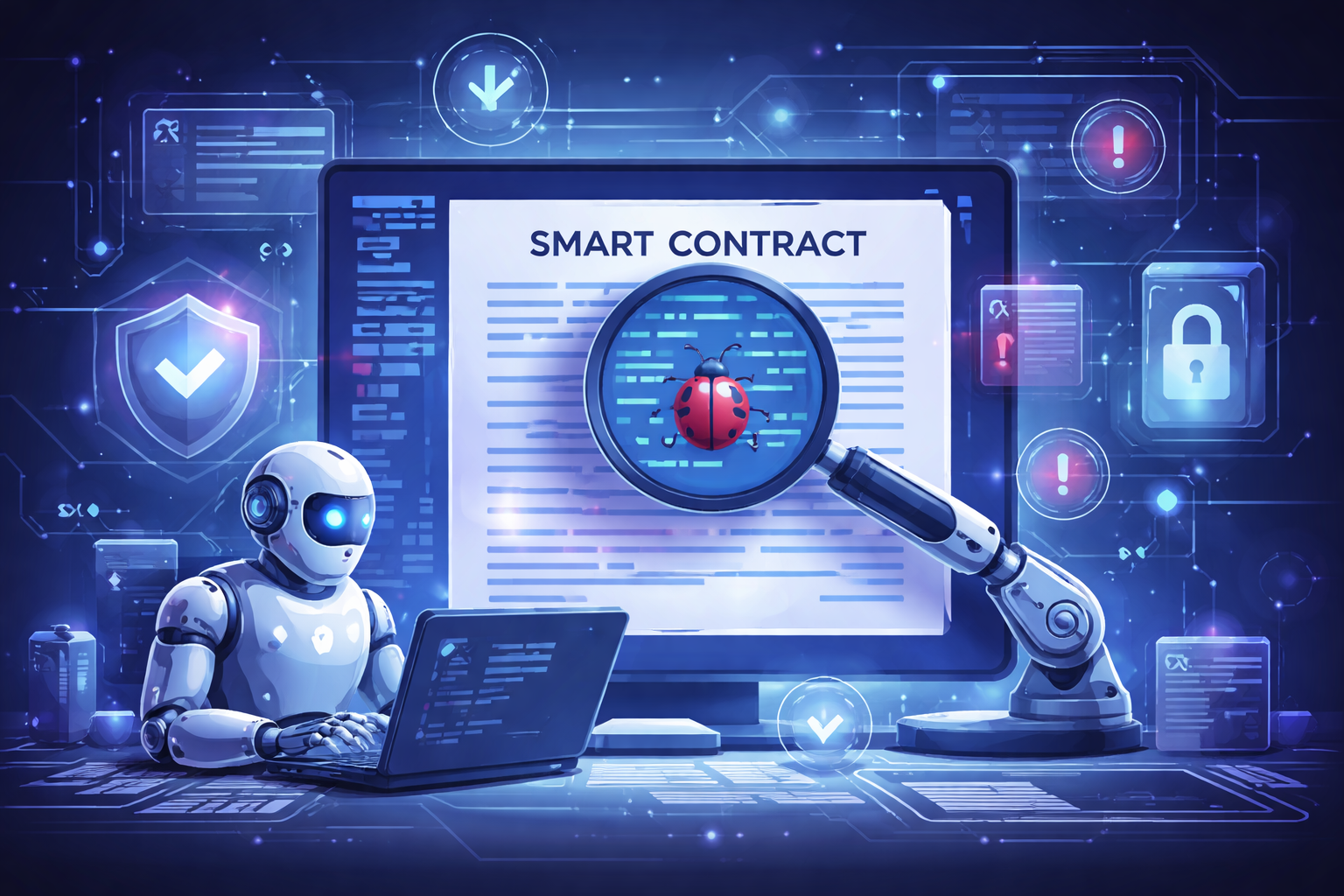
Smart contracts manage billions of dollars across decentralized finance (DeFi), non-fungible tokens (NFTs), and blockchain applications. However, one overlooked vulnerability can lead to irreparable financial loss. In 2025, hackers will exploit vulnerabilities in smart contracts; steal over $3.4 billion Across DeFi platforms.
Traditional auditing methods are often time-consuming, expensive, and have limited ability to detect defects in complex logic. By combining machine learning, natural language processing, and automated testing, artificial intelligence (AI) enables faster and more detailed vulnerability detection before deployment. It also learns from past exploits and helps developers avoid repeating costly mistakes.
This article outlines 10 practical ways developers and security teams can use AI to identify smart contract bugs early and reduce the risk of hacking.
Important points
- AI can help detect bugs in smart contracts early by combining tools such as static analysis, fuzz testing, and formal verification.
- Using AI throughout development can reduce the risk of costly exploitation.
- While AI is most effective when used in conjunction with human smart contract reviews, it is not a replacement for expert audits.
1. Use AI-powered static code analysis
AI-powered static analysis tools (such as Slither, MythX, and Semgrep) scan smart contract code without executing it. These identify vulnerabilities such as unchecked return values, reentrancy, integer overflow, and unsafe external calls.
Machine learning improves detection by recognizing patterns from past exploits, rather than relying solely on predefined rules.
How to use:
- Upload your Solidity or Vyper code to an AI audit tool.
- Run an automatic scan.
- Review flagged vulnerabilities and severity levels.
2. Use AI-driven fuzz testing
Fuzzing involves feeding a smart contract with thousands of random or semi-random inputs to uncover unexpected behavior. Tools like Echidna and Foundry use AI-guided fuzzing to generate inputs that are more likely to trigger edge cases, target high-risk execution paths, and learn which inputs trigger failures.
Test method:
- Define invariants (rules that must never be violated).
- Run the fuzzer on the contract,
- Analyze the failed assertion.
3. Implementation of formal verification with AI assistance
Formal verification uses mathematical proofs to ensure that the contract logic behaves as intended under all possible conditions. AI tools like Certora Prover and Halmos automatically generate specifications and test conditions, making them more practical for real-world use. This method is ideal for high-value contracts where absolute accuracy is important.
4. Leverage large-scale language models (LLM) for code reviews
LLMs like GPT-4 and Claude can also analyze smart contract code to analyze its behavior, identify suspicious patterns, and suggest improvements. Although not always accurate, LLM is a useful tool for initial code analysis. You can enter prompts like “Does this contract have a reentrancy vulnerability?” or “Is there an access control element missing from this function?”
5. Introducing AI for symbolic execution
Symbolic execution tools such as Manticore follow all possible execution paths of a contract by considering inputs as symbolic variables rather than constant values. AI enhancements allow you to prioritize paths that are more likely to introduce bugs. This approach is effective in finding logic bugs that are difficult to identify using fuzzing techniques.
6. Integrate the AI audit plugin into your IDE
Developers can install integrated development environment plugins that use AI to analyze code as it is written. This ensures that contracts are scanned at every stage of development. During code commits or test deployments, AI tools enable early detection of bugs, faster iteration cycles, and less reliance on last-minute audits. Some of these tools include Hardhat with AI enhancements and Audit Wizard.
7. Analyze contract behavior using graph neural networks
Graph-based AI models represent smart contracts as networks of interconnected functions and interactions. This allows you to identify complex dependencies, hidden execution flows, and multi-step exploit scenarios that may be missed by linear code reviews. This approach is particularly effective at discovering logic-based vulnerabilities in large contracts, where the relationships between features are as important as the features themselves.
8. Monitor on-chain behavior with AI anomaly detection
AI-powered monitoring platforms like Forta Network use machine learning to detect anomalous transaction patterns in real-time. By defining expected behavior during testing, teams can set thresholds that trigger alerts when something unusual happens on the chain. This does not prevent deployment bugs, but it does catch exploits in progress and limit the damage.
9. Train AI models to avoid past exploits
AI systems with access to large code datasets can fine-tune models based on known exploits such as DAO hacks, parity wallet bugs, and cross-chain bridging attacks. This allows you to identify recurring attack patterns and flag similar risks in new contracts. Suitable for large security companies rather than individual developers.
10. Leverage AI to generate comprehensive test suites
Writing effective unit tests takes time, and lack of test coverage leaves contracts exposed. Contract testing AI-powered tools like Copilot and Contract Testing Assistant can automatically generate test cases from contract logic. To get started, feed your contract code and natspec documents into AI tools, validate the accuracy of your tests, and include them in your CI/CD pipeline before deployment.
conclusion
AI is a useful tool for securing smart contracts. Build strong defenses against exploits by combining AI-powered static analysis, fuzzing, formal verification, and real-time monitoring. This increases speed, expands coverage, and detects both technical and logical vulnerabilities.
Teams that integrate AI into their development and security workflows are better positioned to identify bugs early, reduce the risk of exploits, and build more resilient blockchain applications. However, using AI to prevent hacking is better suited as a complementary step to traditional auditing.


