
MADISON, Wis.—The University of Wisconsin and the University of Wisconsin Credit Union today announced the launch of a new free short-form online video series aimed at introducing Wisconsinites to the basics of generative artificial intelligence (AI).
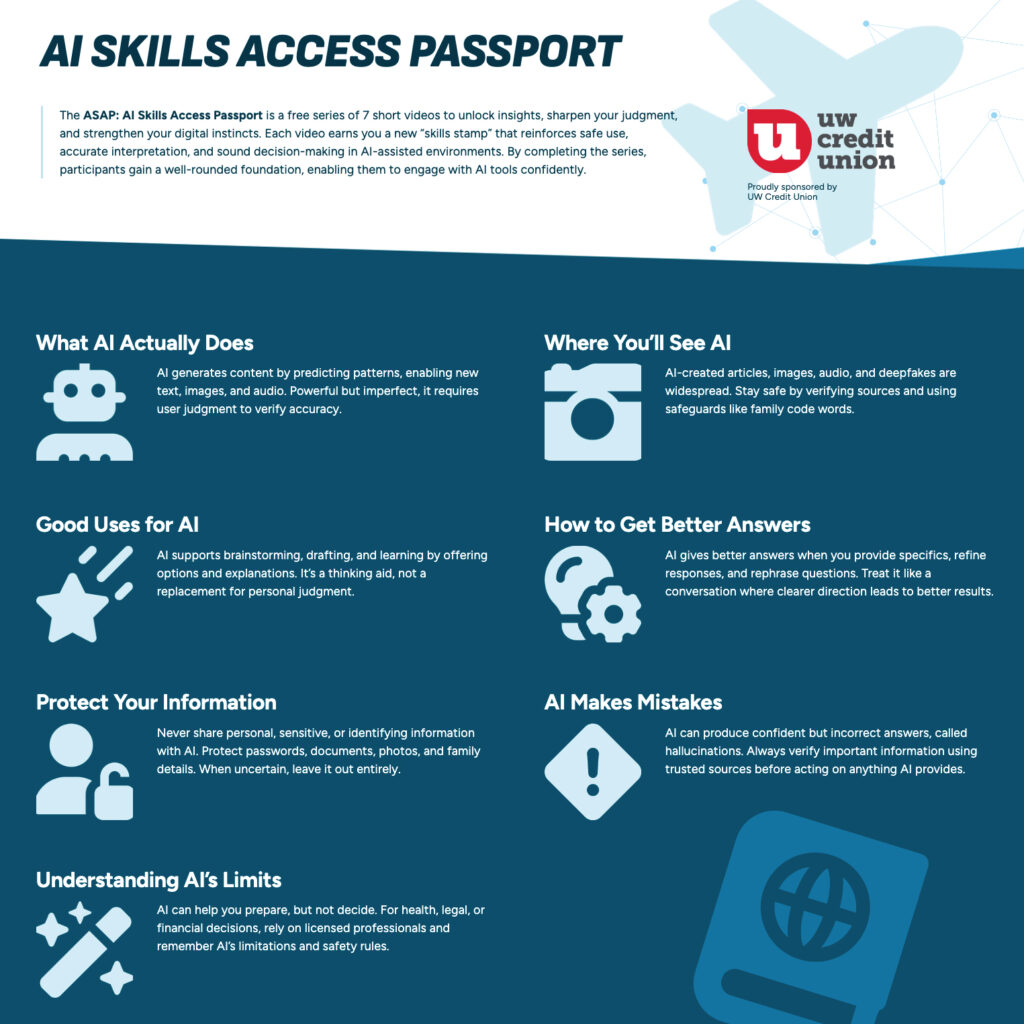
This free series, AI Skills Access Passport (ASAP), is an easy-to-understand AI guide that explains to participants how AI works and how it shows up in everyday life. Intended for adult learners who have a basic knowledge of AI and are interested in the technological changes underway across schools, universities, businesses, and government agencies.
“While the University of Wisconsin aims to prioritize AI education through dedicated majors, AI and literacy integration, focused AI faculty recruitment, and industry partnerships, we also want to play a role in extending that knowledge outward. We want to provide all Wisconsinites with a foundational knowledge of AI so they can choose to build on it,” said University of Wisconsin President Jay Rothman. “This learning opportunity is another example of how the University of Wisconsin serves our state.”
These free online learning sessions are available now and can be found at wisconsin.edu/asap.
This online course consists of seven short videos of approximately 2 minutes each that explain what artificial intelligence is, how it is currently being used, and the opportunities and challenges it presents. This series is intended to be an accessible entry point for those seeking to understand this rapidly evolving technology.
Sponsored by UW Credit Union, this video series is hosted on the University of Wisconsin website, which also serves as a statewide gateway to additional AI courses, programs, and educational resources available at Wisconsin’s 13 public universities.
“UW Credit Union’s commitment to building economic mobility goes far beyond financial services,” said Steph Khalil Kyle, UWCU’s director of financial inclusion and community engagement. “As a strategic partner of the University of Wisconsin, we share the goal of building an informed, capable, and empowered community across Wisconsin. This free educational resource is for anyone looking to understand how AI works so they can use it safely and confidently if they choose to use it.”
This course was developed by the University of Wisconsin’s Office of Online and Professional Learning Resources with assistance from Emily Laird, an AI integration engineer at UW-Stout.
“AI will impact every sector and every community, regardless of age or background,” Laird said. “ASAP provides the shared foundation people need to use AI safely and confidently, helping us build a stronger and more prepared state.”
resource
head shot
 Rothman Rothman |
 Khalil Kyle Khalil Kyle |
 Laird Laird |
a$ap assets
- https://www.wisconsin.edu/news/wp-content/uploads/sites/142/2026/03/ASAP-media-Image-lg-scaled.jpg
- https://www.wisconsin.edu/news/wp-content/uploads/sites/142/2026/03/ASAP-media-Webpage.jpg
| Image 1 | Image 2 |
|
 |
About University of California Credit Union
UW Credit Union is a growing, federally insured financial institution and a leading provider of a full range of financial services to the University of Wisconsin community. This includes on-campus banking services at six campuses in Wisconsin. UW Credit Union’s more than 900 employees serve the financial needs of more than 375,000 members through world-class technology systems and a convenient network of 35 branches and more than 100 ATMs. With $6 billion in assets, UW Credit Union ranks among the nation’s leading credit unions. Founded more than 90 years ago by University of Wisconsin faculty and staff, UW Credit Union continues to operate as a nonprofit, member-owned financial cooperative with locations in the Madison, Milwaukee, Stevens Point, Green Bay, Oshkosh, Whitewater and La Crosse areas.
About the University of Wisconsin
The University of Wisconsin enrolls more than 164,600 students. Awarding more than 37,000 degrees annually, these 13 public universities are Wisconsin’s talent pipeline, positioning graduates to increase their earning power, contribute to their communities, and make Wisconsin a better place to live. Nearly 90% of college graduates in Wisconsin remain in the state for five years after earning their degree. The university provides a 23:1 return on the state’s investment. The University of Wisconsin also contributes to Wisconsin’s cultural and economic richness through groundbreaking research, new companies and patents, and boundless creative intellectual energy. Learn more here wisconsin education.


