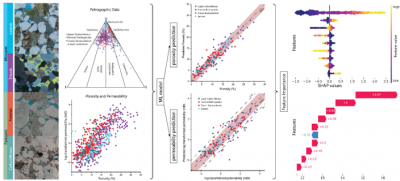
Newswise — Geologists at Germany’s KIT Institute of Applied Geosciences have announced a new machine learning regression approach to derive porosity and permeability based on microscopic evaluation of 30 µm thin rock slices. Their findings are reported as follows. Artificial intelligence in earth sciences.
“While porosity quantifies the volume available for fluids and gases in a rock, permeability characterizes the potential of a porous rock to transmit these fluids,” explains first and corresponding author Benjamin Busch. “Both characteristics are relevant for geothermal energy production (geothermal, hydrocarbons, etc.) and storage scenarios (hydrogen, natural gas, CO, etc.).2). ”
Because the distribution, content, and texture of minerals recorded in these thin sections can be classically related to the physical properties of the rock, machine learning regression, which captures nonlinear, multivariate relationships, was chosen by the researchers as the central method to test whether this hypothesis works.
“The model, applied to a dataset created by at least 21 petrologists, collected over 25 years, and containing data from 51 wells covering four major reservoir lithologies in central Europe, showed strong predictive performance of R²=0.87 (porosity model) and R²=0.82 (permeability model),” Busch shares. “Despite the wide dynamic range of data collection and non-uniform variables, the associated errors (RMSE=2.23% (porosity) and RMSE=0.64 (permeability, orders of magnitude)) are very acceptable for reservoir characterization.”
Different underground use cases require different operational affordances, so cost-limiting factors are considered whenever possible. “Therefore, the costly and time-consuming extraction of core material from the subsurface is often reduced, limiting access to undisturbed rock material for detailed laboratory analysis to confirm storage and production potential (reservoir quality),” Busch says.
Traditionally, microscopic analysis has been the most important for understanding the distribution of high quality intervals in a reservoir, as differences in cement content can clog the available pore space, and the shape of the minerals growing within the pores influences the quality of the reservoir. “Ultimately, understanding the distribution of cement and compaction structures within the framework of the evolution of pressure, temperature, and chemical conditions over millions of years should lead to improved predictive frameworks in uncharted territory,” Busch added.
In the future, the presented approach could be extended to include microscopic evaluation of cut sections. These are millimeter-sized pieces of rock material that are produced as a by-product at every drilling site around the world. By evaluating individual mineral types and textures and evaluating optically visible porosity, it may be possible to predict key reservoir properties based on these materials, potentially reducing the cost of future drilling operations.
###
References
Toi
10.1016/j.aiig.2026.100202
Original source URL
https://doi.org/10.1016/j.aiig.2026.100202
About Artificial intelligence in earth sciences
Artificial intelligence in earth sciences is an open access journal that provides an interdisciplinary forum to share and discuss ideas and solutions regarding artificial intelligence and its applications to the geosciences. To support this discussion, we encourage authors to open source the code, data, and labels used in AI.