
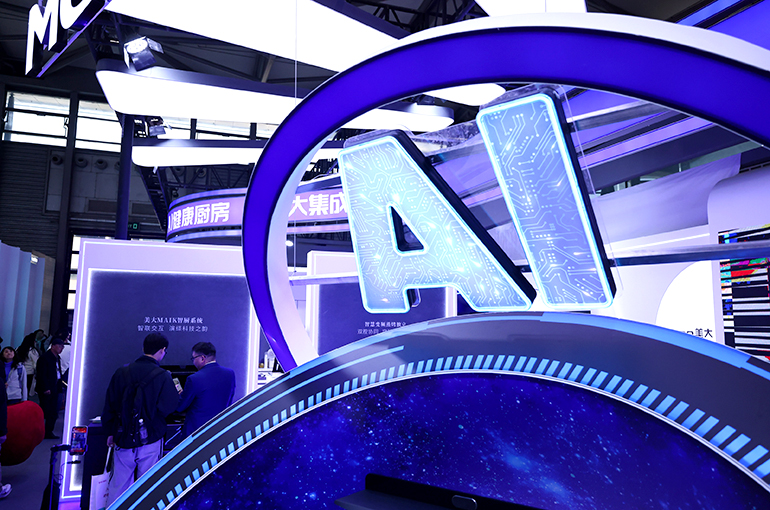
(Yicai) March 16 — This year’s Home Appliances and Electronics Expo held in Shanghai focused more on the practical application of artificial intelligence than home appliances, with service robots, 3D printers, AI cooking glasses, and AI mobile air conditioners taking center stage.
At the four-day AWE, which ended yesterday, “home appliances + AI” and “home appliances + robotics” were the focus of discussions and exhibits. The event attracted a record number of foreign buyers, many of whom came specifically to see innovative Chinese products.
Haier Group exhibited a variety of home service robots and smart refrigerators that use AI to analyze ingredients, Midea Group unveiled an air machine jointly developed with Huawei Technologies’ HarmonyOS that activates fresh air intake when carbon dioxide concentration is too high, and Dream Technology exhibited a vacuum cleaner with a two-stage bionic robot arm and a floor cleaning machine with an edge cleaning probe arm. Additionally, Mova exhibited an AI mobile air conditioner.
AI should not just be a gimmick to attract consumers, but rather be the driving force for consumers to upgrade to new products, industry veterans told Yicai. “We look forward to further use of AI in home appliances, bringing a new era of rapid growth to the Chinese market.”
He Jingmin, vice president of big data platform AVC, said that the overall growth of the global home appliance market is slow, so the Chinese market is shifting from a manufacturer- and channel-driven model to a user-driven model. Companies should treat the integration of AI into their products as a key competitive strategy, he added.
According to AVC, China’s consumer electronics retail sales excluding 3C (computer, communications, and consumer) products decreased by 4.3% from 2024 to 893.1 billion yuan ($129.4 billion) last year due to multiple factors, including a weak real estate market. The split-type home air conditioner market decreased by 0.4% to 235.7 billion yuan, and is expected to decline to 219.5 billion yuan this year.
“By incorporating large-scale language model computing, modern TVs will be able to recognize and analyze the preferences of different families and proactively serve users by recommending more appropriate content,” Weng Zhenhua, vice president and general manager of consumer electronics at AVC, told Yicai. Wen added that using AI chips as the “brains” of TVs has become a key competitive focus among major brands, enabling smarter and more convenient interactions as well as greater alignment with user scenarios, which is crucial for future demand.
“AI is reshaping the entire supply chain of the consumer electronics industry,” he noted, noting that the direction of AI-powered air conditioner upgrades includes providing new intelligent features such as energy efficiency, comfortable airflow, smart voice interaction, and healthy air.
According to AVC data, the penetration rate of smart air conditioners that provide comfortable airflow in China’s domestic market last year was 26% online and 23% offline, compared to 10% for offline smart wall-mounted air conditioners and 8% for floor-mounted air conditioners. Adoption of smart refrigerators with precise temperature control and energy optimization has exceeded 57% online.
Mova’s AI mobile air conditioner is equipped with technologies such as laser radar that records users’ habits to provide proactive services, Yang Xiangwen, head of the company’s air conditioner division, told Yicai. The product is likely to be launched first in the European and American markets, where artificial installation costs are higher, and then gradually expanded to other regions, Yang added.
Foreign brands are also optimistic about the market opportunity for AI home appliances in China.
“We are expanding the application of AI technology in our products,” Masaharu Nakayama, chief strategy officer and head of Northeast Asia business at Panasonic Holdings, told Yicai. He pointed out that Japanese companies’ China strategies have evolved from “in China, for China” to “in China, for the world.”
Panasonic plans to expand its innovative AI home appliances developed in China to overseas markets and double its share of home appliance sales in Asia excluding China and Japan in its Northeast Asia business to 20% within three years, Nakayama said.
Editor: Shihua Tang, Martin Kadyev

