
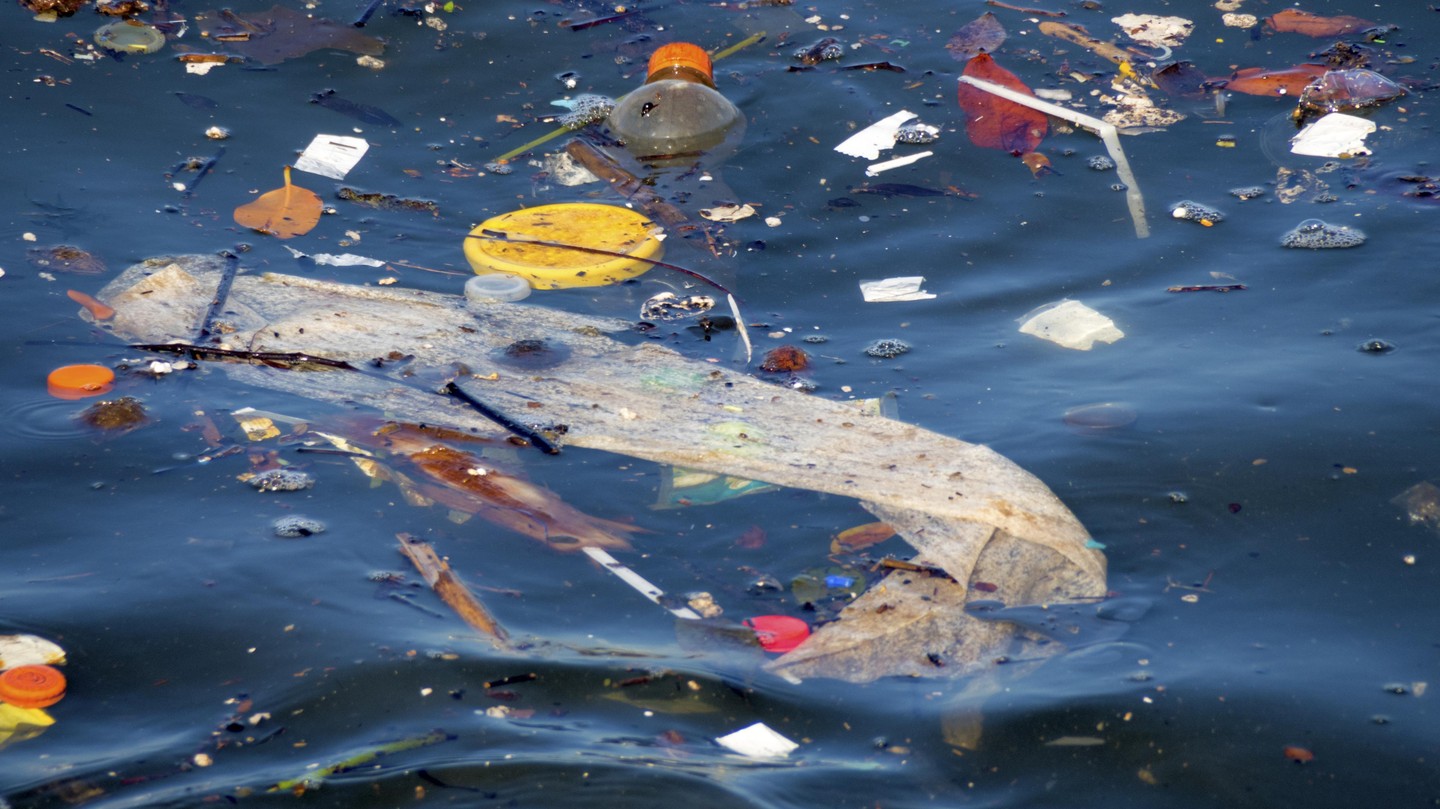
Being able to identify and track floating debris masses is critical to ocean cleanup efforts. Despite the abundance of satellite imagery and weather data currently available, an effective system for doing so remains elusive. But that could soon change thanks to technology being developed under a project launched two years ago called AI for Detecting Ocean Plastic Pollution with Tracking (ADOPT).
ADOPT is being implemented by EPFL’s Institute for Environmental Computational Sciences and Earth Observation (ECEO) and the Swiss Data Science Center (SDSC), a joint initiative of EPFL, ETH Zurich and PSI, in collaboration with Wageningen University in the Netherlands. ECEO scientist Emanuele DalSasso aims to develop two types of systems. “One is to analyze satellite imagery to identify the garbage patch, and the other is to predict where the garbage patch will be floating by the time the cleanup team gets there, usually within 24 hours.” The idea is to fulfill a simple need. Governments and NGOs cannot respond immediately when debris is discovered, as it takes time to organize and deploy cleanup efforts.
The ADOPT team initially worked with open-access data collected by the Sentinel-2 satellites, a series of optical imaging satellites launched by the European Space Agency (ESA). But these instruments only pass a particular point in the ocean once every six days, and their images have a low resolution of just 10 meters per pixel, making it difficult to track debris. To compensate for these two shortcomings, the team designed an AI system that can also be trained on data from PlanetScope. PlanetScope is a constellation of hundreds of microsatellites that collect images daily at a resolution of 3 to 5 meters per pixel. The result is an AI-driven detector that captures data from both sources and is updated daily with high-resolution images without the need for data annotation.
Given the operational scale of this system, it can only detect large aggregates of plastic and other debris, rather than individual bottles, for example. It tracks garbage patches containing long lines of debris known as windrows, which can extend for hundreds of meters and are primarily composed of human-made waste, especially plastic.

Once the debris is identified, the next step is to predict where it will drift by the time the cleanup team arrives. The second system, developed by Christian Donner of SDSC, is designed to make such short-term predictions. “Models often have biases, so I take widely used models for predicting wind and currents and apply machine learning to correct them,” he says. “The machine learning program compiles data from a variety of sources and adjusts for these biases to more accurately predict the trajectory of floating debris.” Since little field data is available at Garbage Patch, he trained the program using data from GPS-equipped drifters as a proxy. These drifters were deployed under the Global Drifter Program and have been used to collect measurements since the 1990s.
But there’s one big problem. The system doesn’t work well in bad weather. Optical sensors do not work above clouds. “One option might be to incorporate radar imagery from Sentinel 1,” DalSasso said. “Radar signals travel through clouds and work day and night. However, they only provide information about the texture and shape of the debris, which means they miss out on important spectral features that are detected by optical sensors and are essential for detecting trash patches.”
For now, the ADOPT team is not considering combination options for radar optics. Perhaps it will be done in the future, but it will likely be done by other research groups, as the project will officially end this fall when the two-year funding program ends. The team plans to leave a solid proof of concept with two publications currently being completed and code for both systems (debris detection and drift prediction). In the future, the Dutch NGO Ocean Cleanup will continue to compare algorithms, and university scientists will also collaborate to further the research. “This work will probably continue, not directly by us, but by our research partners,” Donner said.


