Graph neural networks provide a powerful method for analyzing graph-structured data, but their near-term implementation on quantum computers presents significant hurdles due to circuit depth and qubit resource limitations. Armin Ahmadkhaniha and Jake Doliskani of McMaster University’s School of Computing and Software are tackling this challenge with a new fully quantum graph convolutional architecture for the noisy intermediate scale quantum (NISQ) era. Their work introduces an edge-local, qubit-efficient quantum message passing mechanism inspired by Quantum Alternating Operators Ansatz (QAOA), which decomposes complex operations into simpler hardware-native gate operations. This innovative design significantly reduces qubit requirements. n Log (n) for the graph of n This will be an important step towards scalable quantum machine learning, unlocking the potential of unsupervised node representation learning on complex datasets.
Complex networks underpin many real-world systems, from social connections to molecular structures. Future quantum computers promise to unlock insights from these networks far beyond the reach of today’s machines, and this advancement provides a quantum architecture that can make that potential a reality even with the limited hardware currently available. Scientists are increasingly turning to quantum computing to address machine learning challenges, especially when dealing with complex graph-structured data.
Graphs are used across numerous scientific fields, making it increasingly important to extract useful information from these structures. Traditional machine learning techniques, such as graph neural networks, encounter computational limitations as graphs grow larger and more complex. Researchers have now developed a fully quantum approach to graph convolutional neural networks designed to operate within the constraints of today’s noisy intermediate-scale quantum (NISQ) devices.
This new architecture prioritizes efficiency, unlike previous quantum graph learning models that required large qubit resources or relied on complex quantum operations. This is achieved by decomposing the message passing process, which is how information is shared between nodes in a graph, into simple pairwise interactions along each edge. This design significantly reduces the number of qubits required and scales from O(Nn) to O(n) for graphs with N nodes and n qubit feature registers, representing an important step toward practical implementation.
By focusing on edge-local interactions, this model avoids the need for multi-controlled unitary gates, which are particularly error-sensitive in current quantum hardware. To train the quantum network, the team employed the Deep Graph Infomax objective, a technique for unsupervised node representation learning. This allows the model to discover unique patterns and relationships in graph data without the need for labeled examples.
Experiments conducted on the Cora citation network and a large genomic single nucleotide polymorphism (SNP) dataset revealed promising results. The fully quantum model achieves competitive performance compared to existing quantum and hybrid quantum-classical approaches, suggesting a viable path for quantum graph learning in the NISQ era. This approach not only minimizes qubit requirements but also maintains a level of computational complexity comparable to other quantum graph learning models. This model uses only one-qubit rotation and two-qubit entanglement operations, making it suitable for implementation on currently available quantum processors and opening up the possibility of exploring complex graph data in quantum computing.
Accurate classification of five superpopulations from SNP data
Experiments utilizing the SNP dataset revealed a logistic regression classification accuracy of 98% using this model, demonstrating its ability to identify fine-grained structure in the data and successfully distinguish between five superpopulations despite their inherent genetic overlap. Standard validation metrics suggest an optimal k value of 3 or 4, but the model’s performance at k=5 remains convincing.
Although the silhouette score is slightly lower at k=5, as expected considering the genetic proximity of the human population, the maintained high classification accuracy confirms that the discriminative structure in the learned embedding space is preserved. Further analysis included k-means clustering with k=5, treating cluster assignments as pseudo-labels and assessing internal consistency. A logistic regression classifier trained on these pseudo-labels then achieved 98% accuracy and verified linearly separable regions in the embedding space.
On the Cora citation network, the model achieved a normalized mutual information (NMI) score of 0.51. This shows substantial agreement between the predicted clusters and the true class distribution, suggesting that the semantic structure of the citation graph is preserved. Table 1 summarizes these clustering results, with the SNP dataset achieving 98% accuracy and a silhouette score of 0.51, while the Cora dataset yields 78% accuracy and an NMI of 0.51.
Comparing this full quantum model with a hybrid quantum-classical approach, both demonstrated high internal consistency on the SNP dataset and comparable classification accuracy using pseudo-labels on the Cora network. However, the hybrid model achieved an NMI score of only 0.06 and a classification accuracy of 0.23 on the Cora dataset when evaluated against ground truth labels. This suggests that classical message passing over-smoothes the quantum extracted features.
Edge-local quantum messages passing through a 72-qubit superconducting processor
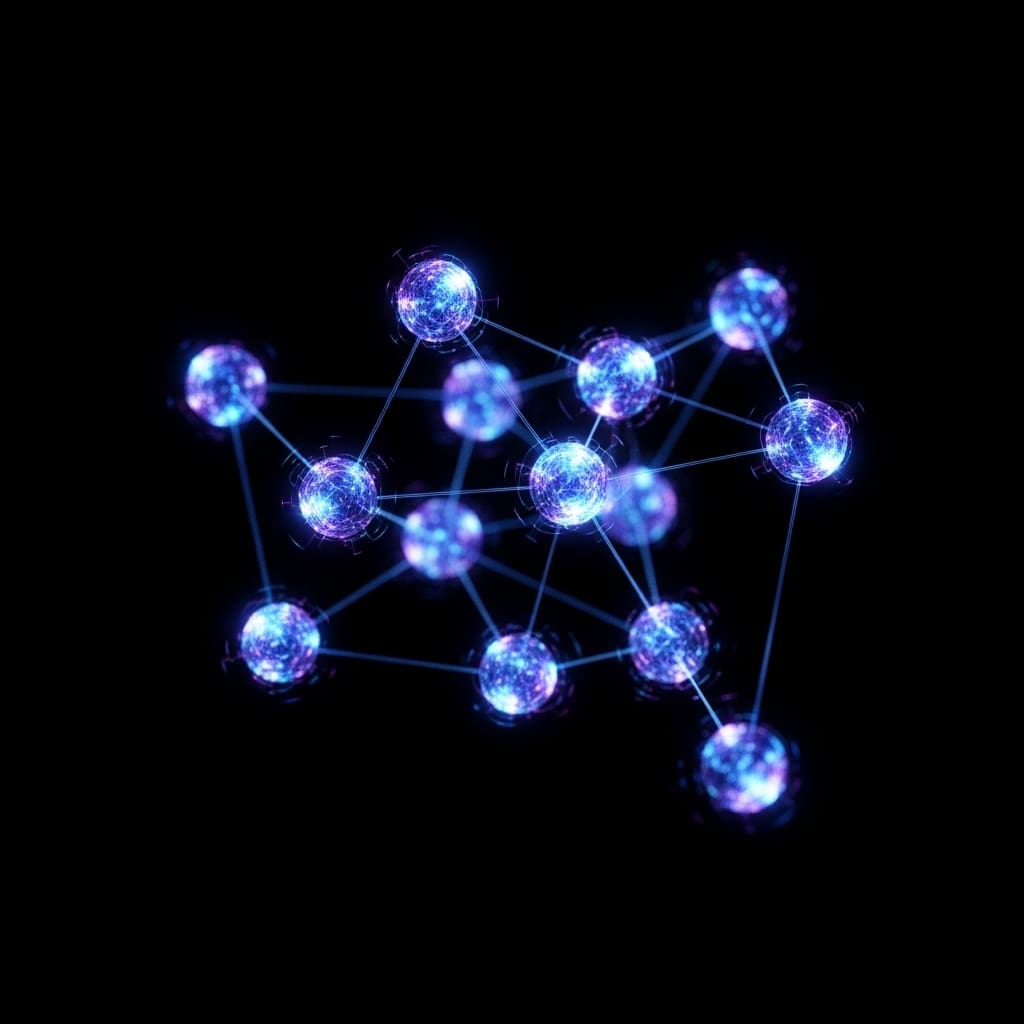
A 72-qubit superconducting processor supports the development of a complete quantum graph convolution architecture for unsupervised learning. The graph structure is encoded using qubit feature registers at each node and a single auxiliary qubit that manages the entire computation. Next, a variational quantum feature extraction layer transforms the initial node embeddings into quantum states suitable for message passing.
Unlike previous quantum graph neural networks, which often relied on complex global operations, this work decomposes message passing into pairwise interactions that occur directly along each edge of the graph. Message passing relies only on hardware-native 1-qubit and 2-qubit gates. This is a design choice aimed at minimizing the effects of noise inherent in short-term quantum devices.
For graphs with nodes, this approach reduces the total qubit requirement, which is significantly lower compared to other methods. The model is trained using the Deep Graph Infomax objective, a technique used for unsupervised node representation learning. Quantum circuits serve as trainable models that adjust parameters to maximize mutual information between node representations and their corresponding graph neighborhoods.
Because this model avoids global operations, it avoids scaling limitations due to graph size and can be implemented on existing quantum hardware regardless of the number of nodes. The use of edge-local interactions aims to preserve relational information within the quantum circuit, potentially mitigating the oversmoothing problem common to hybrid quantum-classical approaches.
The model was tested on the Cora citation network and a large genomic SNP dataset to evaluate its performance across different graph structures and data modalities. By comparing their results with previous quantum and hybrid models, the researchers aimed to demonstrate the competitive performance of this new architecture in an unsupervised learning context, prioritizing scalability and compatibility with the constraints of NISQ-era quantum computers.
Quantum graph neural networks achieve efficiency through new decomposition strategies
Scientists are beginning to address a long-standing difficulty in quantum machine learning: translating promising theoretical models into practical algorithms for today’s limited quantum computers. Over the years, the field has seen a number of proposals calling for qubit counts and circuit depths that far exceed current capabilities, but this new research presents a graph-based machine learning method that appears to circumvent some of those limitations, providing a path to running complex algorithms on hardware in the near future.
Rather than trying to directly map established classical graph neural networks onto quantum circuits, the researchers designed a quantum-native architecture from scratch. The real success lies in reducing resource requirements, as previous quantum graph neural networks required a significant number of qubits to represent even a moderately sized graph.
This model dramatically reduces the number of qubits by cleverly decomposing the message passing process, which is the core of how information spreads in a graph, into a simple two-qubit operation. This approach uses only hardware native gates, thus avoiding the need for complex error correction schemes that add further overhead. Although this model performs competitively on benchmark datasets, it is important to realize that it is not a perfect solution, as it is still unclear whether it can scale to truly large and complex graphs.
Unlike some hybrid approaches, it is fully quantum, so there is no benefit to offloading some of the computation to a traditional processor. The key question is whether the benefits of this streamlined quantum architecture outweigh the inherent noise present in current quantum devices. The most interesting direction at this stage is to explore how this qubit-efficient message passing method can be combined with other quantum algorithms.
Beyond learning graph representations, the principles developed here may be applicable to other areas of quantum computing where pairwise interactions are common. For example, this approach could be applied to quantum simulations and optimization problems. Further improvements could create a new generation of powerful and practical quantum algorithms.