Newswise — Agricultural pest management has traditionally relied on chemical pesticides, whose overuse has led to environmental pollution, health risks, and rapidly evolving pesticide resistance. On the other hand, natural variation in pest resistance exists in crops and their wild relatives, providing a valuable resource for breeding. However, resistive properties are difficult to measure accurately because they are often scored visually using coarse categories that cannot capture continuous variation. This limits the effectiveness of genome-wide association studies and genomic selection. Advances in deep learning offer new opportunities to extract detailed phenotypic information directly from images, overcoming subjectivity and labor constraints. Based on these challenges, there is an urgent need to conduct detailed research on AI-based phenotyping and genomic breeding for pest resistance.
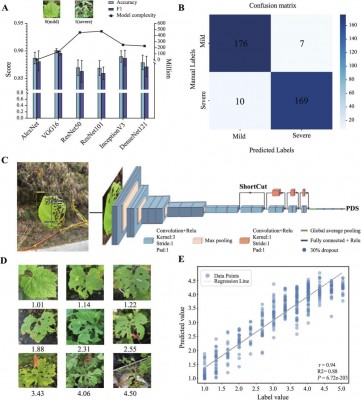
Researchers from the Chinese Academy of Agricultural Sciences and collaborating institutions reported on May 7, 2025 (DOI: 10.1093/hr/uhaf128): horticultural research We found that deep learning can significantly improve the genomic selection of pest-resistant grapes. The research team developed a convolutional neural network to automatically assess insect damage on grape leaves and combined these data with genome resequencing, genome-wide association studies, and transcriptome analysis. By linking AI-derived phenotypes with genetic markers, this study identifies important resistance genes, demonstrates highly accurate pest resistance prediction based on machine learning, and provides a new framework for precision breeding.
In this study, we analyzed 231 grape vine lines exposed to natural infestation by tobacco armyworm, a major leaf-feeding pest. A deep convolutional neural network was trained to classify pest damage as mild or severe and achieved over 95% accuracy. The custom regression model also produced a continuous victimization score that strongly correlated with human ratings. These AI-derived phenotypes enabled more accurate genetic analysis than traditional categorical scoring. Genome-wide association studies identified 69 quantitative trait loci and 139 candidate genes associated with pest resistance, many of which were involved in jasmonic acid, salicylic acid, ethylene, and calcium-mediated signaling pathways. By integrating transcriptome data, the researchers identified important defense genes, including the calcium transporter ATPase ACA12 and the protein kinase CRK3, which are strongly induced during herbivore attack. The machine learning-based genomic selection model further demonstrated high predictive power, reaching 95.7% accuracy for binary traits and strong correlations for continuous traits. Taken together, these results demonstrate that the combination of deep learning phenotyping and genomics can uncover subtle resistance mechanisms and enable reliable prediction of complex polygenic pest resistance traits.
“This study highlights how artificial intelligence can fundamentally change plant breeding,” said the study’s senior authors. “Replacing subjective visual scoring with fast, objective, deep learning-based phenotyping allows us to capture continuous variation in pest damage that was previously overlooked. Integrating these high-quality phenotypes with genomics and transcriptomics reveals the true polygenic architecture of pest resistance. This approach not only improves predictive accuracy, but also enables breeders to make informed choices much earlier in the breeding cycle.”
This discovery has far-reaching implications for sustainable agriculture and crop improvement. AI-powered phenomics enables the rapid and large-scale assessment of pest resistance without increasing labor costs, making it suitable for breeding programs around the world. By identifying resistance genes and accurately predicting pest resistance, breeders can reduce dependence on chemical pesticides while improving crop resilience. The framework established for grapevine can be easily adapted to other crops and stress traits, supporting the development of automated, data-driven breeding platforms. Ultimately, integrating deep learning, genomics, and machine learning could accelerate the creation of pest-resistant varieties essential for food security under increasing environmental pressures.
###
References
Toi
10.1093/hour/uhaf128
Original source URL
https://doi.org/10.1093/hr/uhaf128
Funding information
This research was supported by the National Key Research and Development Program of China (No. 2023YFD2200702), the Project of the National Key Laboratory of Tropical Crop Breeding (No. NKLTCB202325), the National Natural Science Foundation of China (No. 32372662), and the Science Fund Program for Outstanding Young Scholars of the National Natural Science Foundation of China (Overseas) to Zhou Yongfeng.
About horticultural research
horticultural research is an open access journal of Nanjing Agricultural University and was ranked #1 in the Horticulture category of Clarivate’s Journal Citation Reports™ in 2023. This journal is committed to publishing original research papers, reviews, perspectives, comments, correspondence, and letters to the editor related to all major horticultural plants and fields, including biotechnology, breeding, cell and molecular biology, evolution, genetics, interspecies interactions, physiology, plant origins and domestication. crops.