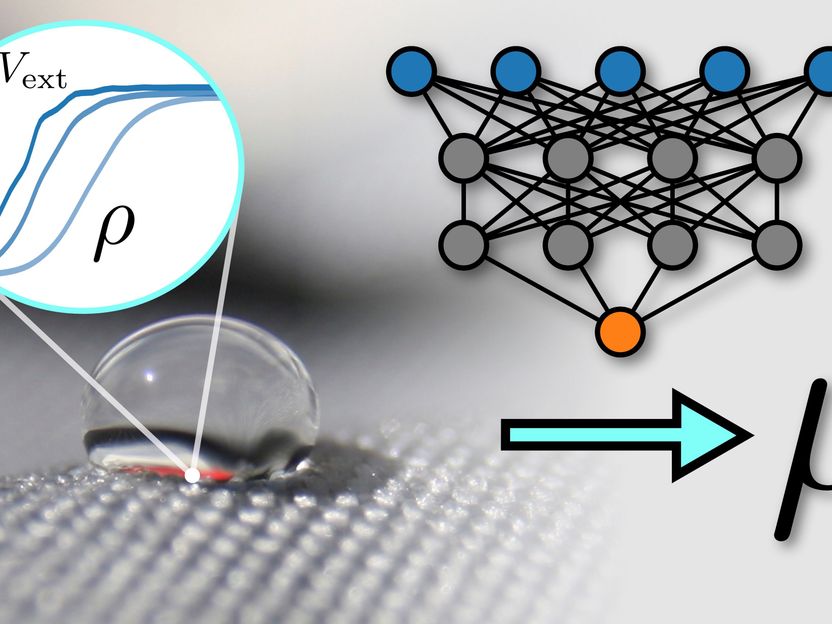
Researchers at the University of Bayreuth have developed a method that can significantly speed up the calculation of liquid properties using artificial intelligence. The AI approach predicts chemical potential, an essential quantity for describing liquids in thermodynamic equilibrium. Researchers present their findings in a new study published in the journal physical review letterIt was chosen as Editor’s suggestion.
Many popular AI techniques are based on supervised machine learning principles. That is, a model (such as a neural network) is specifically trained to directly predict a specific target quantity. An example of this approach is image recognition. The AI system will display a number of images that will tell you whether or not a cat is depicted. Based on this, the system learns to identify cats in new images that it has never seen before. “However, in the case of chemical potentials, such a direct approach is difficult, since the determination of chemical potentials usually requires computationally expensive algorithms,” says Professor Matthias Schmidt, Professor at the Department of Theoretical Physics II at the University of Bayreuth. He and his research assistant, Dr. Florian Samuller, are tackling this challenge with a newly developed AI method. It is based on a neural network that incorporates the theoretical structure of liquids, more generally soft materials, and is able to predict liquid properties with high accuracy.
“What’s special about our method is that the AI doesn’t learn any chemical potentials,” Schmidt explains. Instead, the AI captures the fundamental physical relationships within liquids and learns a universal density functional that remains the same across many different systems. “This can be explained by comparing different surfaces coated with the same liquid. Even if the surfaces have different structures and materials, the liquid still obeys the same underlying physical laws. These ‘intrinsic’ properties of the liquid correspond to a universal density functional that is captured by machine learning,” said Schmidt.
Differences still remain between the learned density function and the observable properties of the system, such as the particle density profile and external potential. This gap is not filled by AI models, but by physical principles. General considerations of thermodynamic stability dictate that this residual difference corresponds uniquely to the chemical potential.
“Our method combines data-driven learning with fundamental insights from theoretical physics. While the AI-derived density functional provides a universal framework, the chemical potential itself is derived from established physical conditions. This approach allows us to indirectly but consistently determine the chemical potential without having to explicitly train it,” said Sammüller. He added: “In terms of image recognition, it would be about as easy for an AI to recognize a cat without ever seeing it during training.”